
Legal and institutional analysis for the marine deployment of floating marine debris collection system in coastal areas

Copyright © The Korean Society of Marine Engineering
This is an Open Access article distributed under the terms of the Creative Commons Attribution Non-Commercial License (http://creativecommons.org/licenses/by-nc/3.0), which permits unrestricted non-commercial use, distribution, and reproduction in any medium, provided the original work is properly cited.
Abstract
Marine debris has become a major environmental issue affecting coastal ecosystems and maritime activities. Floating debris transported by waves and currents often accumulates near coastal structures such as breakwaters due to changes in hydrodynamic conditions. Installing debris collection facilities in these accumulation zones may provide an effective strategy for coastal debris management. However, the deployment of floating structures in marine areas may be subject to various legal and institutional regulations. This study analyzes the legal and institutional framework associated with the installation of floating marine debris collection systems in breakwater areas. Relevant maritime laws, including the Public Waters Management and Reclamation Act, Marine Debris and Marine Polluted Sediment Management Act, Act on Marine Spatial Planning, and regulations related to navigation safety and harbor management, were examined. The results indicate that the installation of such systems may require public water occupation permits, environmental review procedures, and consideration of potential conflicts with existing marine activities. This study finds that current policies mainly focus on vessel-based debris collection, while institutional guidelines for stationary debris collection facilities remain limited. The findings provide policy implications for establishing regulatory frameworks that support coastal marine debris management.
Keywords:
Marine debris, Floating debris collection system, Coastal breakwater, Maritime legal framework, Marine spatial planning1. Introduction
Marine debris has recently been recognized as a major environmental issue affecting coastal and marine ecosystems worldwide. Marine debris is generally defined as waste generated from land- and sea-based activities that enters the marine environment through rivers, coastal runoff, or ocean circulation. These materials cause a wide range of negative impacts on marine ecosystems and coastal environments. Plastic debris has been reported to cause ingestion and entanglement of marine organisms, leading to ecological disturbances and biodiversity loss. Marine debris also causes economic losses in maritime industries such as fisheries, tourism, and harbor operations [1]-[4].
Marine debris is transported by physical processes including ocean currents, tides, and wave action, and it often accumulates in certain coastal areas. Floating debris tends to concentrate in areas where hydrodynamic conditions change, including harbors, estuaries, and waters in front of breakwaters. This accumulation pattern is influenced by coastal structures and shoreline geometry that alter the transport pathways of floating materials. Previous studies have reported that debris accumulation frequently occurs around marine structures such as breakwaters [5]-[7]. Effective marine debris management, therefore, requires not only the reduction of debris generation but also efficient collection and management strategies in coastal accumulation zones.
Various technologies and management approaches have been applied to collect marine debris. Coastal cleanup operations, offshore collection using vessels, and interception systems using floating booms are commonly used methods. These approaches require continuous labor and operational costs, and their efficiency is limited when applied over wide coastal areas. Debris tends to accumulate repeatedly near coastal structures such as breakwaters due to hydrodynamic effects. Structural collection systems capable of continuously managing debris in such areas have received relatively limited attention in previous studies [8][9].
Floating marine debris collection systems have been proposed as an alternative approach to address these limitations. Such systems can utilize the natural transport characteristics of floating debris in coastal waters to guide and collect debris within a designated area. Breakwater front zones represent locations where debris accumulation frequently occurs and may provide suitable conditions for the application of floating collection systems [10].
The need for such systems is further reinforced by the growing severity of marine debris pollution and the increasing policy attention at the international level. The United Nations Sustainable Development Goal 14 identifies the reduction of marine debris as an important objective for protecting marine ecosystems. In addition, international legal frameworks such as the United Nations Convention on the Law of the Sea, MARPOL Annex V, and relevant guidelines of the International Maritime Organization establish general obligations for preventing marine pollution and contribute to the global governance of marine debris. Many countries have introduced policies and technological initiatives to strengthen marine debris management [11]-[13]. In Korea, national marine debris management policies have been strengthened, and the need for systematic management of coastal debris has been increasingly recognized [14]-[18].
Coastal areas such as breakwater zones support multiple marine activities, including navigation, fisheries, and marine environmental management. Therefore, the installation of new structures in such areas requires careful examination of applicable legal regulations, highlighting the need for studies from a legal and institutional perspective. Previous studies have conducted legal and institutional analyses when new types of offshore structures, such as offshore wind power and marine energy facilities, were introduced, focusing on regulatory frameworks and maritime law enforcement concerning offshore platforms [19][20]. Following this approach, similar legal and institutional analysis is required for the installation of stationary marine debris collection systems in breakwater front areas.
This study makes a distinct contribution beyond a descriptive legal review by explicitly linking marine debris accumulation characteristics in breakwater front areas with the legal and institutional feasibility of installing stationary floating collection systems. In contrast to previous research that has primarily examined debris distribution, environmental impacts, or vessel-based collection methods, this study addresses the regulatory implications of deploying fixed or moored debris collection structures within coastal accumulation zones. Furthermore, this study introduces a process-based analytical framework that connects debris generation, accumulation, offshore collection, and onshore treatment with corresponding maritime legal frameworks. Accordingly, it examines the applicable maritime legal frameworks for the installation of floating marine debris collection systems in breakwater front areas, with particular attention to which legal frameworks are applicable, what regulatory issues may arise from their interaction with existing marine uses, and what institutional limitations exist within the current regulatory system.
2. Installation Concept of Floating Marine Debris Collection System
2.1 Debris Accumulation in Breakwater Areas
Breakwaters installed in coastal areas are representative marine structures designed to protect harbors and coastal facilities from wave action. These structures significantly influence wave energy dissipation and the hydrodynamic conditions of coastal waters. In general, breakwaters are constructed as rubble mound structures, and wave-dissipating blocks such as tetrapods are installed on the seaward side to disperse wave energy. Due to these structural characteristics, areas with reduced current velocity may form in front of breakwaters as a result of wave reflection and wave energy attenuation. Under such conditions, the movement of floating materials on the sea surface may slow down and their residence time in the area may increase.
Floating debris transported in coastal waters moves under the influence of physical processes such as waves, tides, and currents, and its transport pathways can be affected by coastal geometry and marine structures. Around artificial coastal structures such as breakwaters, hydrodynamic conditions may change, resulting in the tendency of floating materials to accumulate within specific areas. In particular, large volumes of floating debris have been observed to concentrate around coastal structures under favorable hydrodynamic conditions [21]. These characteristics suggest that the sea area in front of breakwaters may function as a potential zone for marine debris management and collection activities.
The sea area in front of breakwaters also represents an important coastal space where harbor operations and coastal activities occur. Therefore, the installation and operation of structures in this area require consideration of various institutional and regulatory factors, including navigation safety, marine environmental management, and public water use. From this perspective, breakwater front zones can be regarded as representative coastal spaces for examining the applicability of marine debris management systems.
2.2 Concept of Floating Debris Collector
In this study, the marine debris collection system is defined as a floating structure installed on the sea surface in front of a breakwater. The system consists of buoyant structures that remain afloat on the sea surface and can be fixed at a designated location using mooring systems. Such structures can be deployed without modifying existing breakwater structures and may function as facilities for managing floating debris in coastal waters.
The floating debris collector operates by intercepting drifting debris transported by waves and currents in coastal waters. Floating debris carried toward the breakwater is captured by collection components such as net-based or barrier-type structures installed within the system. The collected debris may temporarily accumulate within or around the collection structure and can subsequently be removed using work vessels or transport equipment and delivered to onshore waste treatment facilities.
The installation of floating structures in marine areas may also be interpreted as the deployment of marine structures within marine space. As a result, the installation and operation of such facilities may be subject to various legal and institutional requirements related to public water use, marine environmental management, and navigation safety. Breakwater front areas are spaces where navigation activities, fisheries operations, and coastal utilization may occur simultaneously, and the installation of floating structures requires consideration of potential interactions with these existing marine uses.
Therefore, this study examines the applicability of relevant maritime legal frameworks and regulatory requirements associated with the installation of floating marine debris collection systems in breakwater front areas. Figure 1 illustrates the conceptual installation of a floating marine debris collection system in front of a coastal breakwater, highlighting its spatial relationship with the surrounding marine environment.
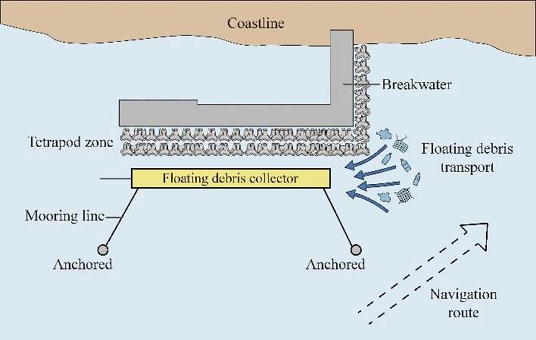
Conceptual installation of floating marine debris collector in front of a breakwater
3. Applicable Maritime Legal Framework
The installation and operation of a floating marine debris collection system in the sea area in front of a breakwater can be interpreted as the deployment of a structure within marine space. As a result, such facilities may be subject to various marine-related legal frameworks during the installation and operational stages. Floating structures installed in marine areas require consideration of multiple regulatory aspects, including public water use, marine environmental management, navigation safety, and marine debris management.
Coastal waters represent spaces where multiple marine uses coexist. Therefore, the installation of new structures in such areas requires careful examination of their relationship with existing marine activities. The sea area in front of breakwaters may involve harbor operations, fisheries activities, and marine environmental management. Consequently, the deployment of floating marine debris collection systems in these areas requires a comprehensive review of the applicable legal and regulatory frameworks.
The major marine-related laws examined in this study and their relevant scopes of application are summarized in Table 1. To systematically analyze these legal frameworks, this study adopts a structured analytical approach based on doctrinal legal analysis and regulatory mapping. Relevant maritime laws and regulations are examined to identify their applicability, interactions, and potential overlaps in the context of installing and operating floating marine debris collection systems in coastal waters.

Applicable legal framework for floating marine debris collection system
3.1 Public Waters Management Act
The Public Waters Management and Reclamation Act provides the fundamental legal basis for the installation of structures in marine areas and aims to ensure the appropriate use and conservation of public waters [22]. Article 2 of the Act defines public waters as waters provided for public use, including seas, rivers, and lakes. Therefore, the installation of structures or the occupation of a certain marine area may be interpreted as an act of public water use.
Article 8 of the Act stipulates that permission from the public water management authority is required when occupying or using public waters. In addition, Article 11(1) specifies the duration of permission for occupying or using public waters, depending on the nature of the facility, thereby allowing artificial structures to occupy public waters for a designated period.
A floating marine debris collection system installed in front of a breakwater may be interpreted as a floating structure occupying a certain area of public waters. Therefore, the installation of such a facility may require a permit for public water occupation and use. The approval process generally considers factors such as the installation location, facility scale, and intended use.
During the public water occupation permit review, potential impacts on the marine environment, navigation safety, and existing marine uses are comprehensively examined. The sea area in front of breakwaters often involves harbor activities and coastal utilization, requiring careful evaluation of the relationship between floating structures and existing marine activities.
3.2 Marine Debris Management Act
The Marine Debris and Marine Polluted Sediment Management Act was enacted to regulate the prevention, collection, and treatment of marine debris [23]. Article 3 defines marine debris as waste that has entered the marine environment or is generated within marine areas. The Act establishes the institutional framework for the systematic management and treatment of marine debris.
Article 5 stipulates that the national government and local governments are responsible for implementing measures to prevent the generation of marine debris and to promote debris collection activities. These provisions provide the policy foundation for marine debris management and support various marine environmental protection activities.
Article 19 requires that operators conducting marine debris collection activities register as marine debris collection businesses by securing appropriate equipment and personnel. Marine debris collection is typically carried out using vessels or collection equipment, and collected debris is transported to onshore facilities for treatment.
Floating marine debris collection systems installed in coastal waters are directly associated with marine debris management activities. Therefore, collection, transportation, and treatment processes associated with debris collected through such systems need to be considered within the management framework defined by the Marine Debris and Marine Polluted Sediment Management Act.
3.3 Marine Spatial Planning Act
The Act on Marine Spatial Planning and Management was enacted to promote the efficient use and conservation of marine space while providing an institutional framework for coordinating conflicts among different marine activities [24].
Article 5 requires the government to establish a national marine spatial management plan. Article 12 allows marine space to be divided into various functional zones, including harbor and navigation zones, fisheries protection zones, and environmental management zones.
The sea area in front of breakwaters is often used simultaneously for harbor operations, fisheries activities, and marine environmental management. When new facilities are introduced in such areas, their compatibility with existing marine uses must be carefully examined. The installation of floating structures may influence navigation safety or fisheries activities and therefore requires evaluation of their consistency with designated marine spatial zones.
3.4 Navigation Safety and Harbor Regulations
Structures installed in marine areas may also be subject to regulations related to navigation safety. In coastal waters near harbors, regulatory frameworks under the Harbor Act, the Framework Act on Maritime Safety, and the Maritime Traffic Safety Act may be applied [25]-[27].
Article 2 of the Harbor Act defines the scope of harbor facilities. When structures are installed or facilities are operated within harbor areas, authorization or consultation procedures under relevant laws may be required. The Framework Act on Maritime Safety also includes provisions to ensure maritime traffic safety. Article 12 stipulates that the potential impacts of marine structures on vessel navigation should be reviewed when structures are installed in navigable waters. In addition, the Maritime Traffic Safety Act provides specific regulatory mechanisms to assess the impact of marine structures on vessel traffic. In particular, Article 13 of the Act stipulates the Maritime Traffic Safety Assessment, which requires that projects likely to affect navigation safety, including the installation of marine structures in navigable waters, be subject to a formal safety assessment.
The sea area in front of breakwaters may be used by harbor vessels and coastal fishing boats for navigation. Therefore, the installation of structures in such areas requires consideration of potential impacts on vessel traffic. The location and scale of floating marine debris collection systems must be carefully reviewed to ensure navigation safety.
Figure 2 illustrates the legal and institutional relationships associated with the installation and operation of a floating marine debris collection system in coastal waters.
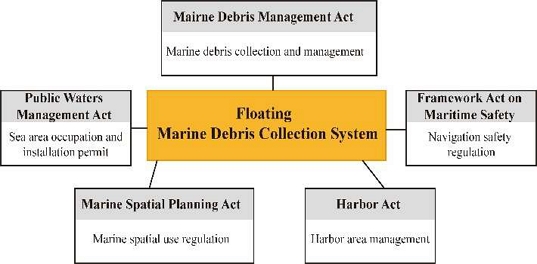
Legal and institutional analysis for the marine deployment of floating marine debris collection systems in coastal areas.
4. Regulatory Issues in Installing Floating Marine Debris Collection Systems
The installation and operation of floating marine debris collection systems in the sea area in front of breakwaters may involve the simultaneous application of various marine-related laws. As a result, several regulatory issues may arise during the installation and operational processes. Floating structures installed in marine areas require comprehensive consideration of legal requirements related to public water use, marine environmental management, navigation safety, and existing marine activities.
Coastal waters represent spaces where harbor operations, fisheries activities, and marine environmental management occur simultaneously. When new facilities are introduced in such areas, their relationship with existing marine uses becomes an important factor in regulatory review. The major regulatory issues associated with the installation of floating marine debris collection systems in breakwater front areas are summarized in Table 2.
Regulatory issues related to floating debris collector installation
4.1 Sea Area Occupancy and Installation Permit
Floating marine debris collection systems can be regarded as floating structures installed in marine areas, thereby occupying a certain part of public waters. Therefore, such facilities may be subject to a public water occupation and use permit under Article 8 of the Public Waters Management and Reclamation Act.
During the permit review process, several factors are considered, including the installation location, the scale of the structure, the intended use of the facility, and the characteristics of the surrounding marine area. Since the sea area in front of breakwaters often involves harbor operations and coastal activities, the potential impacts of the facility on existing marine uses may be evaluated during the approval process.
The permit review procedure may also consider the installation purpose and public interest of the facility. Marine debris collection systems may be regarded as facilities with a public environmental management function. However, depending on the installation configuration and operational characteristics of the structure, the facility may still be interpreted as occupying public waters, which requires appropriate legal interpretation.
4.2 Marine Environmental Review
The installation of structures in marine areas may require procedures to review potential impacts on the marine environment. Marine development projects exceeding a certain scale may be subject to environmental impact review under the Marine Environment Management Act and the sea area use consultation system.
The sea area use consultation system is designed to evaluate the environmental impacts of development activities that utilize marine space before project implementation. Floating marine debris collection systems installed in breakwater front areas may be interpreted as activities that utilize marine space. Therefore, the applicability of sea area use consultation may need to be examined.
Floating structures may influence hydrodynamic conditions or marine ecosystems depending on their installation location and scale. From the perspective of marine environmental management, potential environmental changes caused by the installation of such facilities should be reviewed in advance.
4.3 Conflicts with Existing Marine Uses
Coastal waters support multiple marine activities, including harbor operations, fisheries, and marine environmental management. When new facilities are introduced in such areas, their compatibility with existing marine uses should be carefully examined. The conflicts associated with the installation of floating marine debris collection systems can be categorized into spatial conflicts, operational conflicts, and regulatory overlaps.
Spatial conflicts arise from the use of limited marine space. Breakwater front areas may be used for vessel navigation and fisheries activities, requiring evaluation of the spatial relationship between floating structures and existing marine uses.
Operational conflicts occur when floating structures affect ongoing maritime activities. Waters near harbors may serve as navigation routes for harbor vessels and coastal fishing boats, and the installation of marine structures in these areas may affect vessel traffic conditions. Therefore, the installation location and scale of floating structures require careful consideration to ensure navigation safety. In addition, coastal waters support various forms of fisheries activities, and the installation of structures in specific areas may influence fishing operations.
Regulatory overlaps may arise when multiple legal frameworks related to public water use, marine environmental management, and navigation safety are applied simultaneously, requiring coordinated interpretation and management.
4.4 Institutional Limitations
Existing marine-related laws include regulatory provisions for various types of marine structures, including port facilities, offshore energy installations, and fisheries facilities. However, institutional standards specifically addressing floating facilities designed for marine debris collection remain limited.
Current marine debris management systems are largely based on collection activities conducted using vessels and manual labor. Institutional guidelines for facilities installed in coastal waters for marine debris collection have not yet been sufficiently established. This institutional gap highlights the need for legal interpretation when introducing new forms of marine environmental management facilities.
Therefore, the application of floating marine debris collection systems in breakwater front areas requires clarification of the legal status of such facilities within the existing regulatory framework. Policy discussions may also be required to establish institutional criteria for marine environmental management facilities.
5. Policy Implications for the Installation of Floating Marine Debris Collection Systems
This study examined the major maritime legal frameworks applicable to the installation of floating marine debris collection systems in the sea area in front of breakwaters and analyzed the regulatory issues that may arise during the installation and operation of such facilities. The analysis indicates that the coastal marine debris management process can be understood as a sequence consisting of coastal waste generation, debris accumulation in breakwater front areas, installation of offshore collection facilities, operation of marine debris management systems, and final onshore treatment. Each stage of this management process is associated with different legal and institutional frameworks.
Therefore, the effective implementation of coastal marine debris management policies requires an integrated understanding of the relationships between the management process and the relevant legal systems. Figure 3 presents an integrated management framework that illustrates the coastal marine debris management process and the major legal frameworks associated with each stage. This analytical framework not only identifies regulatory challenges but also provides a structured basis for understanding the interactions among multiple maritime legal systems, thereby offering both academic insights and practical implications for the implementation of marine debris collection systems.
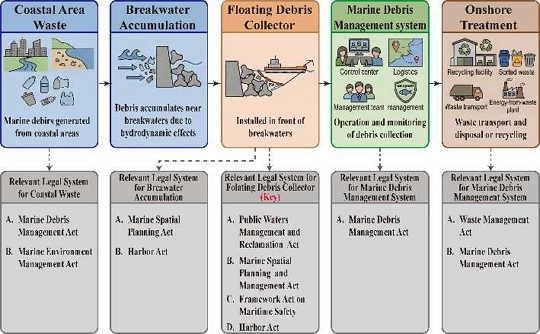
Integrated coastal marine debris management framework and related legal systems
5.1 Coastal Waste Generation and Marine Debris Policy
A significant portion of coastal marine debris originates from human activities in coastal areas or from waste transported through river inflows. Once generated, such debris may be transported offshore by waves and ocean currents. The overall policy direction for the prevention and management of marine debris is established under the Marine Debris and Marine Polluted Sediment Management Act and the Marine Environment Management Act.
The marine debris management system provides a policy framework for preventing the generation of marine debris and promoting debris collection and treatment activities. Under this system, the national government and local governments are responsible for establishing and implementing marine debris management policies. Therefore, this institutional framework can be interpreted as the initial stage of coastal marine debris management policy.
5.2 Debris Accumulation in Breakwater Areas
Marine debris generated in coastal areas is transported by ocean currents and wave action, and its distribution patterns may be influenced by shoreline geometry and the presence of artificial coastal structures. Breakwater front areas are known to create conditions in which floating materials may remain in the vicinity due to wave attenuation and changes in local hydrodynamic conditions.
The sea area in front of breakwaters represents a coastal space where harbor facilities and coastal structures coexist. Therefore, the use and management of this area are associated with the Marine Spatial Planning and Management Act and the Harbor Act. These legal frameworks aim to ensure efficient use and coordinated management of marine space, and the waters surrounding breakwaters are included within this regulatory framework.
Therefore, the utilization of breakwater front areas as marine debris management zones requires careful consideration of their relationship with existing marine spatial management policies. In particular, the installation of floating debris collection systems in such areas may involve overlapping regulatory requirements related to public water use, marine environmental management, and navigation safety, which are governed by different legal frameworks. This fragmentation of regulatory responsibilities highlights the need for a more integrated regulatory approach to ensure consistent decision-making and effective management of marine debris collection facilities in coastal waters.
5.3 Installation of Floating Debris Collectors
The installation of floating marine debris collection systems in breakwater front areas involves the deployment of floating structures in marine space and therefore falls under legal frameworks related to public water use and marine spatial management.
The Public Waters Management and Reclamation Act provides the primary legal basis for the installation of structures in marine areas and requires permission from the public water management authority when occupying or using public waters. The Marine Spatial Planning and Management Act provides a regulatory framework for coordinating different marine activities and requires that the installation of marine structures be reviewed in relation to existing marine spatial use plans.
Breakwater front waters may also serve as navigation routes for vessels. Therefore, regulations under the Framework Act on Maritime Safety and the Harbor Act require consideration of navigation safety when marine structures are installed in such areas. The installation of floating marine debris collection systems may require regulatory review processes related to public water occupation permits, marine spatial compatibility, and navigation safety.
5.4 Marine Debris Management and Operational Framework
Once floating marine debris collection systems are installed, a management and operational framework is required to handle the debris collected through these facilities. These activities are directly associated with the marine debris management framework established under the Marine Debris and Marine Polluted Sediment Management Act.
Marine debris collection activities represent an important component of marine environmental protection policies. These activities aim to establish a continuous management and collection system for marine debris generated in coastal waters. Therefore, the operation of floating marine debris collection systems needs to be integrated with existing marine debris management frameworks.
5.5 Onshore Treatment and Waste Management
Marine debris collected offshore must ultimately be transported to land-based facilities for treatment. This stage of the management process is associated with the Waste Management Act and related marine debris management systems.
During the onshore treatment stage, collected debris undergoes classification, recycling, and disposal. These activities contribute simultaneously to marine environmental protection and resource circulation policies.
Therefore, effective coastal marine debris management requires an integrated approach that connects offshore collection activities with onshore waste management systems. Such an integrated management framework can serve as an important policy foundation for addressing marine debris issues in coastal areas.
5.6 Policy Recommendations
To facilitate the effective deployment of floating marine debris collection systems in coastal areas, several policy measures can be considered. The establishment of a dedicated regulatory category would help clarify the legal status of stationary floating marine debris collection systems within existing maritime frameworks. In addition, the development of an integrated permitting framework that combines public water-use permits, environmental review procedures, and navigation safety assessments would contribute to a more efficient approval process. Furthermore, strengthening institutional coordination among relevant authorities would help address regulatory overlaps and improve consistency in decision-making. These measures can support the systematic implementation of marine debris collection systems in coastal environments.
6. Conclusion
This study analyzed the legal and institutional framework associated with the deployment of floating marine debris collection systems in coastal breakwater areas. Floating debris frequently accumulates near coastal structures due to hydrodynamic conditions, and the installation of floating debris collection systems in such areas may provide an effective approach for coastal debris management.
The results indicate that the installation of floating structures in marine areas may require compliance with multiple legal regulations. These facilities may be subject to public water occupation permits under the Public Waters Management and Reclamation Act and may also need to consider marine spatial planning policies, navigation safety regulations, and harbor management systems.
The collection and management of debris recovered from such facilities must also comply with the legal framework governing marine debris management and onshore waste treatment.
The analysis further identified several regulatory issues related to the installation of floating debris collection facilities, including public water-use permits, environmental review procedures, and potential conflicts with existing marine activities such as vessel navigation and fisheries operations.
Current marine debris management policies are largely focused on vessel-based collection activities, while institutional guidelines for stationary debris collection facilities in marine environments remain limited.
In addition to identifying these institutional limitations, this study offers contributions of both academic and practical significance. From an academic perspective, it introduces a process-based analytical framework that integrates debris accumulation characteristics with maritime legal analysis for stationary marine structures in coastal environments. Unlike previous studies that have primarily focused on offshore wind power, marine energy facilities, or vessel-based debris collection, this study extends the scope of maritime legal analysis to stationary marine debris collection systems in coastal breakwater areas. From a practical perspective, it offers a structured understanding of how multiple legal frameworks interact and highlights key areas requiring regulatory coordination and institutional clarification for the implementation of marine debris collection systems.
Therefore, the systematic deployment of floating marine debris collection systems in coastal areas requires clearer institutional frameworks and integrated regulatory approaches. This study provides a policy-oriented perspective on the legal feasibility of installing floating debris collection systems in coastal waters and offers a foundation for developing future marine debris management strategies.
Future research should further examine the technical feasibility, operational efficiency, and environmental impacts of such systems to support their practical implementation in coastal debris management.
Acknowledgments
This research was supported by a grant (2410014215) from the Design Industry Technology Development Program funded by the Ministry of Trade, Industry and Energy (MOTIE), Republic of Korea.
Author Contributions
Conceptualization, D. Youn; Methodology, D. Youn; Software, D. Youn; Formal Analysis, D. Youn; Investigation, D. Youn; Resources, D. Youn; Data Curation D. Youn; Writing-Original Draft Preparation, D. Youn; Writing-Review & Editing, D. Youn; Visualization, D. Youn; Supervision, D. Youn; Project Administration, D. Youn; Funding Acquisition, D. Youn.
References
-
A. L. Andrady, “Microplastics in the marine environment,” Marine Pollution Bulletin, vol. 62, no. 8, pp. 1596–1605, 2011.
[https://doi.org/10.1016/j.marpolbul.2011.05.030]

-
E. Van Sebille, C. Wilcox, L. Lebreton, N. Maximenko, B. D. Hardesty, J. A. Van Franeker, M. Eriksen, D. Siegel, F. Galgani, and K. L. Law, “A global inventory of small floating plastic debris,” Environmental Research Letters, vol. 10, no. 12, 124006, 2015.
[https://doi.org/10.1088/1748-9326/10/12/124006]
-
S. C. Gall and R. C. Thompson, “The impact of debris on marine life,” Marine Pollution Bulletin, vol. 92, no. 1–2, pp. 170–179, 2015.
[https://doi.org/10.1016/j.marpolbul.2014.12.041]
-
C. M. Rochman, M. A. Browne, B. S. Halpern, B. T. Hentschel, E. Hoh, H. K. Karapanagioti, L. M. Rios-Mendoza, H. Takada, S. Teh, and R. C. Thompson, “The ecological impacts of marine debris: unraveling the demonstrated evidence from what is perceived,” Ecology, vol. 97, no. 2, pp. 302–312, 2016.
[https://doi.org/10.1890/14-2070.1]
-
J. M. Park, D. H. Kim, H. J. Yoon, and W. C. Seo, “A study on identification of characteristics of spatial distribution for submerged marine debris,” Journal of the Korea Institute of Electronic Communication Sciences, vol. 11, no. 5, pp. 539–544, 2016.
[https://doi.org/10.13067/JKIECS.2016.11.5.539]
-
L. C. M. Lebreton, J. Van der Zwet, J. W. Damsteeg, B. Slat, A. Andrady, and J. Reisser, “River plastic emissions to the world’s oceans,” Nature Communications, vol. 8, no. 1, p. 15611, 2017.
[https://doi.org/10.1038/ncomms15611]
- S. P. Choi, “Legal review on the management and disposal of marine waste – Focusing on the formulation of the concept and the review of marine waste bill –,” Oebeop Nonjip, pp. 453–475, 2018 (in Korean).
-
J. G. B. Derraik, “The pollution of the marine environment by plastic debris: A review,” Marine Pollution Bulletin, vol. 44, no. 9, pp. 842–852, 2002.
[https://doi.org/10.1016/S0025-326X(02)00220-5]
-
H.-J. Lee and B.-R. Kim, “Study to improve the legal system to reduce marine accidents caused by marine plastic litter,” Journal of the Korean Society of Marine Environment and Safety, vol. 27, no. 7, pp. 967–976, 2021 (in Korean).
[https://doi.org/10.7837/kosomes.2021.27.7.967]
- B. D. Hardesty and C. Wilcox, “Understanding the types, sources and at-sea distribution of marine debris in Australian waters,” CSIRO, Hobart, Australia, 2011.
- U. Nations, “United Nations Convention on the Law of the Sea (UNCLOS),” Treaty Series 1833, 1982.
- International Maritime Organization, “Guidelines for the Implementation of MARPOL: Annex V,” International Maritime Organization, 2012.
- International Convention for the Prevention of Pollution from Ships (MARPOL), https://www.imo.org/en/about/conventions/pages/international-convention-for-the-prevention-of-pollution-from-ships-(marpol).aspx, , Accessed March 30, 2026
-
R. C. Thompson, C. J. Moore, F. S. Vom Saal, and S. H. Swan, “Lost at sea: Where is all the plastic?,” Science, vol. 304, no. 5672, p. 838, 2004.
[https://doi.org/10.1126/science.1094559]
-
J. Vince and B. D. Hardesty, “Plastic pollution challenges in marine and coastal environments: From local to global governance,” Restoration Ecology, vol. 25, no. 1, pp. 123–128, 2017.
[https://doi.org/10.1111/rec.12388]
-
L. Lebreton and A. Andrady, “Future scenarios of global plastic waste generation and disposal,” Palgrave Communications, vol. 5, no. 1, p. 6, 2019.
[https://doi.org/10.1057/s41599-018-0212-7]
- S. Yun, “How to improve marine litter management legislations in Korea – With special reference to U.S. marine litter-related acts –,” Journal of Hongik Law Review, vol. 23, no. 1, pp. 167–199, 2022 (in Korean).
-
H. Y. Kwon, “Reflections on international regulations to prevent marine pollution (marine debris),” Hanyang Law Review, vol. 40, no. 4, pp. 381–412, 2023 (in Korean).
[https://doi.org/10.18018/HYLR.2023.40.4.012]
-
Q. Wang, “Maritime law enforcement concerning offshore energy platforms: Navigating international law constraints and challenges,” Marine Policy, vol. 170, pp. 106370, 2024.
[https://doi.org/10.1016/j.marpol.2024.106370]
- A. R. Choi, “Legislative and Policy Measures for Offshore Wind Development in Korea: Advancing Energy Justice in the Global Energy Transition,” Korea Legislation Research Institute Journal of Law and Legislation, vol. 15, no. 1, pp. 61-133, 2025 (in Korean).
-
S. W. Jang, D. H. Kim, Y. H. Chung and H. J. Yoon, “Behavior Characteristics of Floating Debris Spilled from the Nakdong River,” Korean Journal of Remote Sensing, vol. 30, no. 1, pp. 127-136, 2014. (in Korean)
[https://doi.org/10.7780/kjrs.2014.30.1.10]
- The Public Waters Management and Reclamation Act, Korea Ministry of Government Legislation. https://elaw.klri.re.kr/eng_mobile/viewer.do?hseq=46970&type=part&key=35, , Accessed March 11, 2026 (in Korean).
- Marine Debris and Marine Polluted Sediment Management Act, Korea Ministry of Government Legislation. https://www.law.go.kr/DRF/lawService.do?OC=dl_lawinfosearch&target=law&MST=259903&type=HTML&mobileYn=&efYd=20250807, , Accessed March 11, 2026 (in Korean).
- Act on Marine Spatial Planning and Management, Korea Ministry of Government Legislation. https://www.law.go.kr/DRF/lawService.do?OC=dl_lawinfosearch&target=law&MST=267423&type=HTML&mobileYn=&efYd=20250621, , Accessed March 11, 2026 (in Korean).
- Harbor Act, Korea Ministry of Government Legislation. https://www.law.go.kr/DRF/lawService.do?OC=dl_lawinfosearch&target=law&MST=283707&type=HTML&mobileYn=&efYd=20260227, , Accessed March 11, 2026 (in Korean).
- Framework Act on Maritime Safety, Korea Ministry of Government Legislation. https://www.law.go.kr/LSW/lsInfoP.do?lsId=000058&ancYnChk=0#0000, , Accessed March 11, 2026 (in Korean).
- Maritime Traffic Safety Act, Korea Ministry of Government Legislation. https://www.law.go.kr/lsLinkCommonInfo.do?lsJoLnkSeq=1022146533, , Accessed March 11, 2026.