
A resource efficiency enhancement scheme for LoRaWAN networks in shipboard IoT

Copyright © The Korean Society of Marine Engineering
This is an Open Access article distributed under the terms of the Creative Commons Attribution Non-Commercial License (http://creativecommons.org/licenses/by-nc/3.0), which permits unrestricted non-commercial use, distribution, and reproduction in any medium, provided the original work is properly cited.
Abstract
The paradigm of maritime operations is rapidly shifting toward data-oriented management, where continuous monitoring and analytical utilization of onboard information have become indispensable. This transformation has significantly accelerated the adoption of Internet of Things (IoT) technologies within ship environments. Implementing IoT systems on vessels, however, requires wireless communication infrastructures that minimize power consumption of distributed devices while simultaneously guaranteeing uninterrupted connectivity under maritime conditions. Without such capabilities, long-term data acquisition and information credibility cannot be sustained. Thus, the Long-Range Wide Area Network (LoRaWAN) protocol emerges as a viable communication framework, particularly due to its suitability for low-power, long-distance transmission scenarios typical of IoT deployments. Nevertheless, when deploying LoRaWAN in shipboard environments, improving wireless resource efficiency becomes a critical design requirement, particularly for latency-sensitive use cases such as real-time monitoring, to ensure sustained network operation and reliable data delivery. Therefore, this paper proposes a scheme that efficiently utilizes the limited wireless resources of a LoRaWAN system while complying with the LoRaWAN standard to enable shipboard LoRaWAN-based IoT implementations that support diverse applications, including real-time monitoring.
Keywords:
Long-range wide area network (LoRaWAN), Shipboard IoT, Resource efficiency1. Introduction
The rapid evolution of IoT technologies has driven their adoption across numerous industrial domains, resulting in continuous growth in both application diversity and economic impact. Ensuring dependable and sustained communication among distributed wireless nodes remains a central technical challenge, particularly under stringent energy constraints. Accordingly, extensive research efforts have focused on prolonging node lifetime through energy-aware system design and power optimization techniques [1]. In practical IoT deployments, devices integrating sensing and communication capabilities are required to provide wide-area connectivity while operating under strict battery limitations [2].
The maritime sector has increasingly adopted data-centric management paradigms aimed at enhancing operational efficiency and navigational safety. Such developments necessitate communication infrastructures capable of operating reliably under the distinct environmental and operational constraints of shipboard environments. Regulatory frameworks support these trends. For example, vessels, whether passenger or cargo ships, with a gross tonnage of 3,000 or above and constructed after July 1, 2002, are mandated to carry Voyage Data Recorders (VDRs) to facilitate post-incident investigations [3]. A VDR is an onboard data acquisition system designed to collect a wide range of navigational and operational parameters through distributed sensors installed throughout the vessel. Its implementation is aligned with the International Maritime Organization (IMO)’s Safety of Life at Sea (SOLAS) Convention requirements, specifically IMO Resolution A.861(20) [4].
Shipboard IoT deployments require communication technologies that allow distributed devices to sustain reliable connectivity under strict power constraints, thereby enabling accurate and continuous acquisition of onboard operational data. Among the various IoT communication solutions currently available, the LoRaWAN [5]-[6] has emerged as a strong candidate, particularly due to its support for low-power operation and data rates optimized for long-range transmission scenarios [2].
Within the context of IoT-enabled data-driven ship management, prior research efforts [7]-[8] investigated energy-related limitations embedded in the LoRaWAN standard and introduced enhancement strategies based on acknowledgment (ACK) mechanisms. Despite these contributions, the analytical focus was confined primarily to energy consumption, leaving the issue of communication resource efficiency insufficiently addressed. In particular, resource utilization has not been thoroughly examined with respect to supporting heterogeneous onboard application requirements.
LoRaWAN networks should be designed to meet diverse use-case requirements while taking into account communication resource loss resulting from packet collisions under the pure ALOHA-based access mechanism [9]. Therefore, this paper aims to propose a method for efficiently utilizing the limited resources of LoRaWAN while satisfying the various requirements specified in the LoRaWAN standard.
The remainder of this paper is structured as follows: Section 2 describes the LoRaWAN data frame exchange procedures defined in the corresponding specification. In Section 3, the proposed access scheme is explained. Section 4 shows performance evaluations of the resulting enhancement. Finally, concluding remarks are presented in Section 5.
2. Data Frame Exchange Procedure in LoRaWAN
After an uplink frame is transmitted by an end device, the system schedules one or two downlink reception windows, denoted as RX1 and RX2, following predefined delay intervals (RECEIVE_DELAY1). These windows provide opportunities for the Network server to deliver corresponding downlink frames [5]. Transmission of a subsequent uplink frame is restricted until one of two conditions is fulfilled [5]: 1) A downlink frame associated with the preceding uplink transmission is successfully received during either the RX1 or RX2 window; or 2) The RX2 reception window related to the prior uplink transmission expires without receiving any downlink response.
Figure 1 illustrates an example of unconfirmed data frame exchange. In this example, the first uplink frame sent by the end device is successfully received by the Network server. No downlink response occurs in RX1 or RX2; in such cases, the end device performs a random backoff after RX2 prior to retransmission. As illustrated in the figure, after an uplink transmission, the system must wait for the duration of RECEIVE_DELAY1 before opening the reception window, and this procedure is repeated for every uplink transmission. During the RECEIVE_DELAY1 interval, communication between the corresponding end device and the Network server is constrained; therefore, the interval may be perceived as available communication resources by other end devices within the network. Since LoRaWAN adopts a pure ALOHA-based access scheme, packet collisions may limit overall system capacity and data reliability. Consequently, such idle communication intervals can be leveraged as collision-avoidance opportunities to improve resource utilization efficiency.
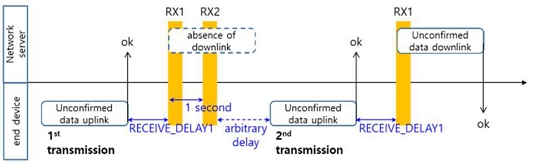
Timing diagram of LoRaWAN data exchange [7]
3. Opportunistic Access Scheme Design
The default value of RECEIVE_DELAY1 is 1 second. However, RECEIVE_DELAY1 is not a fixed parameter. The Network server can configure this value during the Over-the-Air Activation (OTAA) procedure by delivering it to the end device through a Join-Accept message. According to the specification [5], RECEIVE_DELAY1 can be set within a configurable range from 1 second to 15 seconds, depending on network operation policies and service requirements. As described in the previous section, since communication between the end device and the Network server is restricted during this interval, it may be considered wasted wireless resources for the duration specified by the configuration.
As the LoRaWAN standard does not preclude the use of Listen Before Talk (LBT), carrier sensing can be applied to recognize and opportunistically utilize the RECEIVE_DELAY1 period. Accordingly, these idle intervals may be exploited as opportunities to mitigate packet collisions and enhance overall resource utilization. Nevertheless, this approach necessitates controlling the transmission time to ensure that the packet can be fully transmitted within the available RECEIVE_DELAY1 interval.
In LoRaWAN networks, the Network server employs Adaptive Data Rate (ADR) to dynamically determine the optimal spreading factor (SF) for each end device. When an end device transmits a packet, the gateway measures the received signal-to-noise ratio (SNR). If the measured SNR indicates that the link condition is better than necessary, the server transmits a MAC command (LinkADRReq) instructing the device to switch to a lower SF in subsequent transmissions. Conversely, if the SNR degrades, the server directs the device to increase the SF to maintain reliable connectivity. By encouraging devices to operate at the lowest feasible spreading factor (e.g., SF7), ADR minimizes the overall time on air (Tair) across the network, thereby significantly reducing collision probability and improving network capacity. Therefore, this paper proposes a scheme that configures the SF via LinkADRReq command according to channel conditions such that the airtime Tair remains shorter than RECEIVE_DELAY1, thereby enabling effective utilization of the RECEIVE_DELAY1 interval. In other words, by deliberately lowering the SF to reduce the airtime Tair, the Network server can mitigate packet collisions and improve wireless resource efficiency.
4. Performance Evaluation
In this section, the LoRa Modem Calculator [10] was utilized for performance validation. The simulation assumes the SX1262 chipset configuration with a coding rate of 4/5, a preamble of 8 symbols, and a payload length of 50 bytes for the performance evaluation.
Figure 2 presents the relationship between the SF and the corresponding time on air, Tair. This figure indicates that, with increasing spreading factor, the corresponding transmission time grows and reaches approximately 2 seconds.
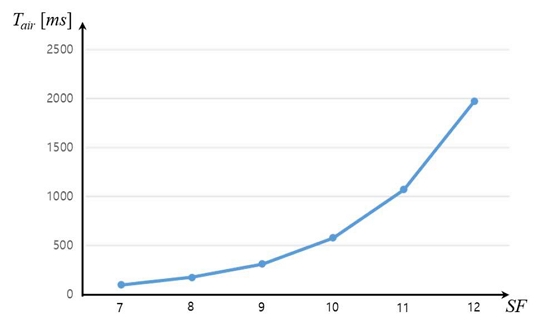
The relationship between the SF and the time on air
Figure 3 illustrates the additional effective data rate that can be achieved by transmitting packets within the RECEIVE_DELAY1 interval, assuming RECEIVE_DELAY1 is set to 1 second. As shown in the figure, an improvement in throughput performance can be observed. However, for SF11 and SF12, the airtime, Tair exceeds the configured RECEIVE_DELAY1, resulting in zero effective data rate gain, as indicated by the solid line. If RECEIVE_DELAY1 is configured to be longer than 1 second, additional throughput gains, represented by the dashed line, can be achieved within the corresponding SF range. By leveraging underutilized wireless resources for data transmission, the effective capacity of the LoRaWAN network can be increased, extending its applicability to a broader spectrum of shipboard IoT use cases.
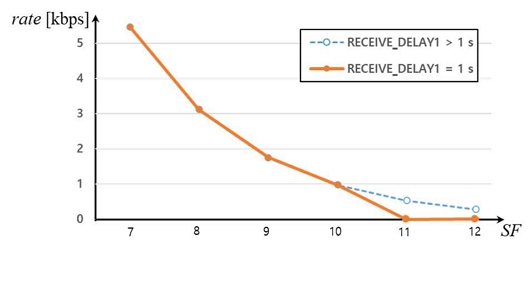
The additional effective data rate gain of the proposed method
5. Conclusion
This study proposes an opportunistic access scheme that efficiently exploits the limited wireless resources of a LoRaWAN system. By utilizing communication intervals that would otherwise remain unused, the proposed approach enhances the effective data rate and extends the capability of LoRaWAN to support a broader range of IoT applications. Furthermore, since the proposed method is fully compliant with the LoRaWAN specification, it can be seamlessly integrated into existing commercial LoRaWAN deployments.
Author Contributions
Conceptualization, Y. -I. Joo; Methodology, Y. -I. Joo; Writing-Original Draft Preparation, Y. -I. Joo; Validation, Y. -I. Joo; Writing-Review & Editing, Y. -I. Joo.
References
- J. de Carvalho Silva, J. J. P. C. Rodrigues, A. M. Alberti, P. Solic, and A. L. L. Aquino, “LoRaWAN — A low power WAN protocol for Internet of Things: A review and opportunities,” in Proceeding of 2017 2nd International Multidisciplinary Conference on Computer and Energy Science (SpliTech), pp. 1-6, 2017.
-
Y. -I. Joo, “Networking strategy for data-driven management in a ship: Requirements and applications,” Journal of Advanced Marine Engineering and Technology, vol. 46, no. 4, pp. 193-195, 2022.
[https://doi.org/10.5916/jamet.2022.46.4.193]

- Voyage Data Recorders, https://www.imo.org/en/OurWork/Safety/Pages/VDR.aspx, , Accessed March 19, 2026.
- Voyage Data Recorders, https://en.wikipedia.org/wiki/Voyage_data_recorder, , Accessed March 19, 2026.
- LoRa Alliance, LoRaWAN 1.1 Specification, October, 2017.
- SEMTECH, LoRa and LoRaWAN: A technical overview, Semtech Corporation, December, 2019.
-
Y. -I. Joo, “Analysis of energy consumption on deferred transmission of LoRaWAN downlink frame for IoT in a ship,” Journal of Advanced Marine Engineering and Technology, vol. 47, no. 4, pp. 208-210, 2023.
[https://doi.org/10.5916/jamet.2023.47.4.208]
-
Y. -I. Joo, “Analysis of energy savings through acknowledgement policy for efficient power management in LoRaWAN for IoT in a ship,” Journal of Advanced Marine Engineering and Technology, vol. 48, no. 4, pp. 232-234, 2024.
[https://doi.org/10.5916/jamet.2024.48.4.232]
-
F. Adelantado, X. Vilajosana, P. Tuset-Peiro, B. Martinez, J. Melia-Segui, and T. Watteyne, “Understanding the limits of LoRaWAN,” IEEE Communications Magazine, vol. 55, no. 9, pp. 34-40, 2017.
[https://doi.org/10.1109/MCOM.2017.1600613]
- LoRa Calculator, https://www.semtech.com/design-support/lora-calculator, , Accessed March 19, 2026.