
Feasibility assessment of a dry towing-based installation method for a 10 MW class jack-up offshore wind turbine considering stability and mooring responses

Copyright © The Korean Society of Marine Engineering
This is an Open Access article distributed under the terms of the Creative Commons Attribution Non-Commercial License (http://creativecommons.org/licenses/by-nc/3.0), which permits unrestricted non-commercial use, distribution, and reproduction in any medium, provided the original work is properly cited.
Abstract
This study investigates the technical feasibility of a dry towing-based installation method for a 10 MW class jack-up offshore wind turbine (OWT), in response to the increasing technical challenges associated with the transportation and installation of large-scale offshore wind turbines. Structural stability and mooring responses during both the transportation and installation phases were evaluated using MOSES and ANSYS AQWA. Particular attention was given to the station-keeping performance and mooring line tensions during the leg lowering process under barge mooring conditions. The analysis results indicate that the barge–OWT system maintains sufficient stability during the dry towing transportation phase. In addition, the mooring system provides stable station-keeping performance during the installation phase. The mooring line tensions were also found to have adequate safety margins compared to the safe working load (SWL). These results demonstrate that the dry towing-based installation method is a feasible alternative for the installation of large-scale jack-up OWTs.
Keywords:
10 MW Offshore wind turbine, Jack-up structure, Dry towing, Towing stability, Mooring analysis1. Introduction
With the global acceleration of carbon neutrality (net-zero) policies and the expansion of renewable energy strategies, offshore wind power has rapidly emerged as a key energy source for the energy transition. In particular, to improve power generation efficiency and enable large-scale offshore wind farm development, the capacity of individual offshore wind turbines has continuously increased. Recently, large-scale offshore wind turbines with capacities exceeding 10 MW have reached the stage of commercial deployment [1]. This trend has significantly increased the technical complexity of transportation and installation processes for offshore wind turbines (OWTs).
OWTs are typically installed using wind turbine installation vessels (WTIVs) or large crane barges. Although these methods ensure high operational precision and stability, they have notable limitations, including high equipment charter costs, restricted weather windows, and limited global availability of WTIVs, which may lead to project delays [2]. In addition, offshore installation operations are highly sensitive to environmental conditions such as waves, wind, and currents, and their feasibility is generally determined through weather window analysis [3].
Recently, alternative installation approaches such as tug-assisted methods have been investigated. In the case of jack-up (self-elevating platform, SEP) offshore wind turbines (OWTs), self-installation using onboard jacking systems enhances the feasibility of such approaches [4]. In terms of transportation, OWTs can be broadly classified into wet towing and dry towing. Wet towing provides high transportation efficiency but exposes the OWT directly to environmental loads, making motion response and stability critical design considerations. In contrast, dry towing transports the OWT on a barge, reducing motion responses and improving transportation stability. Various studies have investigated towing performance and transportation stability of OWTs [5]-[7].
During the installation process of jack-up OWTs, the leg lowering operation and spudcan penetration into the seabed play a critical role in structural stability. Previous studies have investigated spudcan penetration behavior and installation stability for various jack-up systems, providing fundamental insights for installation design [8]-[9].
In addition, recent studies published in the Journal of Advanced Marine Engineering and Technology (JAMET) have investigated mooring system behavior and stability characteristics of offshore wind turbines (OWTs) under environmental loading conditions [10].
However, existing studies have primarily focused on towing stability and transportation performance, while limited attention has been given to the integrated evaluation of both transportation and installation phases for jack-up OWTs transported using dry towing. In particular, the coupled effects of leg lowering and mooring system response on position-keeping performance during installation have not been sufficiently addressed.
In dry towing-based installation, the transportation and installation phases are inherently interconnected, as changes in structural configuration and environmental loading conditions during leg lowering can significantly affect both stability and mooring response. Therefore, an integrated evaluation of both phases is required to ensure the overall feasibility of the installation method.
Therefore, this study aims to evaluate the technical feasibility of a dry towing-based installation method for a 10 MW class jack-up OWT through an integrated analysis of both transportation and installation phases. Numerical analyses were conducted to assess structural stability during transportation and mooring response characteristics during installation. Particular emphasis was placed on the position-keeping capability and variations in mooring line tension during the leg lowering process under barge mooring conditions.
2. Offshore Wind Installation Methods and the Concept of Dry Towing
2.1 Offshore Wind Installation Methods
The installation methods for large-scale OWTs can generally be classified into wind turbine installation vessel (WTIV)-based methods, large crane barge-based methods, anchor mooring-based methods, and tug-assisted installation methods [2].
Among these, the WTIV-based installation method is the most widely used, as it can ensure high levels of operational precision and stability. However, it has notable disadvantages, including high equipment costs and limited availability of such specialized vessels. For these reasons, continuous efforts have been made to develop alternative installation methods for large-scale OWTs.
2.2 Dry Towing
Dry towing is a transportation method in which the OWT is carried on the deck of a barge, thereby reducing structural motions and ensuring transportation stability. This method has the advantage of minimizing wave exposure of the OWT during the transportation [5]-[7].
The main characteristics of dry towing are as follows:
- ① Minimization of wave exposure during transportation
- ② Capability to ensure high restoring stability
- ③ Enhanced transportation stability for large-scale OWTs
On the other hand, the installation phase involves the following procedures:
- ① Securing mooring stability of the barge
- ② Leg lowering and spudcan penetration
- ③ Deck elevation through the jack-up process
- ④ Demobilization of the barge
3. Numerical Analysis Method
3.1 Target Structure
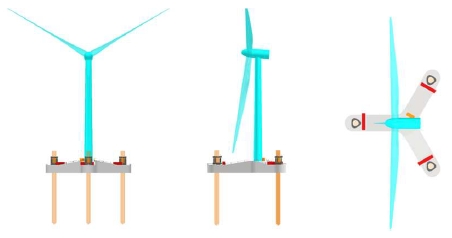
The target structure considered in this study is the 10 MW OWT. The structure consists of a triangular pontoon with three legs arranged at its corners, and each leg is equipped with a spudcan at its base to transfer loads to the seabed. The legs extend vertically from the pontoon, and during the installation phase, the spudcans penetrate into the seabed through the leg lowering process to secure structural support [8]-[9].
The topside structure consists of a deck and a tower, and an rotor-nacelle assembly(RNA) is installed at the top of the tower. The jack-up structure is operated by lowering the legs to fix the structure to the seabed at the installation site, followed by elevating the deck to secure a working platform.
In this study, numerical analyses were conducted under the assumption that the 10 MW OWT, with the above structural characteristics, is transported in a fully assembled condition on a barge and installed at the site through the leg lowering and subsequent jack-up processes. The configuration of the target structure is shown in Figure 1, and its principal particulars are summarized in Table 1 and Table 2.
Configuration of the 10 MW OWT

Main particulars of the 10 MW OWT
Principal particulars of the transportation barge
3.2 Environmental Conditions
The environmental conditions were defined based on the concept of weather-restricted conditions specified in DNV-ST-N001 [11] and ISO 19901-6 [12]. According to these standards, environmental conditions for offshore operations are categorized into the operational limiting condition (OPLIM) and the operating weather forecast condition (OPWF).
The operational limiting condition (OPLIM) represents the maximum allowable environmental conditions used to verify structural safety, whereas the operating weather forecast condition (OPWF) represents the environmental conditions under which offshore operations can be safely carried out. In practice, offshore installation operations are conducted within a weather window determined based on metocean analysis.
In this study, α-factors of 0.59 and 0.71 were applied to wave height and wind speed, respectively, to define the OPWF. Accordingly, the operating conditions were set to be less severe than the design conditions, and the key environmental parameters are summarized in Table 3.
Environmental conditions for operating (OPWF) and design (OPLIM) cases
3.3 Analysis Concept and Positioning Assessment
In the dry towing-based installation method, the 10 MW OWT mounted on a barge is transported to the installation site, where the legs are lowered under moored conditions to allow the spudcans to penetrate into the seabed. During this process, maintaining the target installation position is a critical requirement, as excessive positional deviation may lead to misalignment of the spudcan touchdown location and affect the subsequent jack-up operation and structural stability.
To evaluate the installation feasibility, both transportation stability and position-keeping capability during the installation phase must be considered. In particular, the leg lowering process induces changes in draft, center of mass, and submerged geometry, which in turn affect the hydrodynamic response and mooring system behavior.
In this study, the performance of a four-point mooring system in maintaining the stability of the barge–OWT system under environmental loading conditions was evaluated. The position-keeping capability was assessed based on horizontal offsets (surge and sway), while mooring stability was evaluated using the maximum mooring line tension relative to the allowable limits.
To account for variations during installation, three representative leg lowering stages (5 m, 10 m, and 15 m) were considered. The selected leg-lowering stages represent key transitional conditions during the installation process, where variations in draft, center of mass, and hydrodynamic characteristics significantly influence both motion responses and mooring system behavior. At each stage, the structural motion responses and mooring line tensions were analyzed under identical environmental conditions, enabling a consistent comparison of position-keeping performance and mooring stability throughout the installation process.
3.4 Modeling of the Barge–10 MW OWT and Mooring System
The analysis model consists of the 10 MW OWT mounted on a barge and a four-point mooring system used to maintain its position during installation. The structure was assumed to be rigidly fixed to the barge deck, and the entire system was modeled as a single rigid body with six degrees of freedom, including surge, sway, heave, roll, pitch, and yaw.
The dynamic behavior of the system was described using frequency-domain equations of motion that account for structural mass, added mass, radiation damping, viscous damping, hydrostatic restoring forces, and restoring forces induced by the mooring system. The mooring system provides additional restoring forces that contribute to suppressing environmental load-induced motions and ensuring position-keeping capability.
| (1) |
The motion of the barge–OWT system is governed by the above equation. Here, M denotes the structural mass matrix, A(ω) is the frequency-dependent added mass matrix, B(ω) is the radiation damping matrix, and Bv represents the viscous damping matrix. C denotes the hydrostatic restoring matrix.
In addition, Fmoor represents the restoring force induced by the mooring system, while Fwave, Fwind and Fcurrent denote the external forces due to waves, wind, and current, respectively.
The vector ξ represents the six degrees of freedom of the structure, namely surge, sway, heave, roll, pitch, and yaw.
The mooring lines were configured as a four-point arrangement connected to the corners of the barge and were modeled using a nonlinear catenary formulation that considers self-weight, initial tension, and geometric nonlinearity. This approach enables realistic prediction of mooring line configuration and tension variations under environmental loading.
Environmental loads acting on the system include wave, wind, and current forces. Wave loads were calculated based on linear potential theory in the frequency domain, including second-order drift forces that contribute to mean displacement. Wind and current loads were estimated using drag-based formulations and incorporated into the hydrodynamic analysis.
Numerical analyses were performed using MOSES and ANSYS AQWA. Hydrodynamic coefficients were first obtained, and the motion responses of the barge–OWT system were evaluated in the frequency domain. Subsequently, mooring line tensions and position-keeping performance were assessed by considering the nonlinear restoring characteristics of the mooring system under combined environmental loading conditions.
The dry towing installation concept and the configuration of the mooring system considered in this study are illustrated in Figure 2.
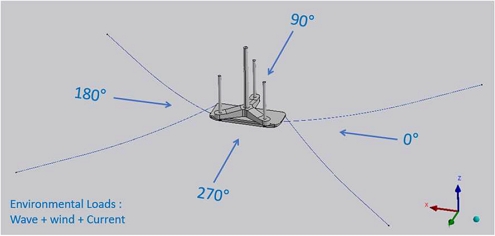
Conceptual configuration of the dry towing installation with four-point mooring system
3.5 Environmental Loads and Numerical Analysis Procedure
In this study, the primary environmental loads acting on the structure include wave, wind, and current loads. The wave loads were calculated using frequency-domain analysis based on linear potential theory, and second-order drift forces causing mean displacement of the structure were also taken into account [13].
Wind loads were estimated using a drag formulation based on air density, drag coefficient, and projected area, while current loads were calculated using the drag term of the Morison equation [14]. These approaches are widely used in hydrodynamic analysis of offshore structures.
Numerical analyses were performed using MOSES and ANSYS AQWA. First, hydrodynamic coefficients of the structure were computed, and motion responses were obtained in the frequency domain. Subsequently, structural motions and mooring line tensions were calculated by considering the nonlinear restoring characteristics of the mooring system.
The overall procedure for hydrodynamic response and installation analysis adopted in this study is illustrated in Figure 3.
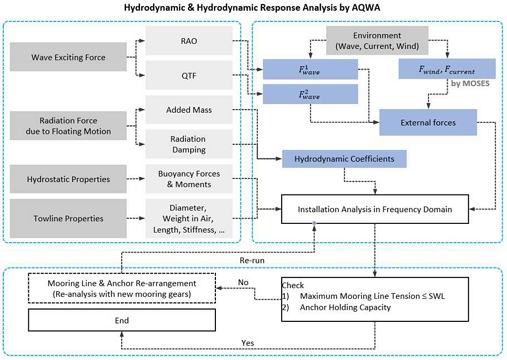
Flowchart of the hydrodynamic response and installation analysis procedure for the barge–OWT system
3.6 Analysis Scenarios for Leg Lowering Stages
In the dry towing installation process, the draft, center of mass, and submerged geometry of the structure change as the legs are lowered. These changes affect the restoring characteristics and hydrodynamic behavior of the structure. Therefore, it is necessary to examine the structural behavior and mooring responses corresponding to different leg lowering stages.
In this study, three installation stages were considered according to the leg lowering depth:
- Step-1: Leg lowering of 5 m
- Step-2: Leg lowering of 10 m
- Step-3: Leg lowering of 15 m
At each stage, identical environmental conditions were applied to compare and analyze the structural motion responses and mooring line tension variations. The installation concept for each leg lowering stage is illustrated in Figure 4.
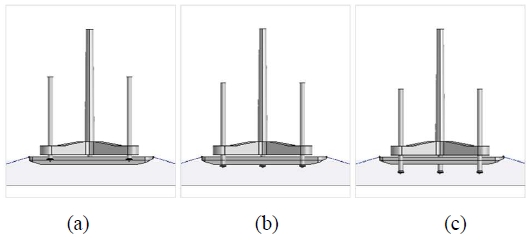
Installation stages of the barge–OWT system during dry towing installation (water depth = 20 m): (a) Step-1, leg lowering of 5 m; (b) Step-2, leg lowering of 10 m; (c) Step-3, leg lowering of 15 m
4. Stability Analysis during Dry Towing Transportation
4.1 Towing Resistance and Required Towing Force Analysis
In dry towing, it is necessary to estimate the total resistance acting on the barge–OWT system during transportation to the installation site and to evaluate the required performance of the tug vessels accordingly.
In this study, the total resistance under dry towing conditions was calculated using the formulation provided in the Enforcement Decree of the Ship Safety Act, specifically the regulations on the provision and inspection of towing equipment. This standard is widely applied in practical offshore structure transportation operations and in Marine Warranty Survey (MWS) assessments.
The calculation conditions for total resistance were set as follows: a towing speed of 2 knots, a wind speed of 36.93 knots (approximately 19 m/s), and a significant wave height of 3 m. The total resistance was obtained as the sum of frictional resistance, wave-making resistance, air resistance, and additional resistance components, and each resistance component is summarized in Table 4.
Resistance components of the barge–10 MW OWT system during dry towing
The calculation results show that the total resistance under dry towing conditions was approximately 64.9 tonf, with air resistance accounting for the largest proportion of the total resistance.
To evaluate the required tug performance based on the estimated total resistance, the effective towing force was assessed using the tug efficiency formulation presented in DNV-ST-N001 [11]. In this study, the specifications of a 4,500 PS-class tug were applied, and the principal particulars are summarized in Table 5.
Principal particulars of the 4500 PS tugboat used in the analysis
In accordance with DNV standards, the effective towing force was calculated by considering the bollard pull and tug efficiency. Under a significant wave height of Hs = 3.0 m, the tug efficiency was estimated to be approximately 62.3 %, resulting in an effective towing force of 34.2 tonf for a single tug.
When two identical tugs are employed, the total pulling requirement (TPR) is calculated to be 68.5 tonf, and the results are summarized in Table 6. The number of tugs was determined to satisfy the required towing force based on the estimated total resistance. The calculated total effective towing force was found to exceed the total resistance estimated for the dry towing transportation phase, indicating that towing of the barge–10 MW OWT system is feasible under the conditions considered in this study.
Towing performance calculation based on DNV-ST-N001
4.2 Stability Analysis
To evaluate the stability of the barge–10 MW OWT system during the dry towing transportation phase, an intact stability assessment was performed. The stability evaluation was conducted with reference to the stability criteria specified in the Korean Ministry of Oceans and Fisheries (MOF) regulations and DNV-ST-N001 [11].
Since dry towing operations are categorized as weather-restricted operations, a wind speed of 50 knots was applied in the stability analysis.
The stability assessment was carried out by comparing the righting arm (GZ) curve with the wind heeling arm curve. For intact conditions, the area under the righting moment curve (A+B) must be at least 40 % greater than the area under the wind heeling arm curve (B+C).
The barge used in this study has an overall length of 97.5 m and a breadth of 36.0 m, which classifies it as a large cargo barge according to DNV standards. Accordingly, the minimum required range of stability under intact conditions was set to 36 ° or greater.
The stability analysis was performed using the MOSES program, and the numerical model used in the analysis is shown in Figure 5.
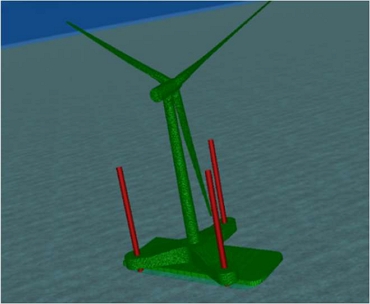
Numerical model of the barge–10 MW OWT system used for intact stability analysis in MOSES
The analysis results show that the ratio of the area under the righting moment curve to that under the wind heeling arm curve was approximately 6.0, which significantly exceeds the required criterion of 1.4. In addition, the range of stability was found to be approximately 37 °, satisfying the intact stability requirement.
The initial stability parameter, GM, was calculated to be 8.37 m, which is well above the minimum required value of 1.0 m. The results of the stability analysis are summarized in Table 7.
Summary of intact stability results
The righting arm curve and wind heeling arm curve are presented in Figure 6.
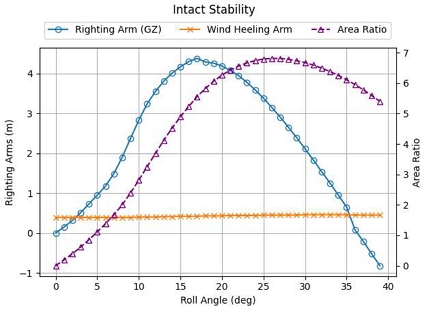
Intact stability curves of the barge–10 MW OWT system showing righting arm (GZ), wind heeling arm, and area ratio
Therefore, the barge–10 MW OWT system is considered to satisfy the intact stability criteria under dry towing transportation conditions.
5. Stability Assessment during Dry Towing Installation Phase
5.1 Installation Procedure and Analysis Overview
The dry towing-based installation method involves transporting the 10 MW OWT mounted on a barge to the installation site, followed by mooring the barge and lowering the legs in a stepwise manner while maintaining the position of the structure.
The typical installation procedure consists of barge mooring, leg lowering, spudcan touchdown, jack-up, and barge demobilization.
Since environmental loads induced by waves, wind, and current act at the installation site, the mooring system must provide sufficient position-keeping capability to maintain the structural position in a stable manner.
In this study, the analysis focused on the leg lowering process, which has a significant influence on structural behavior and mooring stability during installation. The leg lowering depth was divided into three stages at 5 m intervals (5 m, 10 m, and 15 m).
5.2 Mooring System Configuration and Mooring Line Characteristics
In this study, a four-point mooring system was applied for the installation analysis, in which mooring lines are connected to the four corners of the barge. Each mooring line is connected to a seabed anchor and is designed to resist environmental loads induced by waves, wind, and current, while controlling the horizontal motions of the structure to ensure position-keeping capability during the installation process.
The mooring system was modeled to evaluate whether the barge–10 MW OWT integrated system can maintain the target installation position in a stable manner during the leg lowering process. In particular, as the leg lowering progresses, the submerged geometry and hydrodynamic forces acting on the structure change. Therefore, variations in mooring line tension and the positional response of the structure were analyzed simultaneously.
The mooring lines used in this study consist of 42 mm diameter wire ropes (6×24 + FC), and their main properties are summarized in Table 7. The diameter of the mooring lines was selected based on the design criteria for temporary mooring systems used in offshore installation operations, ensuring that the maximum mooring line tension induced by environmental loads does not exceed the safe working load (SWL).
Mooring line properties
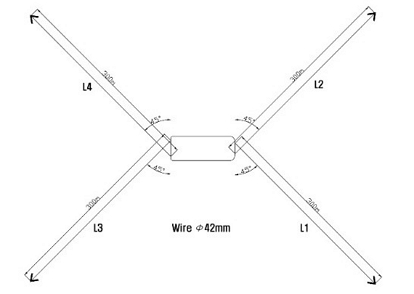
Four-point mooring arrangement of the barge–10 MW OWT system
According to DNV-ST-N001, the safe working load (SWL) of a mooring line can be taken as approximately 60 % of the minimum breaking load (MBL). The MBL of the mooring line used in this study is 1117 kN, resulting in an SWL of approximately 669 kN.
The layout of the four-point mooring system applied to the barge–10 MW OWT system is illustrated in Figure 8.
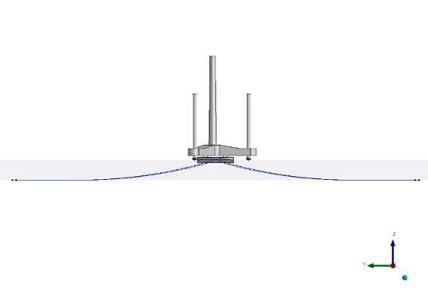
Numerical model of the barge–10 MW OWT system and four-point mooring configuration during leg lowering of 5m
5.3 Analysis Results for Leg Lowering Stages
The installation analysis was performed under the specified environmental conditions, considering eight load directions from 0° to 315° at 45° intervals. The position-keeping performance of the structure was evaluated based on the horizontal offsets in the surge and sway directions.
As the leg lowering depth increases, the center of mass decreases while the submerged geometry changes, resulting in variations in restoring characteristics and hydrodynamic loading. These changes influence both the structural motion responses and the mooring line tension.
Step-1 represents the initial stage of leg lowering, where the center of mass remains relatively high. As shown in Figure 8, the configuration of the barge–OWT system and the mooring lines at this stage reflects the initial installation condition. The analysis results indicate that the maximum surge and sway offsets are 1.219 m and 3.564 m, respectively. The maximum mooring line tension is 514.6 kN, corresponding to approximately 77 % of the safe working load (SWL). Detailed results for each load direction are summarized in Table 9.
Horizontal offsets and mooring tension during step-1, leg lowering of 5m (Hs = 1.0m, Tp = 7.0s)
As the leg lowering depth increases, the overall configuration of the system remains similar, with variation primarily in the leg penetration depth. In Step-2 and Step-3, the maximum surge offsets increase slightly to 1.259 m and 1.377 m, respectively, while the maximum sway offsets remain at a similar level of approximately 3.6 m. The maximum mooring line tension also increases gradually to 533.4 kN and 541.3 kN, corresponding to approximately 80 % and 81 % of the SWL, respectively. The detailed results for each stage are summarized in Tables 10 and Table 11.
Horizontal offsets and mooring tension during step-2, leg lowering of 10m (Hs = 1.0m, Tp = 7.0s)
Horizontal offsets and mooring tension during step-3, leg lowering of 15m (Hs = 1.0m, Tp = 7.0s)
Overall, a slight increase in horizontal displacement and mooring line tension is observed as the leg lowering depth increases. This trend is primarily attributed to the increased current-induced loads acting on the legs as they become more deeply submerged. Despite this increase, all mooring line tensions remain within the allowable range defined by the SWL, indicating that sufficient safety margins are maintained throughout the installation process.
6. Results Analysis and Evaluation of Applicability of the Installation Method
6.1 Comparison of Position-Keeping Performance at Different Leg Lowering Stages
The position-keeping performance of the barge–10 MW OWT system during the installation process was evaluated by comparing the maximum horizontal offsets (surge and sway) at each leg lowering stage. As shown in Figure 9, the horizontal displacement exhibits a slight increasing trend as the leg lowering depth increases.
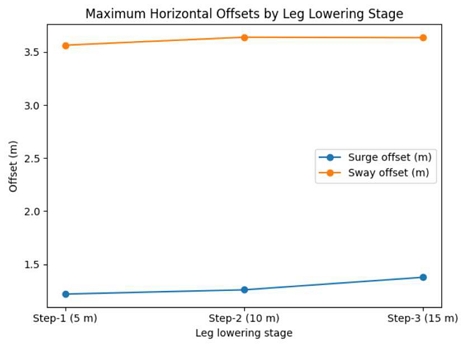
Maximum horizontal offsets according to leg lowering stages
This behavior is primarily attributed to changes in the submerged geometry and the associated increase in hydrodynamic loading acting on the legs, particularly due to current effects. As the legs penetrate deeper into the water, the projected area exposed to environmental loads increases, resulting in higher external forces acting on the system.
Despite this trend, the overall horizontal displacement remains within the acceptable range for offshore installation operations. In general, position-keeping accuracy on the order of 5–10 m is considered acceptable depending on the installation method and operational conditions [11]. The results obtained in this study fall well within this range, indicating that the applied mooring system provides sufficient position-keeping capability throughout the leg lowering process.
Furthermore, it should be noted that actual offshore installation operations are typically conducted under weather-restricted conditions that are less severe than the design conditions considered in this study. Therefore, smaller positional deviations are expected in practice, further supporting the applicability of the proposed installation method.
6.2 Comparison of Mooring Line Tension during Leg Lowering Stages
The variation in mooring line tension during the leg lowering process was evaluated by comparing the maximum tension values at each stage, as shown in Figure 10. The results indicate a gradual increase in mooring line tension as the leg lowering depth increases.
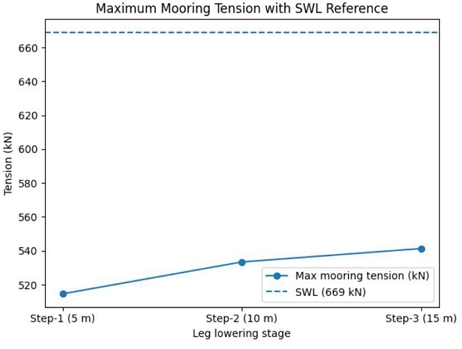
Maximum mooring tension according to leg lowering stages
This increase is closely related to the changes in hydrodynamic loading caused by the increasing submergence of the legs. As the submerged portion of the structure increases, the environmental loads acting on the system also increase, leading to higher mooring line tensions.
However, the maximum mooring line tensions at all stages remain within the allowable limits defined by the safe working load (SWL). This indicates that the mooring system has sufficient strength and stiffness to resist the environmental loads encountered during the installation process.
Overall, the mooring system provides stable restoring performance and maintains adequate safety margins throughout the entire leg lowering process.
6.3 Evaluation of the Applicability of the Dry Towing-Based Installation Method
Based on the comprehensive analysis of both the transportation and installation phases, the technical feasibility of the dry towing-based installation method was evaluated from three key aspects.
First, the stability of the barge–OWT system during the transportation phase satisfies all required criteria, including GM, stability range, and area ratio. In addition, the required towing force can be sufficiently secured using conventional tugboats, confirming the feasibility of the dry towing operation.
Second, during the installation phase, the barge–OWT system maintains stable position-keeping performance throughout the leg lowering process. The horizontal displacement remains within the acceptable range for offshore installation operations, indicating that the applied mooring system can effectively control the structural position under environmental loading.
Third, the structural safety of the mooring system is ensured, as the mooring line tensions remain within the allowable limits throughout the installation process. This confirms that the mooring system can provide sufficient restoring capacity and maintain structural stability during leg lowering.
Therefore, the dry towing-based installation method can be considered a technically feasible and practical alternative for the installation of large-scale jack-up OWTs. In particular, the proposed method offers potential advantages in reducing dependence on wind turbine installation vessels (WTIVs) and lowering overall installation costs, making it a viable solution in regions with limited availability of specialized installation vessels.
7. Conclusions
This study evaluated the technical feasibility of a dry towing-based installation method for the 10 MW OWT through numerical analyses using MOSES and ANSYS AQWA. The structural stability and mooring system responses during both the transportation and installation phases were systematically investigated.
The main findings of this study are summarized as follows:
- 1. The barge–OWT system satisfies all intact stability criteria during the dry towing transportation phase, demonstrating sufficient stability under the considered environmental conditions.
- 2. The required towing force can be achieved using two 4,500 PS-class tugboats, indicating that the transportation of the system is practically feasible.
- 3. During the installation phase, stable position-keeping performance is maintained throughout the leg lowering process, with horizontal displacements remaining within acceptable limits for offshore operations.
- 4. The mooring system ensures structural safety, as the maximum mooring line tension remains within the allowable range of the safe working load (SWL), providing sufficient safety margins.
Overall, the results confirm that the dry towing-based installation method is a technically feasible and practical alternative for the installation of large-scale jack-up OWTs. In particular, the proposed method offers potential advantages in reducing dependence on wind turbine installation vessels (WTIVs) and lowering installation costs.
For future work, more detailed analyses incorporating realistic barge configurations, ballast control systems, and damage stability should be conducted. In addition, time-domain dynamic analyses are recommended to capture transient responses and nonlinear effects under varying environmental conditions during actual offshore operations.
Acknowledgments
This work was supported by the Korea Institute of Energy Technology Evaluation and Planning (KETEP) grant funded by the Korean Government (MOTIE) (No. 20223030020240). The authors would like to acknowledge KOMS Co., Ltd. for their technical support.
Author Contributions
Conceptualization, J.-H.K.; Methodology, M.H.; Formal Analysis, M.H.; Investigation, M.H.; Data Curation, M.H.; Writing—Original Draft Preparation, M.H.; Writing—Review & Editing, J.-H.K.; Visualization, J.-H.K.; Supervision, J.-H.K.; Project Administration, J.-H.K.; Funding Acquisition, J.-H.K.
References
-
A. Myhr, C. Bjerkseter, A. Ågotnes, and T. A. Nygaard, “Levelised cost of energy for offshore floating wind turbines in a life cycle perspective,” Renewable Energy, vol. 66, pp. 714–728, 2014.
[https://doi.org/10.1016/j.renene.2014.01.017]

-
S. Hong, J. McMorland, H. Zhang, M. Collu, and K. Halse, “Floating Offshore Wind Farm Installation, Challenges and Opportunities: A Comprehensive Survey,” Ocean Engineering, vol. 304, p. 117793, 2024.
[https://doi.org/10.1016/j.oceaneng.2024.117793]
-
Z. Yang, Y. Lin, and S. Dong, “Weather window and efficiency assessment of offshore wind power construction in China adjacent seas using the calibrated SWAN model, Ocean Engineering, vol. 259, p. 111933, 2022.
[https://doi.org/10.1016/j.oceaneng.2022.111933]
-
M. Han, Y. I. Park, A. R. Ko, J. Y. Sung, and J. H. Kim, “Numerical verification of an anchor-free jack-up installation method for offshore wind turbine structures using tugboat fleet,” Journal of Marine Science and Engineering, vol. 13, p. 1906, 2025.
[https://doi.org/10.3390/jmse13101906]
-
R. C. Ramachandran, J. J. Serraris, J. Hernandez Montfort, E. J. De Ridder, C. Desmond, J. Murphy, “Towing analysis and validation of a fully assembled floating offshore wind turbine based on an experimental study,” Journal of Marine Science and Engineering, vol. 12, p. 689, 2024.
[https://doi.org/10.3390/jmse12040689]
-
P. Gao, X. Yuan, S. Liu, W. Lin, M. Chen, Z. Wang, Y. Tang, X. Jiang, “Towing resistance and design of a towing scheme for a floating wind turbine,” Journal of Marine Science and Engineering, vol. 13, p. 789, 2025.
[https://doi.org/10.3390/jmse13040789]
-
X. Cao, Z. Zhuowei, H. Zhang, and N. Zhang, “A review on the stability of towed floating bodies during wet towing operations,” Ocean Engineering, vol. 340, p. 122449, 2025.
[https://doi.org/10.1016/j.oceaneng.2025.122449]
-
P. Hu, A. Haghighi, J. Coronado, C. Leo, S. Liyanapathirana, and Z. Li, “A Comparison of Jack-up Spudcan Penetration Predictions and Recorded Field Data,” Applied Ocean Research, vol. 112, 102713, 2021.
[https://doi.org/10.1016/j.apor.2021.102713]
-
M. J. Lee and Y. W. Choo, “Penetration behavior of jack-up leg with spudcan for offshore wind turbine to multi-layered soils using centrifuge tests,” Journal of Ocean Engineering and Technology, vol. 38, pp. 30-42, 2024.
[https://doi.org/10.26748/KSOE.2023.039]
-
S. H. Park, Y. H. Jung, and W. C. Chung, “Effect on mooring line separation angles including one-line failure for 15 MW floating offshore wind turbine system,” Journal of Advanced Marine Engineering and Technology, vol. 49, no. 4, pp. 295-306, 2025.
[https://doi.org/10.5916/jamet.2025.49.4.295]
- DNV. DNV-ST-N001: Marine Operations and Marine Warranty; DNV: Høvik, Norway, 2021.
- ISO. ISO 19901-6: Petroleum and Natural Gas Industries—Marine Operations; International Organization for Standardization: Geneva, Switzerland, 2020.
- Chakrabarti, S.K. Hydrodynamics of Offshore Structures; WIT Press: Southampton, UK, 2001.
-
J. R. Morison, M. P. O’Brien, J. W. Johnson, and S. A. Schaaf, “The force exerted by surface waves on piles,” Petroleum Transactions, AIME 1950, vol. 189, 149–157.
[https://doi.org/10.2118/950149-G]