
Characteristics of tennis stroke and trajectory of the ball hit by a player using an accelerometer

Copyright © The Korean Society of Marine Engineering
This is an Open Access article distributed under the terms of the Creative Commons Attribution Non-Commercial License (http://creativecommons.org/licenses/by-nc/3.0), which permits unrestricted non-commercial use, distribution, and reproduction in any medium, provided the original work is properly cited.
Abstract
In this paper, we predict the drop position of the tennis ball at a given speed and a given angle using the MATLAB and propose the optimal values for swing speed and swing angle in order to send the ball from the center point of one end of the court to another end point of the court. And, a sensor including 3-axes acceleration and gyro, which is attached on the central surface of the racket frame, is used to obtain data. By analyzing the data generated during the swing, the swing type: stroke and volley, and the swing direction: forehand and backhand are classified. Additionally, by analyzing the swing data difference of 3 kinds of grips, we could distinguish interesting characteristics such as swing angle.
Keywords:
Tennis stroke, Trajectory, Accelerometer, Ball, Angle1. Introduction
Recent It’s essential for healthy life to have the harmony between mental and physical elements. Tennis is one of sports that fit well with these aspects because it requires not only instantaneous agility to hit a ball but also communication and cooperation with fellow players. One of the most effective ways to improve tennis skills is to observe and imitate famous players. In order to learn the serve motion, beginners often observe and practice the serving techniques of professional athletes. However, such imitation is based on visual observation of the athlete’s movements, and compared to direct and detailed feedback from a coach, it tends to take considerable time to achieve the desired level of perfection. Therefore, it has been suggested that recording professional players’ movements and providing them with real-time performance feedback can improve training efficiency [1].
By analyzing match videos using computer vision, various statistics about the player can be obtained [2]. These statistics can be applied to improve a player’s performance. By using stored data, it has been shown to virtually simulate a player’s match in real time, so it is possible to enhance their performance.
By using an accelerometer, energy consumption data for different body parts of professional and non-professional players were analyzed [3]. Professional athletes generally consumed more energy in the ankle area. Non-professional athletes consumed less energy in the waist area, indicating that they have not yet fully mastered the correct tennis posture.
In this paper, we apply the acceleration and gyro sensor to tennis. Sensor is attached to the racket to obtain the data about the racket's movement for 3-axes during the swing and these data are analyzed. Because classification of a tennis swing is categorized by a hand movement, analyzed results can be used to defined the swing motion, angle and velocity of the swing. Tennis motion is categorized into forehand and backhand, and stroke and volley. The travel distance and speed of the ball are predicted by calculating the speed and angle, and compared with the results on the actual court. The swing position with other people was compared by analyzing the acceleration result and the rotation result obtained through the sensor. In addition, MATLAB, which is one of the most widely used programs for easy data analysis, visualization and modeling, predicted the drop position of the tennis ball at a given speed and angle. As a result, we develop a system to improve your skills even if player practice alone without going to the tennis court in this study.
2. Methods
2.1 Mathematical Analysis
The MATLAB program is used to visualize the trajectory of the ball, and the projectile motion of the ball is analyzed by the following equation:
| (1) |
| (2) |
| (3) |
Where y(x) is the projectile equation, y and x is the vertical and horizontal moving distance of the ball, respectively. T is the staying time of the ball in the air, and R is the horizontal moving distance, respectively. The tennis ball which launched at the angle of θ and velocity of V0 shows uniform velocity motion in horizontal direction. In vertical direction, it receives only gravity and shows the uniformly accelerated motion, which is the same movement as the motion of the object that is thrown up vertically. These results are analyzed in two dimensions without all friction, including air resistance for simplification of analysis.
2.2 3D Acceleration Sensor Device
An acceleration including gyro sensor (LORD MicroStrain, 3DM-GX5-25) is used to measure acceleration and rotation changing of racket. This sensor can measure tri-axial acceleration and a triaxial gyroscope resulting in three dimension and this data, which is obtained as a vector quantity is used to distinguished patterns of representative tennis motions. The sensor is attached and move with racket as shown in Figure 1 and sending out the data. Acceleration values (ax, ay and az) for the three axes are measured in vector form and are either positive or negative depending on the direction of motion. Similarly, the rotation is measured positively or negatively on three axes (roll, pitch, and yaw). The information around the swing point is used to classify swing type (stroke and volley) and direction (forehand and backhand). The specifications of sensor are listed in Table 1.

Fixation of the 3D acceleration and gyro sensor on the tennis racket. The arrows indicate the orientation of the three axes of the sensor

Acceleration and gyro sensor specifications
3. Results and Discussion
3.1. MATLAB Analysis
Figure 2 shows the MATLAB result of relationship between the initial velocity and the launching angle of the tennis ball. Since the ball is hit at about 60 cm in a real tennis game, the ball’s initial height in calculation is set to 60 cm. And the ball’s drop position is analyzed by adjusting the initial velocity for various launch angle. Figure 2(a-c) shows the moving distance of the ball with change of initial velocity at θ = 35˚, 45˚, and 55˚, respectively. According to Equation (3), the tennis ball moves the longest distance R = 23.3 m and reach the edge of the end line and sideline horizontally even though the launching velocity is slow when the angle is 45˚ (Figure 2(b)). The minimum velocity is V0 = 11 m/s to cross the net at the center, and if it is slower than that, the ball will not cross the net. In this calculation, resistance components such as tennis and racket repulsion, ball rotation, air resistance, and wind were not considered. Figure 2(d) shows the results when the firing angle is from 15° to 85°. In the case of θ = 85 °, it can be seen that much more energy is required to pass the net compared to other angles, and when θ = 45°, the energy for reaching the end line is minimal. Figure 2(e) shows the speed required for the ball to reach the end line according to the initial height when θ = 45°. At h = 60 cm, the most common height, the required velocity V0 = 15.1 m / s, and at other heights the required velocity was larger or smaller but no significant difference. Figure 2(f) shows the maximum left and right angles to turn when launching the ball at θ = 45° from one side of the court. When the ball is launched from the corner of the court, it can be deflected up to θ =20° and it will be out of the side line when it is bent further.
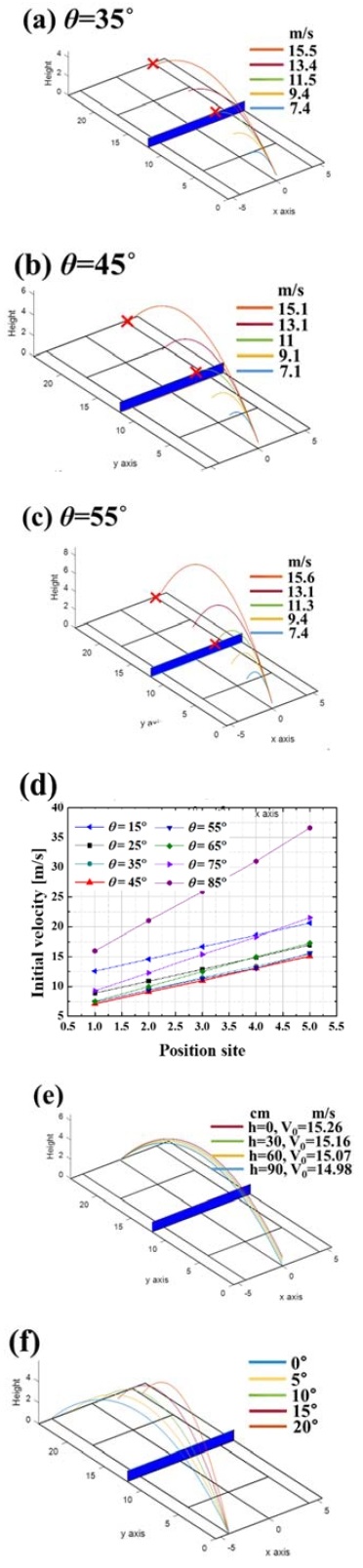
Trajectories of tennis ball with various velocity in which shot at an angle of (a) 35°, (b) 45°, and (c) 55°, (d) initial velocity with position site, (e) at various heights, (f) at various angles at left corner of end line
3.2. 3D Acceleration and Gyro Sensor
Figure 3 shows the measured accelerometer values for the 3-axes (X-axis, Y-axis, and Z-axis) when the player performs swing motion with this sensor. The height difference and direction of the pick depends on the speed and direction of the swing. These waveforms can be divided into a ready stage, backswing stage, a swing stage, and recovery stage. By analyzing the height and direction of the graph, swing speed, the forehand or backhand, and stroke or volley can be analyzed. Each graph in Figure 3, the picks show repeatedly low and high because of slow and fast of swing speed. Firstly, the swing speed can be calculated by analyzing the acceleration difference at the hitting point. In Figure 3(a), ZS,F2 and ZS,F3 of az are the points that swing starts and ends, respectively. If the acceleration difference between these two points are also obtained in ax and ay, the acceleration for the 3-axes can be calculated by using the following equation
| (4) |
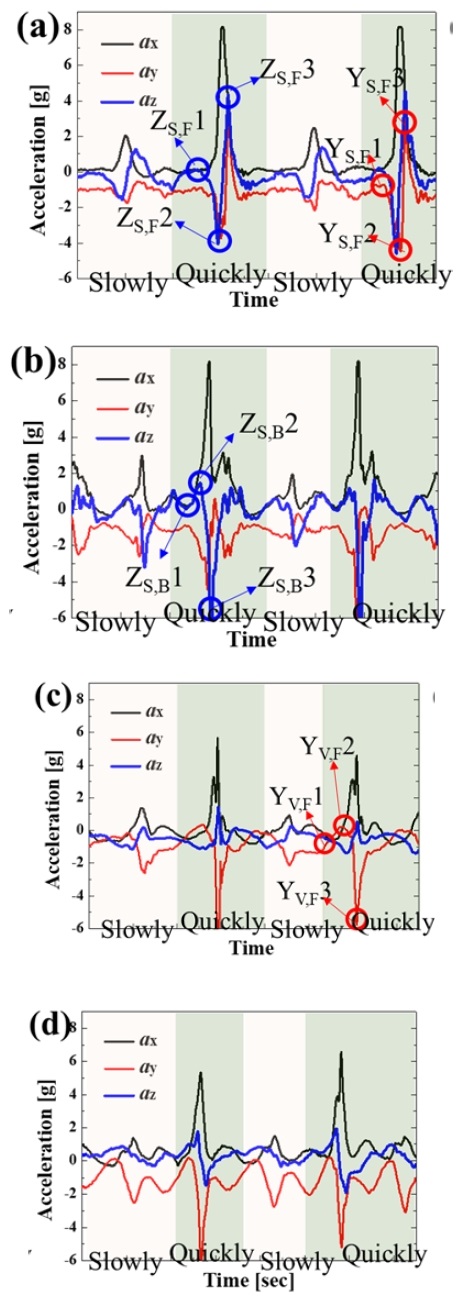
Accelerometer value of the 3-axes (a) forehand stroke, (b) backhand stroke, (c) forehand volley, and (d) backhand volley
The swing speed can be obtained by multiplying this acceleration value and the time gap between ZS,F2 and ZS,F3. Secondly, the forehand and the backhand are distinguished by the accelerometer value of az, due to the evident direction difference in Figure 3 (a) and (b). Before ZS,F1 stage, all acceleration value for the 3-axes maintain constant state. Between ZS,F1 and ZS,F2 stage means back swing stage and az value for Z-axis change to negative direction. Finally, az value reach minimum peak, which means finishing back swing of forehand stoke. In ZS,F21 and ZS,F3 stage, az value significantly move to upward and reach maximum value. az value has a positive direction because this stage is forward swing of forehand stroke. The swing speed reaches the maximum at ZS,F3 stage. After then, acceleration decreases and becomes stable state because of swing finishing after ZS,F3. Because the movement of player stops temporarily after the swing, all values for the 3-axes are approaching to the ready stage. Figure 3 (b) shows the backhand stroke, and since the swing direction is reversed, it can be seen that the direction of the value is also reversed. As a result, ZS,B2 and ZS,B3 is towards in opposite direction compared to ZS,F2 and ZS,F3. Finally, swing types such as stroke and volley can be categorized by analyzing accelerometer value. Since the swing trajectory, which is up and down movement, of volley is different from the stroke, Y-axis value show a distinctive feature compared to other axes. When the ay value is in the ready stage, it remains stable state and changes in the positive direction during the backswing (YV,F2). In the forward swing, the value reaches the lowest value (YV,F3), and then returns to the stable state as the ready stage. In the contrast, Since the stroke is different in the movement of the racket, the direction of the value is formed in the opposite direction as in YS,F2 and YS,F3.
The way of holding a tennis racket can be divided into three types: Eastern grip, Western grip, and Semi-Western grip. The way the racket is held is one of the most important factors in a tennis game, as it affects racket control, the power of striking the ball, and the spin of the ball [4][5]. Figure 4 shows the acceleration in the z-axis and the rotation in the x-axis according to the three grips.
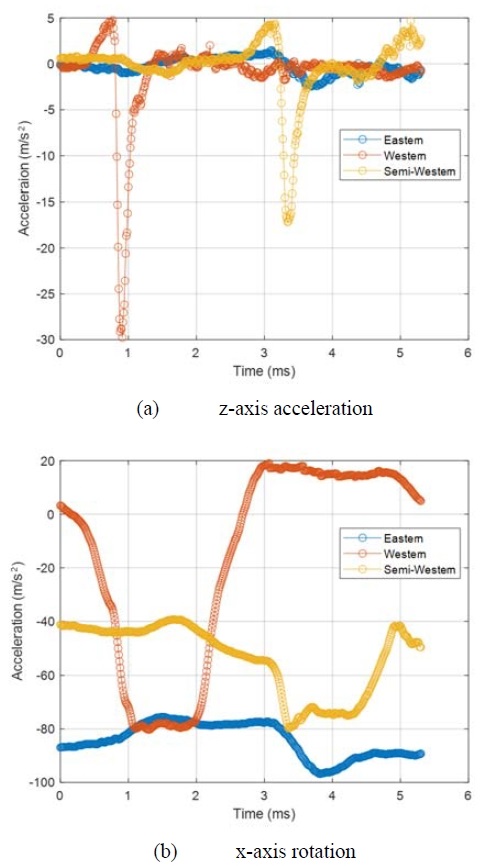
Stroke characteristics for 3 kinds of grips (Eastern, Western and Semi-Western grip)
In Figure 4(a), the Eastern grip was swung slowly, the Western grip was swung fast, and the Semi-Western grip was swung at a medium speed. When observing the acceleration in the z-axis direction, it can be seen that the peak value of the Western grip is the highest, followed by the Semi-Western and then the Eastern grip, in decreasing order. The negative peak value indicates that the forehand stroke moves in the direction opposite to the z-axis.
In Figure 4(b), it can be seen that the Eastern grip is positioned vertically to the ground, while the Western grip is positioned horizontally. The Semi-Western grip shows an intermediate angle between the Eastern and Western grips. During the back swing, the angle relative to the ground decreases, and as the motion proceeds to the forehand swing, the angle increases. The moment when the angle reaches the largest negative value indicates that the finishing motion is being performed.
Figure 5 shows the sensor’s results that the ball was hit on the tennis court. The power of hitting the ball was adjusted differently so that the ball reached the net line, service line, and base line as shown in Figure 5(a). This test was conducted that player tossing and hitting the ball by himself at end of the baseline. The acceleration sensor always has a gravitational acceleration value, but this test was conducted by omitting the gravitational acceleration value acting on the sensor using the estimation filter provided by the sensor software. Figure 5(b and c), Figure 5(d and e), and Figure 5(f and g) show the acceleration value and rotation degree of the sensor when the ball is hit to fall off net line, service line, and base line, respectively. Those results include stay state, foreswing state, ball impact, follow swing and end stroke. The backswing state was skipped because it was swung in place as shown Figure 6. As the swing starts and ends, the acceleration of the racket tends to increase and decrease in one direction, and the rapid changing of the graph indicate the moment the ball hits the racket. The red dash line shows the moment the ball is impacted. Impact starts when the ball hits the racket and ends when the ball leaves the racket. During the impact, the tennis racket loses momentum and the acceleration is decreased rapidly in the moving direction by the ball, and acceleration is recovered its moving direction from the moment the ball leaves the racket. The trend of the graph is similar regardless of the distance the ball travels, but the acceleration value is large because the ball is hit with a greater force when it drops further. The changing of acceleration value in X-axis is the largest, and on the X-axis, an acceleration value of 20 m/s2 and 70 m/s2 was measured approximately when the ball is hit the weakest and strongest. Since the swing motion is similar regardless of the distance, there is no significant difference in the amount of rotation of the sensor. However, it can be seen that a lot of rotation occurs in the sensor before and after the ball is hit.

(a) Drawing of the three travel distance of the ball. Acceleration value and rotation degree from the sensor for 3-axes to (b and c) net line, (d and e) service line, and (f and g) base line
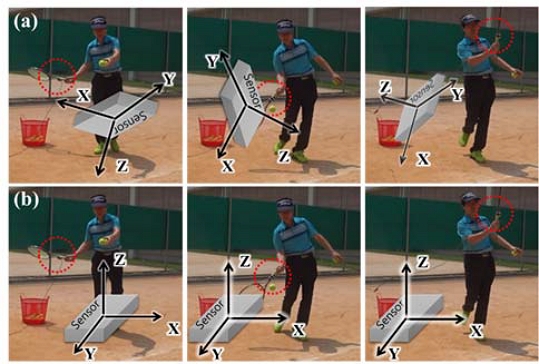
(a)Real and (b)after calculated movement of the sensor in swing
The sensor, which attached to the racket rotates with the swing of the racket, and the coordinate system of the sensor rotates with the rotation of the racket as shown in Figure 6(a). The sensor provides an acceleration value for the coordinate system of the sensor itself, and it is difficult to determine the amount of acceleration change for each axis because the coordinate system changes in real time when swinging and the acceleration value for the axis changes. Since the sensor provides an acceleration value for the coordinate system of the sensor itself, an acceleration value according to the coordinate system changing in real time is obtained when swinging. For this reason, it is difficult to determine the amount of acceleration change in absolute coordinate system. The acceleration value in Figure 5 is the result of the coordinate system changing in real time. Therefore, in order to grasp a quantity of change in acceleration for each axis in the absolute coordinate system, the acceleration value was calculated using Equations (5)-(8). The new acceleration value in absolute coordinate system as shown in Figure 6(b) were calculated using the Roll, Pitch, and Yaw value, which is obtained in Figure 5.
| (5) |
| (6) |
| (7) |
| (8) |
Figure 7 shows the calculated acceleration value from the rotation of the sensor and calculated swing velocity based on the previous acceleration value. In Figure 7(a, c, and e), it can be seen that the ball is hit near ti = 0.5 s, and the change in acceleration about the Y-axis shows the largest value because the rotation of the sensor is a calculated result. Here, the Y-axis direction is the direction of hitting the ball to forward, and the Z-axis is the direction of hitting the ball to upward. The instantaneous changing in the acceleration value means the impact moment as in Figure 5. Figure 7(b, d, and f) shows the calculated velocity for each axis. The speed was calculated by integrating the acceleration result to compare with the velocity that obtained through simulation, and Equation (9) was used for integration calculation. Simpson's rule was used as the integral method, where i = 0, 1, 2,… , n-1, n is the number of samples of x, x-1 is the first element of the initial condition, xn is the first element of the final condition. Table 2 shows the calculated speed of each case.
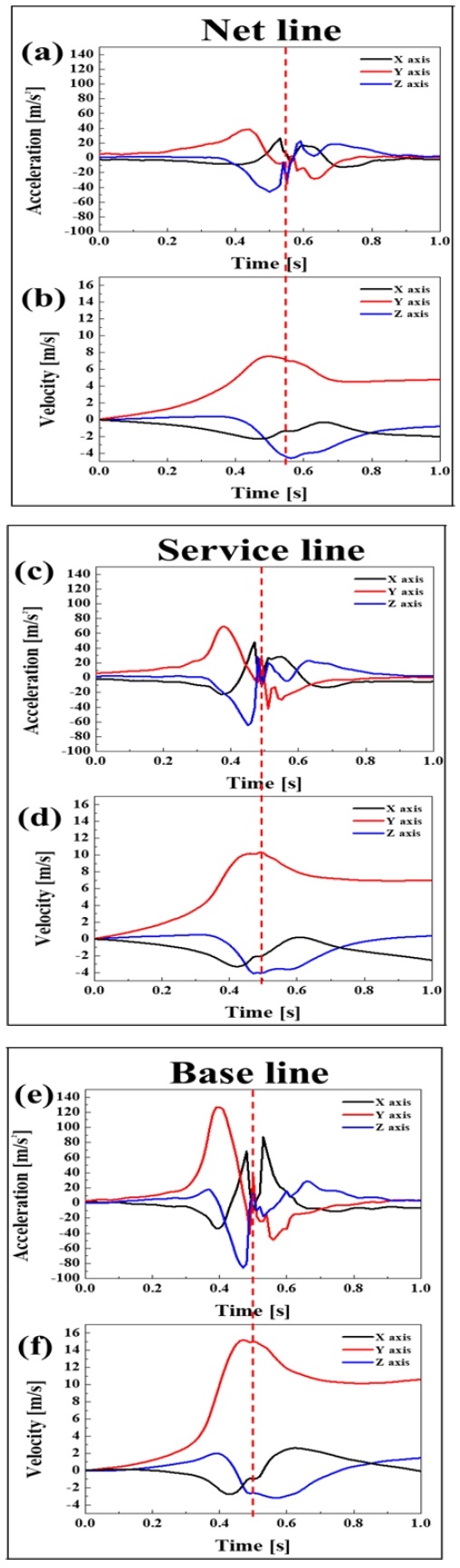
Calculated acceleration value and integrated velocity of sensor for 3-axes to (a and b) net line, (c and d) service line, and (e and f) base line
| (9) |
Calculated velocity of 3 cases
As a result of velocity calculation, the velocity of the swing increased as the ball was sent farther away, and the velocity value were calculated to 8.42, 11.12, and 15.14 m/s for each case. Compared to the simulation-based speed, the results of the two calculations were not exactly the same, but showed a similar tendency. And given that there are several assumption, these results are reliable.
4. Conclusion
In this study, we applied the sensor to tennis to classify the type of swing, calculate the speed and angle, and analyze the ideal angle and speed of hitting the ball through computer calculation using MATLAB. The sensor is attached to the racket to analyze the acceleration values for each axis to distinguish between forehand, backhand, stroke and volley. In addition, the speed and angle of the swing are calculated using the acceleration values, and the information is obtained to help analyzing the swing characteristics and taking the ideal swing. The z-axis acceleration and racket rotation angle according to the three types of grips were actually presented, and differences among the grips were identified. Finally, the distance of the ball is calculated from the sensor data and compared with the distance of the ball when it was actually hit. In this study, we tried to help the beginners to make the ideal swing by analyzing the 3-axes acceleration and rotation value of the swing through the sensor.
Acknowledgments
This research was supported by the Korea Institute of Machinery and Materials under Ministry of Science and ICT [KN033E].
Author Contributions
Conceptualization, P. W. Heo.; Methodology, P. W. Heo.; Software, P. W. Heo.; Formal Analysis, P. W. Heo.; Investigation, P. W. Heo.; Resources, P. W. Heo.; Data Curation P. W. Heo.; Writing-Original Draft Preparation, P. W. Heo.; Writing-Review & Editing, P. W. Heo.; Visualization, P. W. Heo.; Supervision, P. W. Heo.; Project Administration, P. W. Heo.; Funding Acquisition, P. W. Heo.
References
-
Y. Hiramoto, M. Al-Sada, and T. Nakajima, “Design and implementation of a virtual reality tennis serve practice system for creative tennis serve practice,” Lecture Notes in Computer Science Including Subseries Lecture Notes in Artificial Intelligence and Lecture Notes in Bioinformatics, pp. 84-102, 2024.
[https://doi.org/10.1007/978-3-031-61047-9_5]

- P. Shiralagi, R. Bhandary, and B. Rajeshwari, “A novel approach to tennis game analysis and emulation using computer vision,” International Conference on Communication and Signal Processing, July 28 - 30, pp. 286-292, 2020.
-
T. He and Q. Luo, “Energy consumption assessment of college tennis players based on Actigraph GT9X accelerometer,” Advances in Intelligent Systems and Computing, pp. 549-555, 2020.
[https://doi.org/10.1007/978-3-030-25629-6_85]
- M. Reid, B. Elliott, and M. Crespe, “Mechanics and learning practices associated with the tennis forehand: A review,” Journal of Sports Science & Medicine, vol. 12, no. 2, pp. 225-231, 2013.
-
D. Knudson and B. Elliott, “Biomechanics of tennis stroke,” Biomedical Engineering Principles in Sports, vol. 1, pp. 153-181, 2004.
[https://doi.org/10.1007/978-1-4419-8887-4_7]
- W. Pei, J. Wang, X. Xu, Z. Wu, and X. Du, “An embedded 6-axis sensor based recognition for tennis stroke,” IEEE International Conference on Consumer Electronics, pp. 55-58, 2017.