
DeRiskbeta: Comparative quantitative risk assessment of fuel oil, LNG, methanol, and hydrogen on a 170 m RoPax ferry

Copyright © The Korean Society of Marine Engineering
This is an Open Access article distributed under the terms of the Creative Commons Attribution Non-Commercial License (http://creativecommons.org/licenses/by-nc/3.0), which permits unrestricted non-commercial use, distribution, and reproduction in any medium, provided the original work is properly cited.
Abstract
To support global decarbonisation, the maritime industry is increasingly adopting alternative fuels such as liquefied natural gas (LNG), methanol, ammonia, and hydrogen. While these fuels offer environmental benefits by reducing emissions, compared to conventional marine fuels they also introduce significant safety hazards. These hazards include higher flammability, explosion potential, and toxicity. This study presents a comparative Quantitative Risk Assessment (QRA) of fuel oil, LNG, methanol, and hydrogen on a 170-metre RoPax ferry, evaluating both individual and societal risks. Using the DeRiskbeta tool, fuel-specific hazards have been assessed and integrated with historical casualty data from non-fuel-related events to derive overall results. The results indicate that hydrogen presents the greatest fuel-specific risk, with a Potential Loss of Life (PLL) approximating 5.4E-03 fatalities per ship-year, primarily due to its high explosion potential. LNG follows, with a PLL approximating 2.1E-03, whereas methanol and fuel oil show a comparatively lower risk of 1.2E-04 and 3.3E-05, respectively. While all fuels meet the IMO’s individual risk acceptance criteria, for hydrogen and LNG, calculating societal risk illustrates the potential for high-fatality events that would not be identified by calculation of individual risk. This study underscores the importance of integrating societal risk into safety evaluations.
Keywords:
Risk assessment, QRA, Alternative fuels, LNG, Methanol, Hydrogen, RoPax, Societal risk1. Introduction
To support global decarbonisation, the maritime industry is increasingly adopting alternative fuels such as liquefied natural gas (LNG), methanol, ammonia, and hydrogen. While these fuels offer environmental benefits by reducing emissions, compared to conventional marine fuels they also introduce significant safety hazards, notably higher flammability, explosion potential, and toxicity.
These hazards are of particular concern for passenger vessels due to the number of persons on board, and recognising that many of these are members of the public with no training specific to the vessel. A single incident involving fire, explosion, or toxic exposure could result in mass casualties, significantly undermining public confidence in these alternative fuels, and adversely impacting regulatory acceptance. Previous studies, including those by Floyd et al. [1] and Davies [2] [3], have shown that the public and regulators exhibit a strong aversion to rare but catastrophic events than to frequent low-fatality events.
Even if individual risk from alternatively fuelled ships can be managed similarly to conventional fuels, a single severe accident could dramatically affect public and regulatory acceptance. Hence, societal risk, capturing public aversion to high-fatality accidents, must be considered alongside individual risk in evaluating alternative fuel safety.
While numerous studies have examined safety risks associated with alternatively fuelled ships through hazard identification studies [4], [5], [6], consequence modelling [7], and calculation of individual risk [8], [9], [10], few have examined societal risk.
To address this gap, this study applies Quantitative Risk Assessment (QRA) using DeRiskbeta [11], to evaluate both individual and societal risks for a 170-metre roll-on/roll-off passenger (RoPax) ferry using four different fuels: fuel oil, LNG, methanol, and hydrogen.
The novelty of this study lies in extending comparative QRA to explicitly include societal risk, whereas previous research has primarily focused on individual risk. In addition, the analysis incorporates the most recent decade of casualty data together with detailed fuel-specific hazard modelling.
The main focus of this paper is to provide a comprehensive comparison of the risk profiles of a RoPax ferry operating on the four fuels noted above. The sub-topics addressed are:
- 1) establishing a baseline risk level for conventional RoPax vessels based on fleet statistics and casualty records from 2014–2023;
- 2) modelling fuel-specific hazards including jet fire, pool fire, flash fire, explosion, and toxicity;
- 3) integrating fuel-specific risks with non-fuel related risks to derive overall risk levels;
- 4) comparing individual and societal risk profiles for different fuels; and
- 5) evaluating potential risk reduction measures for hydrogen-fuelled designs.
2. Safety Level of Conventional RoPax
2.1 World RoPax Fleet
Understanding the safety levels of alternatively fuelled RoPax ships requires a baseline risk based on a conventional vessel. This study examines the global RoPax fleet over 1,000 gross tonnage (GT) from 2014 to 2023 using S&P Sea-Web data [12]. Figure 1 shows the number of the RoPax fleet over 1,000 GT in service between 1 January 2014 and 31 December 2023. Smaller vessels under 1,000 GT were excluded due to their typically shorter voyages and open configurations that are not representative of larger passenger operations. Total exposure over this ten-year period was 18,192 ship-years.
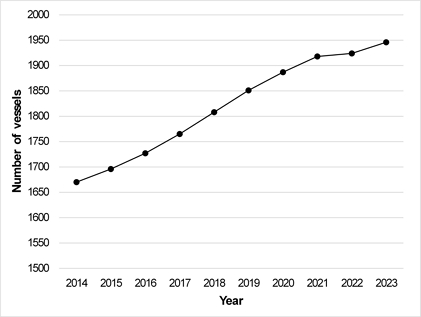
Global RoPax fleet development (2014 – 2023)
2.2 Historical Casualty Data
Table 1 summarises reported casualty data for RoPax vessels over 1,000 GT between 2014 and 2023 [12]. Hull and machinery damage accounted for the largest share of casualties (37.2%), followed by contact (26.6%) and collision (15.2%). Fires and explosions represented 12.0% of all casualties. Some hull and machinery incidents escalated into secondary events such as fire, explosion and foundering. Overall, incident frequency during this period was 6.90E-02 per ship per year (i.e. per ship-year).

Number of incidents and incident frequencies between 2014 and 2023, RoPax (over 1,000 GT)
Table 2 lists 14 fatal incidents during the same period [12] as the casualties listed in Table 1. Notably, Table 2 includes the SEWOL disaster, which resulted in 304 fatalities due to the sinking of the vessel.
Fatal incidents between 2014 and 2023, RoPax (over 1,000 GT)
2.3 Individual Risk
Table 3 provides the historical Potential Loss of Life (PLL) for RoPax operations over the ten-year period (2014-2023). The overall PLL is calculated as 2.13E-02 fatalities per year, indicating a significant improvement from 9.53E-02 fatalities per year reported for the period 1994–2004 [13] [14] [15].
Potential Loss of Life between 2014 and 2023, RoPax (over 1,000 GT)
Assuming a typical RoPax ferry carrying 600 persons on board (550 passengers and 50 crew), indicative Individual Risk (IR) levels can be calculated as follows:
- • Crew (onboard 75% of the year): 2.67E-05 fatality per year
- • Passenger (4-day/year exposure): 3.90E-07 fatality per year
3. Basis of Quantitative Risk Assessment
3.1 Vessel Design
A 170 m RoPax ferry accommodating 550 passengers and 50 crew members was selected as the reference vessel (Figure 3). The main particulars of the vessel are summarised in Table 4. The vessel is equipped with two electric propulsion trains, powered by either six 5,760kW dual-fuel generators for fuel oil, LNG, and methanol or by 154 x 225 kW proton-exchange membrane (PEM) fuel cells for hydrogen.

Profile of a 170 m RoPax
Main particulars
Figure 4 illustrates the general arrangements of the RoPax using fuel oil, LNG, methanol, and hydrogen as fuel. The fuel oil, LNG, and methanol designs incorporate two engine rooms, each housing three generator sets and auxiliaries. The hydrogen fuelled design replaces engine rooms with Fuel Cell Rooms (FCR) each containing 77 fuel cell cabinets.
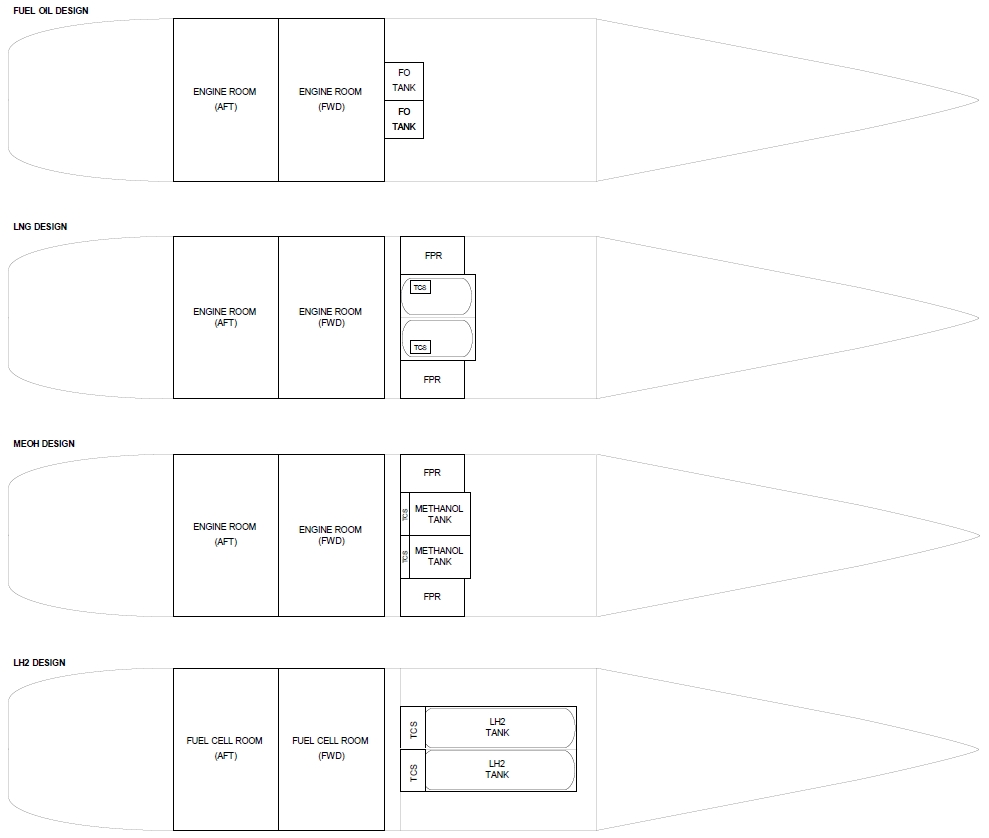
General arrangements of fuel oil, LNG, methanol, and hydrogen fuelled designs (RoPax reference vessel)*FO: Fuel Oil. TCS: Tank Connection Space. FPR: Fuel Preparation Room. MEOH: Methanol. LH2: Liquid Hydrogen
Two dedicated fuel tanks are located forward of the engine rooms (or FCR), sized to offer equivalent energy storage across different fuels (Table 5). Tanks for fuel oil and methanol are integral to the ship’s structure, whereas LNG and hydrogen tanks are independent cylindrical tanks, referred to by IMO as ‘Type C’ tanks.
Comparison of fuel tank capacity
Each fuel tank has its dedicated Tank Connection Space (TCS) and Fuel Preparation Room (FPR), providing fuel to the associated engine room (or FCR). The hydrogen fuelled design only includes TCSs due to its simpler configuration utilising a pressure build-up unit in lieu of fuel pumps. All fuel handling spaces are below deck, ventilated at 30 air changes per hour, and equipped with airlocks. Inerting is not applied.
Schematics for each fuel supply system are illustrated in Figure 5 to Figure 7. Each design incorporates two independent fuel supply systems, one for each engine room, to meet Safe Return to Port (SRtP) requirements [17]. It was assumed that hydrogen fuel cells are housed individually in gastight cabinets (1.2 m × 1.0 m × 2.1 m), each ventilated at 30 air changes per hour.
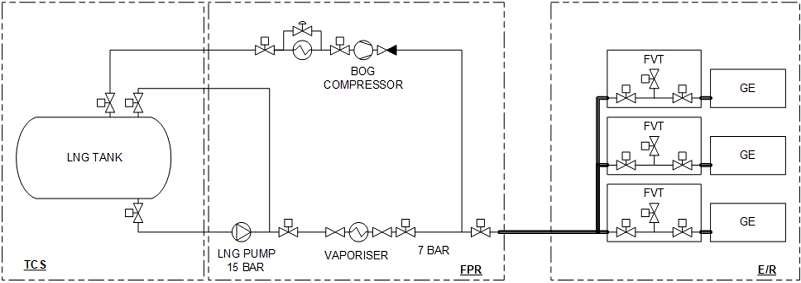
LNG fuel supply system*BOG: Boil-Off Gas. FVT: Fuel Valve Train. GE: Generator Engine. TCS: Tank Connection Space. FPR: Fuel Preparation Room. E/R: Engine Room
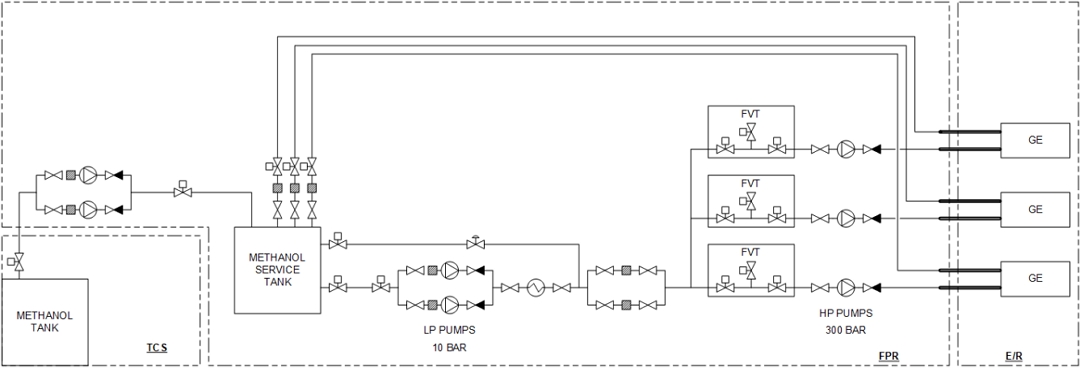
Methanol fuel supply system*LP: Low Pressure. HP: High Pressure. TCS: Tank Connection Space. FPR: Fuel Preparation Room. E/R: Engine Room
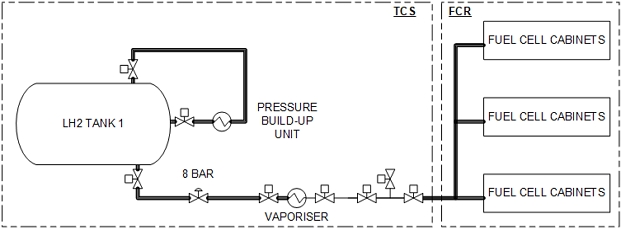
Liquid hydrogen fuel supply system*FCR: Fuel Cell Room. TCS: Tank Connection Space. LH2: Liquid Hydrogen
Bunkering operations and associated equipment are not considered in the study.
3.2 Crew and Passenger Distribution
To determine individual risk, an assumed location and residence time for crew and passengers is required, as shown in Table 6. Table 7 presents the distribution for various operating scenarios assumed for the societal risk calculations. It was assumed that the vessel operates at sea on alternative fuel for 77% of the time, with the remaining 23% spent in port also using alternative fuels. The presented data are indicative and may vary by operator and vessel.
Number of persons onboard, time onboard, and time distribution assumed for individual risk
Distribution of persons assumed for societal risk
3.3 QRA Methodology
The Quantitative Risk Assessment (QRA) was performed using DeRiskbeta [11]. DeRiskbeta is an in-house tool that integrates a generic risk model for non-fuel risks with fuel-specific hazard modelling, together with data on the number and distribution of crew and passengers. This enables the calculation of fuel-specific risk and overall ship risk, expressed in terms of both individual risk (fatalities per year) and societal risk (Potential Loss of Life and FN curves).
The methodology comprises likelihood and consequence analyses as described below.
The following data and models were used to estimate the likelihood of hazardous events associated with alternative fuels.
- • Leak frequency data: IOGP data for 1992–2015 period [18]
- • Ignition probability model: CCPS Level 3 [19] with 0.25 ignition strength for unclassified spaces [20], and MISOF data [21] for classified spaces.
- • Isolation failure: assumed probability of isolation failure, 3.16E-02 [22]; Manual isolation assumed within 30 minutes upon isolation failure [23].
- • Event tree model: Generic event tree encompassing jet fire, pool fire, flash fire, explosion, and toxic exposure scenarios (Table 8).
Event tree model used to estimate fuel risks
The following formulas, models, and threshold values were adopted to estimate the magnitude of fuel releases, associated fires and explosions, and their potential consequences in terms of number of fatalities.
- • Fuel release rate: formulas in Annex B of IEC 60079-10-1 [24].
- • Gas dispersion in open space: GEXCON EFFECTS v12 [25] [26].
- • Gas concentration in enclosed space: equations proposed by Harris [27].
- • Jet fire model: Chamberlain [28] model for gas releases and Cook [29] model for two-phase releases as implemented in GEXCON EFFECTS v12. These are partially validated for hydrogen [30].
- • Pool fire model: Yellow Book model [25] implemented in GEXCON EFFECTS v12.
- • Vapour cloud explosion in open spaces: TNO multi-energy method [31] (Curve 7 for methane/methanol; curve 10 for hydrogen).
- • Confined explosion in enclosed spaces: Bauwens model [32], validated for Hydrogen [33]. Compartments are assumed to withstand up to 0.5 barg overpressure [34]; failure of a compartment triggers escalation to adjacent compartments, which are modelled by TNT equivalency method [35]. The following TNT equivalence factors are assumed: 15% for hydrogen, due to its high reactivity with detonation potential and high degree of confinement, and 5% for other fuels [36].
- · Explosion resulting in foundering: assumed based on explosion severity.
o 0.5 bar overpressure radius ≤ half-length of one engine room (i.e., loss of up to one engine room): no additional fatality is assumed as the vessel is expected to return to port safely in accordance with SOLAS regulations II-1/8-1 and II-2/21 (SRtP) [17].
o 0.5 bar overpressure radius > half-length of one engine room (i.e., loss of more than one engine room): slow sinking is assumed with a 5% fatality rate [37]. Essential systems for evacuation and abandonment are expected to remain operational for at least 3 hours, as required by SOLAS II-2 regulation 22 [17].
o 0.5 bar overpressure radius > the full length of one engine room (i.e., loss of more than two engine rooms): fast sinking is assumed with 80% fatality rate [37]. - • Human vulnerability: Fatality thresholds for explosion overpressure and thermal radiation recommended in IOGP [38].
Further details are available in Moon et al. [11]. It should be acknowledged that secondary events beyond explosion induced foundering may occur; however, these are outside the scope of the current QRA model. Inclusion of these events could increase the overall risk.
3.4 Limitations
The QRA methodology is subject to several uncertainties and limitations. These stem from the lack of operating experience and marine-specific data, uncertainties in the models, and simplifying assumptions. In particular, the current estimation of explosion consequences is based on simplified models that do not account for structural responses or complex geometry. These limitations mean the results should be interpreted as order-of-magnitude estimates for comparative purposes rather than precise risk values.
3.5 Risk Measures
Based on the likelihood and consequence analyses, the risk was calculated and aggregated using the following measures:
- • Individual Risk (IR): a risk experienced by an individual, measured in the chance of fatality per year
- • Societal Risk (SR): risk experienced by a whole group, measured in Potential Loss of Life (PLL) and also illustrated as a FN curve.
3.6 Risk Criteria: Individual Risk
IMO MSC 72/16 [39] defines the following acceptance criteria for individual risk:
- • Maximum tolerable individual risk: 1.00E-03 fatality per year
- • Negligible individual risk: 1.00E-06 fatality per year
Additionally, IMO proposes the following target criteria for new ships:
- • Crew: 1.00E-04 fatality per year
- • Passenger: 1.00E-05 fatality per year.
As noted, in Section 2.3, for RoPax vessels (all operating on fuel oil), the individual risk was 2.67E-05 fatality per year for crew, and 3.90E-07 fatality per year for passengers during the period 2014 to 2023.
3.7 Risk Criteria: Societal Risk
IMO MSC 72/16 [39] suggested a benchmark method to set the societal risk criteria using an average acceptable Potential Loss of Life (PLLA). PLLA is derived from an aggregated indicator (𝑟) observed in the aviation sector and is defined as fatalities per contribution to Gross National Product (GNP). Using this approach, PLLA is calculated as:
| (1) |
- EV Economic Value (EV) of the activity
From recent data noted in Table 9, PLLA is calculated as 7.38E-03 fatalities per ship-year for the reference RoPax vessel.
Values used to establish societal risk criteria for reference RoPax vessel
With the calculated PLLA and adoption of risk aversion factor (b) of 1, as suggested by IMO MSC 72/16, the FN curve intercept at N=1 (F1) can be determined as 1.06E-03 using Equation (2)-(4), which is further rounded down to 1.00E-03.
| (2) |
In Equation (3), setting b=1 yields:
| (3) |
Equation (4) can be rearranged with regard to F1:
| (4) |
- PLLA Average acceptable Potential Loss of Life
- fn Frequency of an accident involving N fatalities.
- N Number of fatalities
- NMax Maximum number of fatalities that may occur
- F1 Acceptable cumulative frequency of an accident involving 1 or more fatalities
- b Risk aversion factor
This results in the following societal risk criteria:
- • Maximum tolerable risk : 10∙F1∙N-1 = 1.00E-2∙N-1 fatalities per ship-year
- • Negligible risk : 0.1 F1 N-1= 1.00E-4∙N-1 fatalities per ship-year
These criteria closely align with those proposed by UK HSE [42].
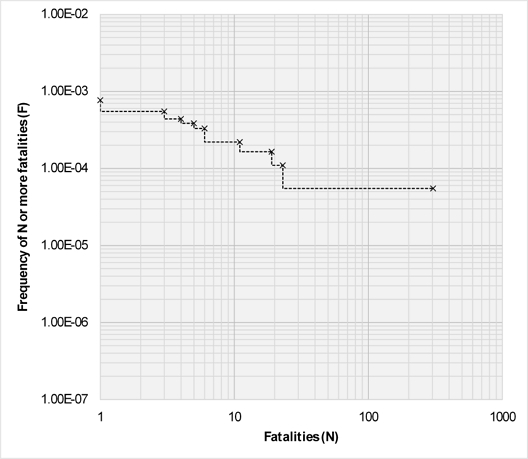
Figure 8 shows the FN curve for RoPax vessels over 1,000 GT from 2014 to 2023, derived in Section 2, overlaid with both original and revised societal risk criteria. While the curve mostly remains within the tolerable region, it exceeds the maximum tolerable limit at fatality levels above 100. This is due to the SEWOL disaster, which caused 304 fatalities and had profound social and political consequences in Korea [43], [44], [45]. It led to regulatory reforms, widespread distrust in authorities, and national demands for accountability.
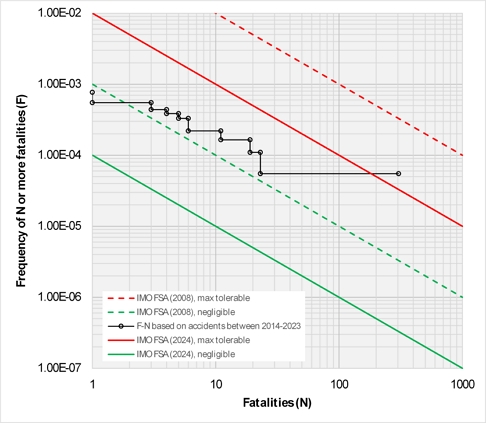
FN curve of RoPax fleet worldwide, over 1,000 GT (2014 – 2023) with societal risk criteria
4. QRA for RoPax using Fuel Oil, LNG, Methanol, and Hydrogen
4.1 QRA Result: Fuel Oil Risk - PLL
The fuel specific Potential Loss of Life (PLL) for fuel oil is shown in Figure 9. Owing to its high flash point, fuel oil does not readily produce flammable vapour under normal conditions, resulting in low ignition probabilities (0.02%–0.03%). Consequently, scenarios involving jet fires, flash fires, or explosions are not anticipated. The dominant risk is thus pool fires, with a total fuel-related PLL of 3.02E-05 fatalities per ship-year.
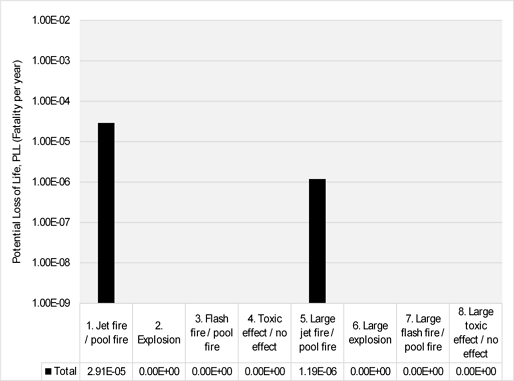
Fuel oil PLL by hazardous event type
To validate the QRA, the estimated PLL for fuel oil was compared with historical records. Between 2014 and 2023, one engine room fire/explosion was reported. Assuming that 60% of machinery-related fire and explosion events are fuel-related [46] [47], the historical PLL is roughly estimated at 3.30E-05 fatalities per ship-year, which closely aligns with the QRA estimate. Despite this similarity, uncertainties remain due to limited data, simplifying assumptions, and inherent model limitations. The results should therefore be interpreted with caution and regarded as an indicative estimate. This fuel oil PLL (baseline) establishes the reference point for evaluating the relative risk increases introduced by alternative fuel systems.
4.2 QRA Result: LNG Risk - PLL
Building upon the fuel oil baseline, the assessment of LNG reveals a markedly different risk profile. The risk profile for LNG is summarised in Figure 10, and compared to fuel oil indicates a significantly greater fuel-specific PLL of 2.06E-03 fatalities per ship-year. The primary risk contributors are explosions, flash fires, and jet fires.

LNG – PLL by hazardous event type
As the vessel design locates fuel handling compartments below the main deck, LNG explosions could compromise hull integrity, potentially causing flooding and foundering of the vessel. Explosion scenarios thus dominate, with a PLL of 1.97E-03 fatalities per ship-year (i.e. explosions and large explosions shown in Figure 10.
4.3 QRA Result: Methanol Risk - PLL
The QRA results for methanol are presented in Figure 11, indicating a total fuel related PLL of 1.17E-04 fatalities per ship-year. This is substantially less than LNG but is still a notable increase over fuel oil. Methanol, unlike LNG or hydrogen, has a high boiling point and remains in the liquid phase after release, forming a pool. Although vapour is generated through pool evaporation, its emission rate is much lower than that of LNG or hydrogen, which tend to flash immediately upon release. The use of drip trays further reduces methanol vapour release by limiting the surface area of the pool. As a result, gas concentrations rarely reached flammable or toxic thresholds, and pool fire is identified as the primary hazard associated with methanol. Nonetheless, under certain extreme conditions, methanol vapour may form a flammable atmosphere, potentially resulting in an explosion. The methanol results demonstrate that fuel physical properties significantly influence risk profiles, with liquid fuels generally presenting lower risk than gaseous fuels.
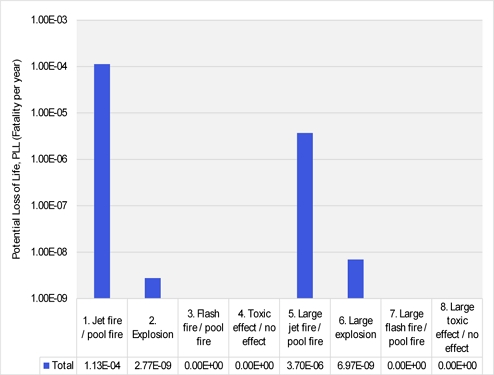
Methanol – PLL by hazardous event type
4.4 QRA Result: Hydrogen Risk - PLL
Figure 12 illustrates that hydrogen presents the ‘highest’ fuel-specific PLL with 5.41E-03 fatalities per ship-year. This is because of hydrogen’s inherent high reactivity, significantly increasing ignition probability and explosion potential under delayed-ignition scenarios.
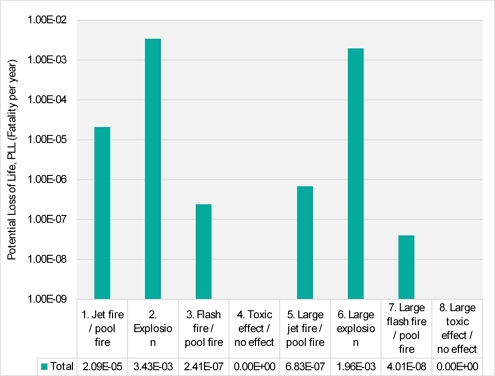
Hydrogen – PLL by hazardous event type
Hydrogen’s distinctively low minimum ignition energy (0.02 mJ), wide flammability range (4%–75%), and rapid combustion velocity (2.37 m/s) results in extensive explosion zones. These are significantly amplified when equipment items containing hydrogen are located within enclosed spaces. Whilst hydrogen's low density and high diffusion coefficient favour rapid dilution in open environments, where its buoyant properties allow it to disperse quickly into the atmosphere, enclosed spaces present markedly different challenges. Consequently, hydrogen explosions below deck dominate the risk profile, highlighting a crucial area for risk management.
The hydrogen results underscore the fundamental challenge of managing highly reactive fuels in marine environments; where the combination of confined spaces and potential ignition sources create particularly hazardous conditions.
4.5 Comparison of PLL by fuel type
Figure 13 summarises the PLL for fuel oil, LNG, methanol, and hydrogen.
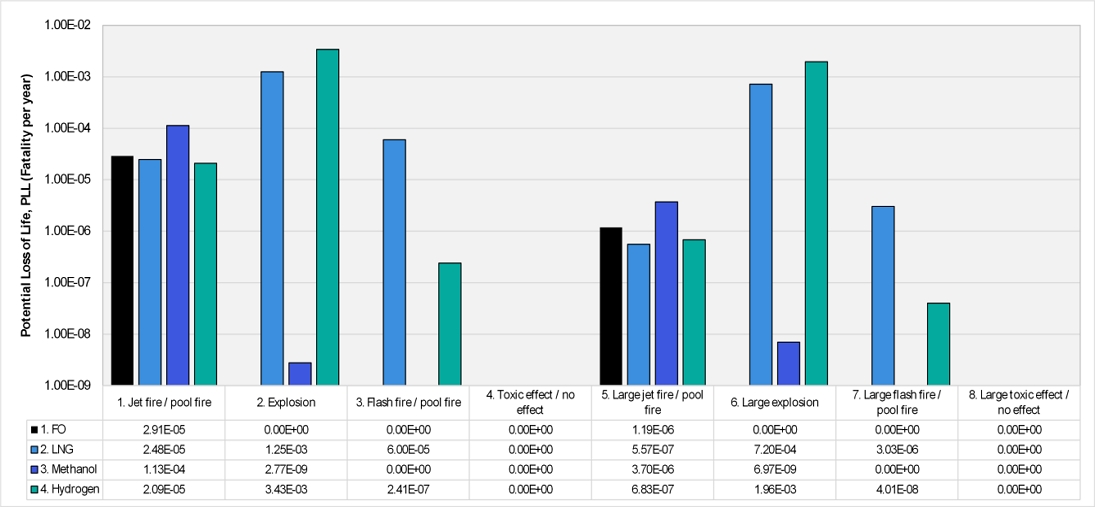
Comparison of PLL by fuel and event type
Hydrogen demonstrates the ‘highest’ fuel-specific PLL of 5.41E-03 fatalities per ship-year. This elevated risk is due to hydrogen’s high reactivity, resulting in a relatively greater probability of ignition and subsequent explosion. LNG follows with a PLL of 2.06E-03, also driven by explosion scenarios. Methanol shows limited explosion and flash fire risks but still exhibits a notable pool fire risk, resulting in a PLL of 1.17E-04 fatalities per ship-year.
Figure 14 presents a comparative overview of fuel-related risks by event category and can be used to help prioritise risk mitigation. It is evident that explosion hazards show the ‘highest’ PLL; therefore, preventing explosion is a key priority in the design of a RoPax utilising LNG or hydrogen as fuel.
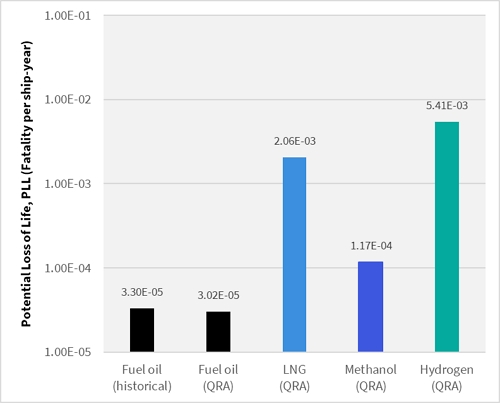
Comparison of PLL by fuel type
4.6 Overall PLL - Fuel Oil, LNG, Methanol, and Hydrogen
The overall PLL for each fuel, integrating fuel-specific and historical non-fuel risks, is summarised in Table 10. To avoid double-counting of fuel risks, the fuel oil risk presented in Section 4.1 was excluded when calculating the overall risk for RoPax vessels using LNG, methanol, and hydrogen.
PLL - 170 m RoPax using fuel oil, LNG, Methanol, and Hydrogen
The methanol fuelled design exhibits a comparable overall PLL (2.14E-02 fatalities per ship-year) to that of fuel oil (2.13E-02), with only a marginal increase of 8.40E-05 fatalities per ship-year. The LNG fuelled design shows a greater increase in overall PLL (2.33E-02 fatalities per ship-year) with LNG contributing almost 9% of the calculated PLL (2.06E-03 fatalities per ship-year). In contrast, the hydrogen fuelled design significantly elevates the overall PLL (2.67E-02) with hydrogen explosions contributing 20.3% of the total.
4.7 Individual Risks
Individual risks are calculated using onboard time distributions given in Table 6 with the results presented in Figure 15.
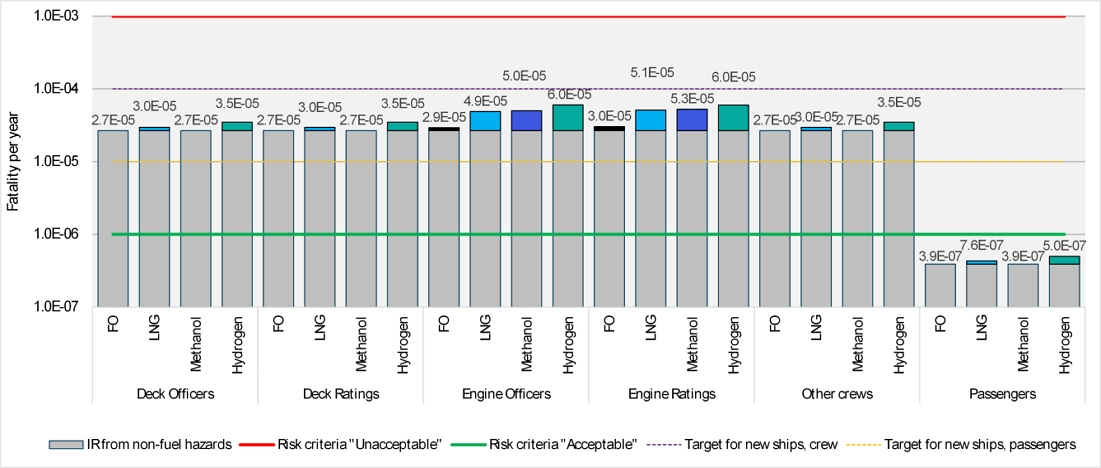
Comparison of Individual Risk by crew category and fuel type
Compared to fuel oil, the use of alternative fuels introduces additional risks to both crew and passengers. In particular, the individual risks for Engine Officers and Engine Ratings - who routinely access compartments containing fuel handling equipment - experience notable increases in individual risk. For example, the individual risks for an Engine Officer are:
- • Fuel Oil design: 2.9E-05 fatalities per year
- • LNG fuelled design: 4.9E-05 fatalities per year
- • Methanol fuelled design: 5.0E-05 fatalities per year
- • Hydrogen fuelled design: 6.0E-05 fatalities per year
Despite these increases, all individual risks for crew remain below the maximum IMO target thresholds and passenger individual risks remain negligible (<1.0E-06 fatalities per year based on an assumed passenger exposure of four days/year).
4.8 Societal Risks
Figure 16 presents fuel-specific risks as FN curves. The FN curves for fuel oil and methanol show negligible potential for high-fatality events. In contrast, those of LNG and hydrogen reveal clear potential for high-fatality events. According to the International Code of Safety for Ship Using Gases or Other Low-flashpoint Fuels (IGF Code) [48], the safety level of an alternative fuel system should be equivalent (that is, similar) to that of fuel oil systems. However, Figure 16 illustrates that both LNG and hydrogen pose considerably greater risks. Particularly, the hydrogen fuel system shows the greatest frequency of high fatality scenarios, highlighting the need for risk-reduction measures targeted at hydrogen’s unique hazards.
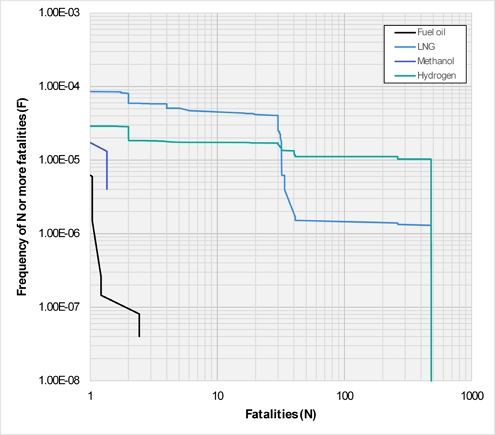
Comparison of Societal Risk by fuel type (attributable to fuel hazards only)
Figure 17 illustrates the overall risk FN curves, incorporating both fuel-related and non-fuel hazards. While all FN curves surpass the maximum tolerable criterion at the point of 304 fatalities (attributable to the SEWOL ferry disaster), this particular event stems from non-fuel-related factors such as compromised stability and insufficient emergency response. As such, it should not be attributed to fuel system design but rather addressed through improvements in ship stability, operational procedures, and emergency responses. Figure 18 additionally presents FN curves without the SEWOL disaster to help interpret its influence on the overall risk distribution.
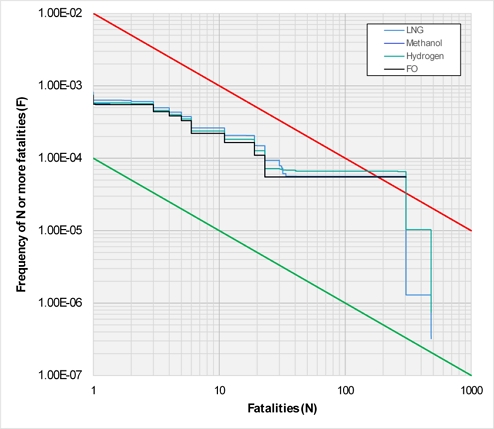
Comparison of societal risk by fuel type (attributable to fuel and non-fuel hazards)
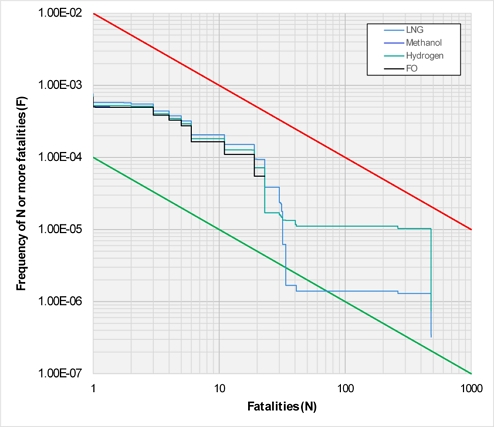
Comparison of societal risk by fuel type, excluding SEWOL disaster
Nevertheless, hydrogen introduces a distinctly elevated societal risk in the high-fatality range (approximately 20–300 fatalities), largely due to its explosion potential and the associated risk of foundering due to explosion. This could raise concerns about societal acceptability of hydrogen as fuel. Therefore, these risks should be addressed in the design and minimised (an example of this is given in Section 4.10).
4.9 Sensitivity study on QRA results
As noted in Section 3.4, QRA results are subject to significant uncertainties, particularly with limited operating experience. To manage these uncertainties, the study adopted conservative parameters and approaches wherever possible. Especially, assumptions used to estimate the consequences associated with hydrogen involve considerable conservatism. To test the sensitivity of the QRA results on hydrogen fuelled RoPax to key parameters, sensitivity analysis has been performed. The results of the sensitivity study can be found in Table 11.
Sensitivity analysis results
4.10 Potential Risk Reduction Measures for the Hydrogen Fuelled RoPax
The QRA identified significant risks associated with explosions and subsequent foundering events for the hydrogen fuelled RoPax design. Furthermore, Section 4.3 (“Limitation of explosion consequences”) of the IGF Code stipulates that an explosion in any space containing any potential source of release and ignition shall not damage the ship in such a way that flooding of water below the main deck occurs. As the RoPax design places fuel handling compartments below the main deck, certain explosion scenarios have the potential to cause hull breaches, resulting in flooding and vessel foundering.
To reduce these risks and achieve a safety level comparable to conventional fuels, two potential risk reduction measures, also known as risk control options (RCOs), were evaluated using the DeRiskbeta tool.
RCO 1 – atmosphere control in the TCS (to minimise ignition potential)
- • TCS atmospheres are inerted (i.e. nitrogen-enriched), maintaining oxygen levels below 4.6% [49].
- • Oxygen concentration is continuously monitored. Alarms and automated safety actions (fuel shutdown and ventilation extraction) activate before oxygen levels reach 4.6%.
- • The oxygen monitoring and safety system is designed to Safety Integrity Level (SIL) 2, with a Probability of Failure on Demand (PFD) of 3.16E-03 [22].
- • Access to TCS areas is strictly controlled; therefore, the risk of asphyxiation due to inerting has not been considered.
RCO 2 – Explosion-Proof Equipment in FCR (to minimise ignition potential)
- • FCR spaces are classified as hazardous zones, with appropriate explosion-proof equipment installed throughout. Reduction of the ignition strength of FCR from 0.25 to 0.01 is assumed.
As shown in Table 12, both RCOs achieve notable risk reductions compared to the baseline hydrogen fuelled design.
PLL – with and without Risk Control Options
Assuming approximate implementation costs of USD 250,000 for RCO1 and RCO2, respectively, and considering a typical vessel lifespan of 30 years, the Gross Cost of Averting a Fatality (GCAF) is estimated at USD 2.1 million for RCO 1, USD 6.4 million for RCO 2, and 3.2 million for the combined measures (RCO 1&2), as summarised in Table 13.
GCAF by implementing RCO1 and RCO1&2
Given that IMO recommends a CAF threshold of USD 8.7 million [50], the adoption of these risk control measures could be considered justified. However, it is important to acknowledge that these calculations rely upon broad and indicative assumptions. In practice, detailed project-specific assessments considering precise cost data, vessel-specific operational profiles, and engineering feasibility must be conducted prior to deciding upon implementation.
The societal risk improvements resulting from implementing the RCOs are illustrated in Figure 19 (overall) and Figure 20 (fuel-specific). Although the overall FN curves exceed the maximum tolerable criterion owing to the SEWOL disaster, both RCO 1 and the combined RCO 1 + RCO 2 configurations demonstrate clear risk-reduction benefits in the high-fatality range, as seen in Figure 20.
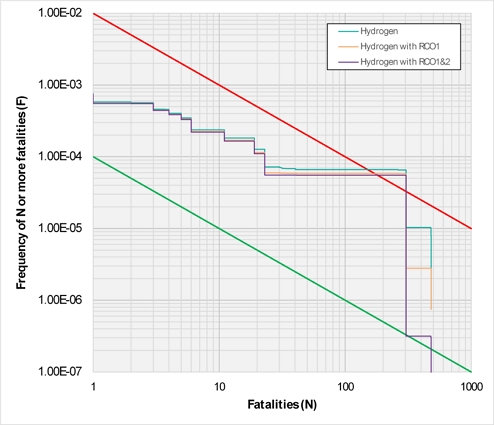
Comparison of overall societal risk: hydrogen base-case design (fuel and non-fuel), and hydrogen design with RCO1, and RCO1 and 2
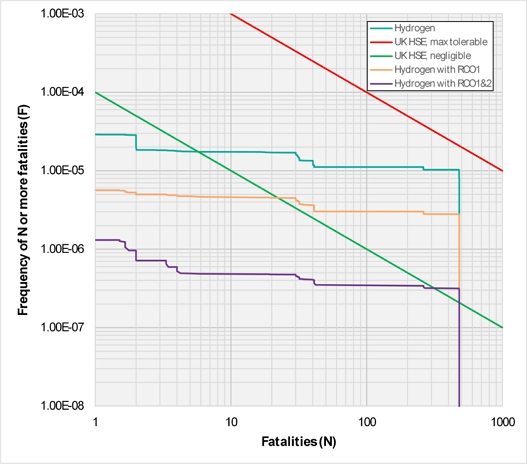
Comparison of fuel-specific societal risk - hydrogen base-case design, and hydrogen design with RCO1, and RCO1 and 2
5. Conclusion
This paper describes a comparative QRA study of fuel oil, LNG, methanol, and hydrogen for a 170 m RoPax ferry, evaluating both individual and societal risks. The assessment integrated fuel-specific hazard modelling using the DeRiskbeta tool with historical casualty data from non-fuel events. This provided comprehensive insight and means to evaluate risk across the fuel options.
The results show that, although all fuel options satisfy the IMO’s individual risk acceptance criteria, the introduction of alternative fuels can significantly increase the overall risk. In particular, the hydrogen-fuelled design exhibits the greatest fuel-specific risk and, therefore, the highest overall risk. Compared to fuel oil, LNG also presents an elevated societal risk, whereas methanol exhibits a relatively low fuel-specific risk which is comparable to fuel oil.
The results also highlight the importance of calculating societal risk. For hydrogen and LNG, calculating societal risk reveals the potential for high-fatality events that could cause societal and regulatory concerns that would not be identified by calculation of individual risk.
As an example, to address the risks associated with hydrogen, two potential risk mitigation measures were evaluated: inerting of the tank connection space; and, classification of the fuel cell room as a hazardous area with explosion-proof equipment. Both options significantly reduced risk, and assuming IMO’s approach to cost-benefit analysis, were calculated to be cost-effective. These examinations also demonstrate how QRA can be applied as a practical tool to support the evaluation of mitigation options and to inform the development of alternative fuel regulations.
The findings from this study indicate that alternative fuels, particularly hydrogen, cannot be regarded as providing an equivalent safety level to conventional fuel oil when societal risk is considered. To ensure the safe and socially acceptable adoption of alternative fuels, societal risk should be incorporated within regulatory frameworks and, in particular, in the development of alternative fuel regulations, so that high-fatality events are effectively prevented.
Acknowledgments
The authors have no acknowledgements to declare.
Author Contributions
Conceptualization, P. Davies and K. T. Moon; Methodology, K. T. Moon; Software, K. T. Moon; Formal Analysis, K. T. Moon; Investigation, K. T. Moon; Data Curation K. T. Moon; Writing-Original Draft Preparation, K. T. Moon; Writing-Review & Editing, P. Davies and L. Wright; Visualization, K. T. Moon; Supervision, P. Davies and L. Wright; Project Administration, P. Davies and K. T. Moon; Funding Acquisition, P. Davies.
References
- P. Floyd and D. Ball, “Societal Risk Criteria - Possible Futures,” in Foresight and Precaution, Rotterdam, 2000, pp. 183-190.
- P. Davies, “Risk: A Growing Aversion,” in The Chemical Engineer, Institution of Chemical Engineers, 2009, pp. 19-21.
- P. Davies, “Societal Risk - Societal Risk in High Hazard Industries,” Lloyd’s Register EMEA, London, 2011.
-
H. Etemad and J. -H. Choi, “Hazard identification (HAZID) of LNG dual-fueled ships operating between the Korean port of busan and the iranian port of Bandar Abbas,” Journal of the Korean Society of Marine Engineering, vol. 41, no. 5, pp. 473-488, 2017.
[https://doi.org/10.5916/jkosme.2017.41.5.473]

-
H. Etemad and J. -H. Choi, “Fire, explosion and safety hazard identification (HAZID) of the entire methanol dual fueled system and ship,” Journal of the Korean Society of Marine Engineering, vol. 41, no. 10, pp. 992-1005, 2017.
[https://doi.org/10.5916/jkosme.2017.41.10.992]
-
E. Y. Park, Y. K. Seo, S. J. Han, and M. I. Cho, “Hazard identification of ammonia FSS for ammonia fuelled ammonia carrier,” Journal of Ocean Engineering and Technology, vol. 38, no. 6, pp. 402-413, 2024.
[https://doi.org/10.26748/KSOE.2024.078]
-
B. Jeong, B. S. Lee, and P. Zhou, “Quantitative risk assessment of fuel preparation room having high-pressure fuel gas supply system for LNG-fuelled ship,” Ocean Engineering, vol. 137, pp. 450-468, 2017.
[https://doi.org/10.1016/j.oceaneng.2017.04.002]
-
A. Franks, S. Parkar, and C. R. Hansen, “Use of quantitative risk assessment to enhance the safety of ships using ammonia as fuel,” Journal of Safety and Sustainability, vol. 1, no. 3, pp. 127-140, 2024.
[https://doi.org/10.1016/j.jsasus.2024.09.004]
-
F. Aarskog, O. Hansen, T. Strømgren, and Ø. Ulleberg, “Concept risk assessment of a hydrogen driven high speed passenger ferry,” International Journal of Hydrogen Energy, vol. 45, no. 2, pp. 1359-1372, 2020.
[https://doi.org/10.1016/j.ijhydene.2019.05.128]
-
R. Abubakirov, M. Yang, G. E. Scarponi, V. C. Moreno, and G. Reniers, “Towards risk-informed design and operation of ammonia-powered ships: critical aspects and prospective solutions,” Ocean Engineering, vol. 314, no. 2, 119753, 2024.
[https://doi.org/10.1016/j.oceaneng.2024.119753]
-
K. -T. Moon, P. Davies, L. Wright, and S.-J. Choi, “DeRiskbeta: Comparative Quantitative Risk Assessment (QRA) of fuel oil, LNG, methanol, and ammonia on a 15,000 TEU containership,” Journal of Advanced Marine Engineering and Technology, vol. 49, no. 1, pp. 42-61, 2025.
[https://doi.org/10.5916/jamet.2025.49.1.42]
- S&P Global, Sea-web, S&P Global, [Online]. Available: https://maritime.ihs.com/, . [Accessed 28 5 2025].
-
D. Konovessis and D. Vassalos, “Risk Evaluation for RoPax Vessels,” Proceedings of the Institution of Mechanical Engineers, Part M: Journal of Engineering for the Maritime Environment, vol. 222, no. 1, pp. 13-26, 2008.
[https://doi.org/10.1243/14750902JEME90]
- International Maritime Organization, MSC 85/17/2, FSA – RoPax Ships, International Maritime Organization, 2008.
- International Maritime Organization, MSC 85/INF.3, FSA – RoPax Ships, Details of the Formal Safety Assessment, International Maritime Organization, 2008.
- F. R. Farmer, “Siting Criteria – A New Approach,” in Containment and siting of nuclear power plants, Vienna, 1967.
- International Maritime Organization (IMO), International Convention for the Safety of Life at Sea (SOLAS), International Maritime Organization, London, 2024.
- International Association of Oil & Gas Producers, Risk Assessment Data Directory - Process Release Frequencies, International Association of Oil & Gas Producers, 2019.
- Center for Chemical Process Safety, Guidelines for Determining the Probability of Ignition of a Released Flammable Mass, New Jersey: John Wiley & Sons, Inc., 2014.
-
M. Moosemiller, “Development of algorithms for predicting ignition probabilities and explosion frequencies,” Journal of Loss Prevention in the Process Industries, vol. 24, no. 3, pp. 259-265, 2011.
[https://doi.org/10.1016/j.jlp.2011.01.012]
- Lloyd's Register Consulting, Modelling of Ignition Sources on Offshore Oil and Gas Facilities - MISOF(2), Lloyd's Register Consulting, 2018.
- International Association of Oil & Gas Producers, “Risk Assessment Data Directory - Guide to finding and using reliability data for QRA,” International Association of Oil & Gas Producers, 2019.
- National Institute of Public Health and the Environment, CPR 18E - Guidelines for quantitative risk assessment, National Institute of Public Health and the Environment, 2005.
- International Electrotechnical Commission, IEC 60079-10-1 Explosive Atmospheres – Part 10-1: Classification of Areas, Geneva: International Electrotechnical Commission, 2020.
- Netherlands Organisation for Applied Scientific Research, Methods for the Calculation of Physical Effects Due to Releases of Hazardous Materials (liquids and gases), Committee for the Prevention of Disasters, 2005.
- A. Mack, Dispersion Model in EFFECTS v12, Gexcon, 2025.
- R. Harris, The Investigation and Control of Gas Explosions in Buildings and Heating Plant, New York: British Gas Corporation, 1983.
- G. Chamberlain, “Developments in design methods for predicting thermal radiation from flares,” Chemical Engineering Research and Design, vol. 65, no. 4, pp. 299-309, 1987.
-
J. Cook, Z. Bahrami, and R. J. Whitehouse, “A comprehensive program for calculation of flame radiation levels,” Journal of Loss Prevention in the Process Industries, vol. 3, no. 1, pp. 150-155, 1990.
[https://doi.org/10.1016/0950-4230(90)85039-C]
- R. V. Haaften, Validation Report - Jet Fire Model, Gexcon, 2025.
-
A. van den Berg, “The Multi-Energy Method - A framework for vapour cloud explosion blast prediction,” Journal of Hazardous Materials, vol. 12, no. 1, pp. 1-10, 1985.
[https://doi.org/10.1016/0304-3894(85)80022-4]
-
C. Bauwens and S. Dorofeev, “CFD modeling and consequence analysis of an accidental hydrogen release in a large scale facility,” International Journal of Hydrogen Energy, vol. 39, no. 35, pp. 20447-20454, 2014.
[https://doi.org/10.1016/j.ijhydene.2014.04.142]
-
M. C. Devin, B. D. Ehrhart and E. S. Hecht, “Validation of HyRAM+ Version 5.1 Physics Models,” Sandia National Laboratories, 2024.
[https://doi.org/10.2172/2480221]
- The Norwegian Directorate for Civil Protection (DSB), Guidelines for Quantitative Risk Analysis of Facilities Handling Hazardous Substances, The Norwegian Directorate for Civil Protection, TØNSBERG, 2021.
- W. Baker, P. Cox, J. Kulesz, R. Strehlow and P. Westine, Explosion Hazards and Evaluation, Elsevier Scientific Pub, Amsterdam, 1983.
- Factory Mutual Insurance Company, Guidelines for Evaluating the Effects of Vapor Cloud Explosions Using a TNT Equivalency Method, FM Global, 2008.
-
A. Papanikolaou, R. Hamann, B. S. Lee, C. Mains, O. Olufsen, D. Vassalos and G. Zaraphonitis, “GOALDS—Goal Based Damage Ship Stability and Safety Standards,” Accident Analysis and Prevention, vol. 60, pp. 353-365, 2013.
[https://doi.org/10.1016/j.aap.2013.04.006]
- International Association of Oil & Gas Producers, Risk Assessment Data Directory - Vulnerability of Humans, International Association of Oil & Gas Producers, 2010.
- International Maritime Organization, MSC 72/16, Decision Parameters Including Risk Acceptance Criteria, International Maritime Organization, 2000.
- International Air Transport Association, IATA Annual Safety Report - 2024, International Air Transport Association, 2025.
- International Air Transport Association, Global Outlook for Air Transport, International Air Transport Association, 2024.
- Health & Safety Executive, Reducing Risks, Protecting People - HSE’s Decision-Making Process, Crown, Norwich, 2001.
-
H. -O. Park, “The politics of time: the sewŏl ferry disaster and the disaster of democracy,” The Journal of Asian Studies, vol. 81, no. 1, pp. 131-144, 2022.
[https://doi.org/10.1017/S0021911821001492]
-
J. Jin and G. Song, “Bureaucratic accountability and disaster response: Why did the Korea coast guard fail in its rescue mission during the Sewol ferry accident?,” Risk, Hazards & Crisis in Public Policy, vol. 8, no. 3, pp. 220-243, 2017.
[https://doi.org/10.1002/rhc3.12115]
-
S. Lim, J. Moon, and Y. Oh, “Policing reform in the South Korean maritime police after the Sewol ferry disaster,” Public Administration and Development, vol. 36, no. 2, pp. 144-156, 2016.
[https://doi.org/10.1002/pad.1757]
- O. V. Nilsen, “FSA for Cruise Ships – Subproject 4.1. Task 4.1.1 – Hazid identification,” SAFEDOR, 2005.
- A. Charchalis and S. Czyz, “Analysis of fire hazard and safety requirements of a sea vessel engine rooms,” Journal of KONES Powertrain and Transport, vol. 18, no. 2, pp. 49-56, 2011.
- International Maritime Organization (IMO), International Code of Safety for Ships Using Gases or Other Low-Flashpoint Fuels (IGF Code), International Maritime Organization, London, 2016.
-
I. A. Zlochower and G. M. Green, “The limiting oxygen concentration and flammability limits of gases and gas mixtures,” Journal of Loss Prevention in the Process Industries, vol. 22, no. 4, pp. 499-505, 2009.
[https://doi.org/10.1016/j.jlp.2009.03.006]
- International Maritime Organization (IMO), Formal Safety Assessment - Updating threshold for IMO cost benefit assessment, IMO, 2024.