
Vibration analysis of FRP ship for eco-friendly design by considering resonance

Copyright © The Korean Society of Marine Engineering
This is an Open Access article distributed under the terms of the Creative Commons Attribution Non-Commercial License (http://creativecommons.org/licenses/by-nc/3.0), which permits unrestricted non-commercial use, distribution, and reproduction in any medium, provided the original work is properly cited.
Abstract
This study analyzes the natural vibration characteristics of a 19-ton fiber-reinforced plastic (FRP) pilot boat to investigate resonance risks between the hull structure and excitation frequencies induced by the main engine and propeller. Finite element analysis (FEA) was conducted using MSC Patran–Nastran to evaluate both hull-girder and deck modes under lightship and full-load conditions. The FRP material properties were defined based on previous studies, and hydrodynamic mass effects were included in the modeling. The natural frequencies were compared with the excitation frequencies derived from the propulsion system. Results show that the hull-girder modes fall within safe frequency ranges, while deck modes—especially the bottom plate—exhibited critical resonance risks, indicating complete frequency coincidence with excitation forces. The findings emphasize that many small FRP vessels may be inherently vulnerable to excessive vibrations due to resonance. The outcomes provide fundamental reference data for vibration mitigation strategies at the design stage of small FRP vessels, with implications for the development of next-generation eco-friendly ships.
Keywords:
Hydrogen ship, FRP vessels, Vibration analysis, Natural frequency, Resonance, Finite element method1. Introduction
According to statistics released by the Ministry of Oceans and Fisheries in July 2024, the number of registered fishing vessels in Korea reached 64,233 in 2023, with 62,220 (96.87%) constructed from fiber-reinforced plastic (FRP). Despite ongoing efforts to promote the use of eco-friendly materials such as high-density polyethylene (HDPE), FRP vessels remain dominant due to their superior cost competitiveness.
Small FRP fishing vessels are typically designed and built without considering vibration and noise reduction. Furthermore, most owners are unwilling to incur additional costs for such improvements. However, excessive vibration and noise cause crew fatigue, reduce work efficiency, and, in the long term, lead to musculoskeletal disorders and hearing loss. Structurally, they accelerate fatigue failure of the hull, increase wear and clearance of components, and ultimately shorten service life, resulting in economic losses. Despite these risks, studies addressing vibration and noise in small FRP vessels remain limited.
In order to analyze the vibration characteristics of small fishing vessels, a study was conducted on the causes and effects of vibration and noise, their threshold limits, and possible mitigation strategies from the perspective of engine-induced vibrations. Experimental investigations on FRP (Fiber-Reinforced Plastic) fishing vessels confirmed that in the low-speed operating range of the engine, vibrations of both the rotating machinery and the hull exceeded the allowable vibration limits [1][2]. A study evaluating the onboard working environment through vibration and noise measurements in coastal small vessels demonstrated that the main deck vibration of a 25-ton vessel reached 1406.3 mm/s², which is more than three times higher than the ISO 2631:1997(E)-Comfort vibration limit of 315 mm/s² [3]. In research that measured and analyzed the engine room vibrations of five small FRP fishing vessels under 20 tons, vibration measurements at the fore and aft parts of the main engine showed values ranging from 3–70 mm/s at the fore section and 2–62 mm/s at the aft section. These results significantly exceeded the DNV-GL vibration limit of 15 mm/s and further revealed the existence of resonance points between the hull and the main engine [4]. In line with policies promoting the development of eco-friendly small fishing vessels, an analytical study on the natural vibration characteristics of three small aluminum fishing vessels found that numerous resonance frequencies were present between the excitation forces of the main engine and propeller and the hull deck [5].
In this study, a natural vibration analysis was conducted on a 19-ton FRP pilot boat currently in service. The analysis evaluated both hull-girder and local deck modes, and the results were compared with excitation frequencies generated by the main engine and propeller. This approach provides a detailed understanding of vibration characteristics and enables the assessment of resonance risks in small FRP vessels.
While previous studies have primarily focused on small aluminum vessels or on hull-girder modes, the present study offers several novel contributions. First, a detailed deck-level resonance analysis was performed, covering the bottom plate, upper deck, and deckhouse top, which allows for the identification of specific regions susceptible to resonance. Second, the hydrodynamic added mass effect was incorporated using MFLUID, improving the accuracy of natural frequency predictions under realistic operating conditions. Third, this study focuses on eco-friendly FRP vessels, which are increasingly used in the development of hydrogen-powered leisure boats, providing relevant baseline data for next-generation vessel design.
Recently, vibration and resonance issues have become even more critical in hydrogen-electric propulsion vessels, where the propulsion system includes electric motors, gearboxes, and high-speed hydrogen fuel cells. Unlike conventional diesel engines, electric motors generate continuous electromagnetic torque fluctuations at specific harmonic frequencies that may coincide with the natural modes of the hull structure, thereby increasing the likelihood of resonance [6–7]. In particular, lightweight composite structures used in eco-friendly designs tend to have lower structural damping, further amplifying the vibration response.
Overall, the findings of this study provide valuable design-stage insights for mitigating vibrations in small FRP vessels. By combining numerical analysis with detailed deck-level evaluation and consideration of hydrodynamic effects, this work contributes both to the scientific understanding of vessel vibrations and to practical applications in the development of eco-friendly small vessels.
2. Methodology
2.1 Principal Dimensions of the Pilot Boat
The principal dimensions of the 19-ton pilot boat are given in Table 1. Specifications of the main engine and propeller are listed in Tables 2 and 3.

Principal dimensions of 19 ton pilot boat
Main engine spec. of 19 ton pilot boat
Propeller spec. of 19 ton pilot boat
The mechanical properties of FRP materials used in a 19-ton pilot boat may vary depending on the type of fibers, stacking sequence, and other manufacturing parameters, and can only be accurately determined through experimental testing. In this study, the material properties of the FRP used in the 19-ton pilot boat were defined as summarized in Table 4, based on previous research on collision analysis of fishing vessels [8]. Since small FRP vessels generally adopt similar materials and stacking methods, it was assumed that the material properties would be comparable. The actual fiber orientations and detailed laminate configurations were not considered; instead, representative values for E-glass fibers in a vinyl ester resin matrix were applied. While this simplification does not capture anisotropic effects due to fiber direction, it allows a preliminary evaluation of the natural frequencies and resonance behavior of the vessel.
Material properties of small FRP boat
The adopted properties were carefully applied within the finite element models, together with appropriate boundary conditions and hydrodynamic added mass effects, to ensure reasonable accuracy in the numerical predictions. It should be noted that the FRP material properties used in this study do not account for fiber orientation or detailed laminate structure, which introduces some uncertainties in the predicted natural frequencies and resonance risks. Despite this limitation, the analysis provides valuable baseline data for preliminary vibration assessment of small FRP vessels. Future studies will incorporate detailed laminate modeling and experimental validation, including modal testing and sea-trial measurements, to refine the numerical predictions and improve the reliability of vibration assessments.
2.2 Finite Element Modeling
For the natural frequency analysis, MSC Patran-Nastran 2022, a commercial FEA package widely used for structural and vibration analysis in naval architecture and ocean engineering applications, was employed. A full-ship finite element model was developed, as illustrated in Figure 1, to evaluate both the global hull-girder vibration modes and the local natural frequencies of individual decks.
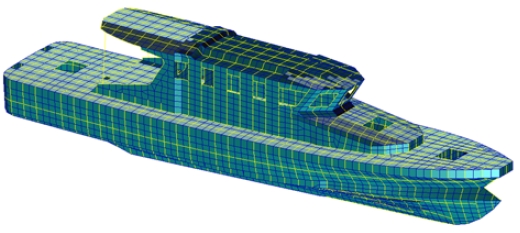
Finite element model of 19 ton pilot boat
The numbers of elements and nodes used in the finite element model for the vibration analysis were summarized for each analysis condition, as presented in Table 5.
Number of elements and nodes in FE model
In the full-load condition, additional weights not included in the lightship condition—such as the fuel oil tank, bilge tank, stores and equipment, and the weight of ten crew members—were considered. Although this results in a 22% increase in total mass compared with the lightship condition, the number of finite elements and nodes remains nearly unchanged. This is because the added weight was applied as non-structural 0D point masses or distributed along existing structural elements without altering the mesh topology. Therefore, the slight change in the number of elements reflects only minor local adjustments to accommodate the additional point masses, rather than a significant remeshing of the hull structure.
In the finite element model, plate-like components of the hull were represented using 2D shell elements, primary and secondary structural members as well as brackets were modeled using 1D beam elements, and heavy components such as equipment and cargo were represented using 0D point mass elements. The mesh size was determined based on the spacing of longitudinal members in accordance with standard practices for ship structural analysis [9].
To account for the weight of outfitting items not explicitly modeled in the finite element analysis, such as piping, cable trays, and equipment, non-structural masses were distributed along the hull based on the longitudinal center of gravity of the 19-ton pilot boat. The total non-structural mass was 1.25 tons, corresponding to approximately 6.5% of the lightship weight, and was applied to 0D point mass elements at locations representing the actual distribution of equipment and fittings. This approach ensures that the additional mass contribution is accurately reflected in the global and local vibration characteristics of the vessel. The actual weight and longitudinal center of gravity of the 19-ton pilot boat were referenced from the vessel’s stability calculation report. The weight and longitudinal center of gravity of the 19-ton pilot boat are summarized in Table 6. To account for the hydrodynamic added mass of seawater on the hull plating during hull-girder mode analysis, the MSC Nastran MFLUID method was employed. In this approach, the fluid is modeled as a mass-spring system coupled to the structure, providing an approximation of the fluid-structure interaction without fully solving the acoustic field. This coupling allows the finite element model to include the effect of added mass on the natural frequencies while maintaining computational efficiency. It should be noted that MFLUID is primarily applicable to ships at zero forward speed. In this study, the vessel was assumed to be stationary, providing a conservative estimate of the natural frequencies and potential resonance regions. Although added mass may decrease slightly at operational speeds, this simplification ensures that potential resonance risks are not underestimated. Future work will consider speed-dependent hydrodynamic effects through advanced fluid-structure interaction analyses or experimental validation.
Weight & LCG of 19 ton pilot boat
To evaluate the natural frequencies of the hull-girder modes, the full-ship model was analyzed as a free vibration system with six rigid body constraints applied to prevent rigid-body motion, corresponding to three translational and three rotational degrees of freedom. This ensures the stability of the finite element solution while maintaining the model’s free vibration characteristics. For the evaluation of the natural frequencies of individual decks, constraints such as the hull plating and bulkheads were applied as simply supported boundary conditions, as illustrated in Figure 2.

Simply supported boundary conditions applied in the finite element model; (a)decks, (b)hull plating, (c)bulkheads
2.3 Design Target Frequencies
In ship design, analyzing the dominant excitation frequencies of major machinery such as the engine and propeller and preventing resonance with the natural frequencies of primary structural components such as the hull and decks can significantly reduce vibration. Therefore, the natural frequencies of main structures should be separated from dominant excitation frequencies. The range of natural frequencies that the primary structures may possess is defined as the target design frequency range, which corresponds to the Allowable Zone illustrated in Figure 3, while the resonance frequency range is indicated as the Critical Zone. An error margin of 10% was applied to the analysis results. This value is an empirical factor derived from comparisons between modal test results and numerical analyses of large ships and is commonly adopted in practical vibration analysis of large-scale vessels. The reliability of the numerical model was ensured by applying standard FEA procedures, realistic boundary conditions, and validated material properties. Although experimental validation was not performed in this study, future work will include modal testing and sea-trial vibration measurement to verify and refine the numerical predictions.

Allowable zone and critical zone
The Normal Continuous Rating(NCR) and Maximum Continuous Rating(MCR) ranges shown in Figure 3 represent the practical operating regions in which the engine and propeller are most frequently used during vessel operation. The frequencies fNCR and fMCR denote the excitation frequencies corresponding to these practical ranges. In Figure 3, the allowable zone represents the frequency ranges within which structural vibrations are considered safe according to ISO 6954 and DNV-GL guidelines, whereas the critical zone indicates frequencies where resonance or excessive vibration may occur. It should be noted that these target frequency ranges were adapted from guidelines for large ships. While they provide a useful reference, scale effects may result in different allowable and critical frequency ranges for small FRP vessels. Future studies will investigate scale-appropriate corrections and validation for small vessel applications.
The excitation frequencies derived from the main engine and propeller of the 19-ton pilot boat under the Maximum Continuous Rating(MCR) and Normal Continuous Rating(NCR) conditions are summarized in Table 7.
Excitation frequency of 19 ton pilot boat
By applying the excitation frequencies from Table 7 to Figure 4, the resonance and non-resonance regions can be distinguished. Table 8 summarizes the target design frequencies of the 19-ton pilot boat, corresponding to the non-resonance region. These frequencies were determined by considering the excitation frequencies of the main engine and propeller with gear reduction effects.
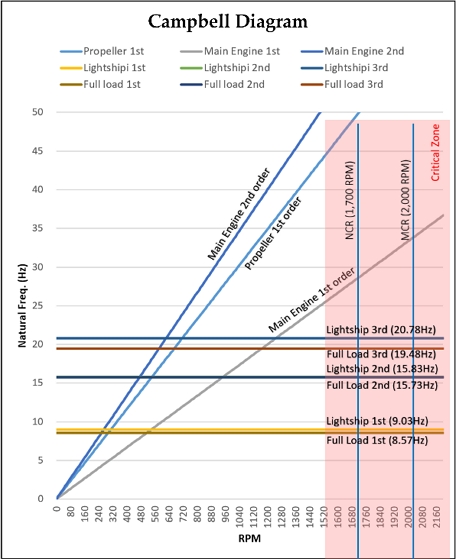
Campbell diagram of hull-girder mode
Design target frequency of 19 ton pilot boat
For the propeller NCR, a 10% margin was applied to account for uncertainties, and the target frequencies were selected between the 10% margin of the main engine MCR and the second mode of the propeller NCR to avoid resonance.
It should be noted that the present study relies solely on finite element analysis (FEA) and does not include experimental validation such as modal testing or sea-trial vibration measurements. While this approach is suitable for a preliminary investigation, the absence of experimental data introduces uncertainties in the predicted natural frequencies and resonance risks. The reliability of the numerical models was ensured by following standard FEA procedures, carefully applying material properties and boundary conditions, and incorporating hydrodynamic added mass effects. Future work will include experimental validation to refine and verify the numerical predictions.
3. Results
3.1 Hull-Girder Natural Frequencies
The hull-girder natural vibration analysis of the 19-ton pilot boat was conducted under two loading conditions: the lightship condition, representing the vessel’s minimum weight, and the full-load condition, representing the maximum weight. The results are presented in Figures 4–5 and Table 9.
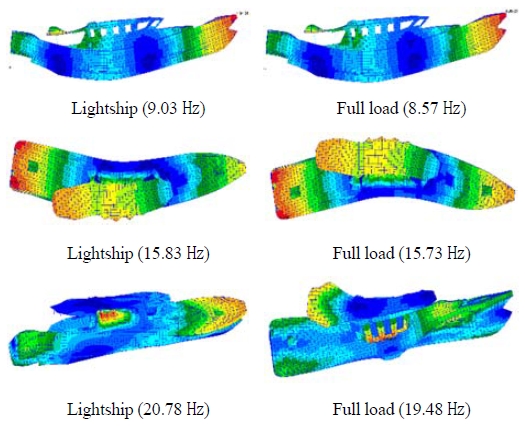
Hull-girder vibration mode of 19 ton pilot boat
Hull-girder natural frequencies of 19 ton pilot boat
The results of the hull-girder mode analysis indicate that the natural frequencies under both lightship and full-load conditions show no significant differences, and all values fall within the design target frequency range. Since the remaining loading conditions lie between the lightship and full-load states, it can be confirmed that the hull-girder modes of the 19-ton pilot boat are free from resonance.
3.2 Deck Natural Frequencies
A local natural vibration analysis was conducted for each deck of the 19-ton pilot boat, and the results are summarized in Table 10 and Figures 6–11.
Deck natural frequencies of 19 ton pilot boat

Bottom vibration mode of 19 ton pilot boat

Campbell diagram of bottom mode
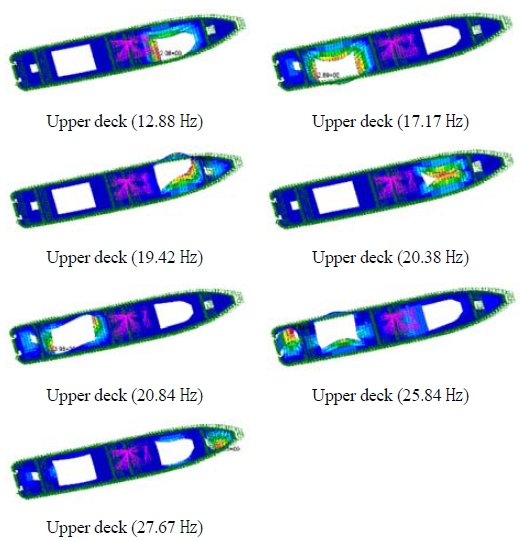
Upper deck vibration mode of 19 ton pilot boat
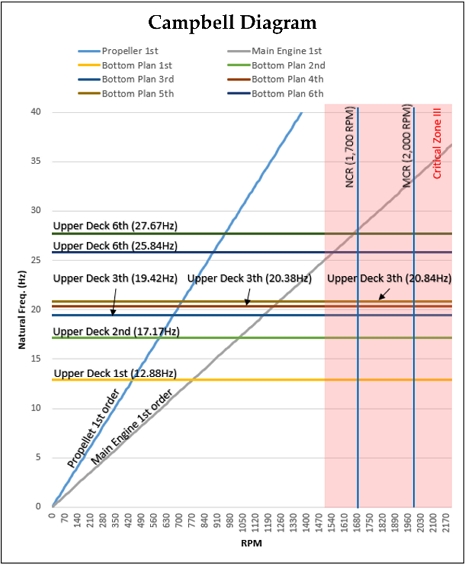
Campbell diagram of upper deck mode
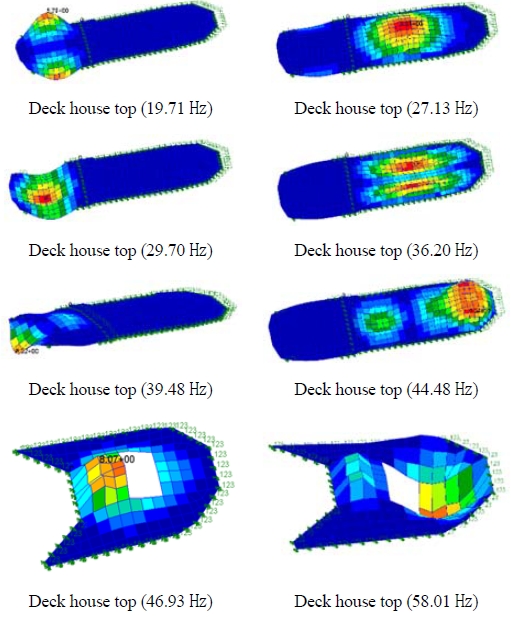
Deck house top vibration mode of 19 ton pilot boat
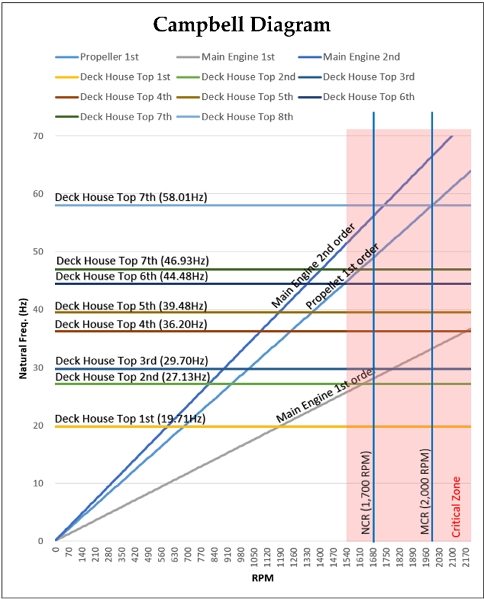
Campbell diagram of deck house top mode
The results of the natural frequency analysis for each deck indicate the possibility of resonance across all decks. In the bottom plate, all regions were identified as susceptible to resonance. On the upper deck, resonance was observed at both the aft and fore ends of the deck. For the deckhouse top, the analysis revealed that none of the regions were free from resonance.
According to the natural frequency analysis results in Table 10, the bottom plate corresponds to the hull plating. Since the hull plating of small FRP fishing vessels is fabricated using molds, vessels of similar tonnage built at the same shipyard generally adopt identical hull plating.
Furthermore, considering that there are relatively few designers specializing in small vessels, and that the shape of the hull plating directly affects hydrodynamic resistance, ship speed, and fuel efficiency—making design changes difficult—it can be inferred that small FRP vessels of similar tonnage generally employ hull plating of similar form.
The natural frequencies of a vessel are influenced by various factors such as hull mass and geometry, and the occurrence of resonance also depends on the interaction with the engine and propeller. Therefore, it cannot be conclusively stated that the hull plating of all small FRP vessels is exposed to resonance risk. However, the finding that the hull plating of the vessel analyzed in this study exhibited a 100% probability of resonance suggests that a significant portion of existing small FRP vessels are subject to excessive hull vibrations. Unless improvements are made to the hull plating design, resolving such resonance issues will remain challenging.
It should be noted that the resonance evaluation in this study was based on the coincidence of natural and excitation frequencies as identified in the Campbell diagrams. This simplified approach provides a conservative estimation of resonance risk for small FRP vessels. However, damping and frequency bandwidth effects were not explicitly considered, which may cause deviations from actual vibration responses. These effects will be addressed in future work through modal testing and vibration response measurements during sea trials to improve predictive accuracy.
4. Conclusion
In this study, the vibration characteristics of a 19-ton FRP pilot boat were investigated through finite element analysis to evaluate the natural frequencies of the hull-girder and deck structures and to compare them with the excitation frequencies generated by the main engine and propeller. The analysis revealed that the hull-girder modes were free from resonance, whereas the bottom plate exhibited complete frequency coincidence with the excitation sources. Partial coincidences were also observed in the upper deck and deckhouse top.
The consistent occurrence of bottom plate resonance, which was also reported in previous studies on small FRP and aluminum vessels, suggests that many small vessels currently in operation may be structurally vulnerable to excessive hull vibrations caused by the interaction between natural and excitation frequencies. This issue is particularly significant because the bottom plate, being directly exposed to hydrodynamic loading, plays a crucial role in resistance, stability, and fuel efficiency. Modifying its structural configuration is technically challenging and economically burdensome for most small vessel owners, emphasizing the need for preventive design measures.
It should be noted that the cross-comparison with previous studies, including those conducted on small aluminum vessels, may be influenced by differences in material stiffness, hull geometry, and propulsion system specifications. For a more consistent evaluation, normalization based on stiffness-to-mass ratio (E/ρ), geometric similarity ratios (L/B and B/D), and engine power density will be considered in future studies. Despite these differences, the consistent occurrence of bottom-plate resonance across various materials and configurations indicates a common structural vulnerability in small vessels, emphasizing the need for vibration control measures in the design stage.
Although the present study was limited to numerical analysis, it provides essential baseline data for predicting vibration behavior in small FRP vessels and for establishing vibration mitigation strategies at the design stage. Future research will include experimental modal testing and sea-trial measurements to validate and refine the analytical models, thereby improving the reliability of vibration prediction for small vessels.
From a design perspective, the findings highlight the necessity of considering vibration characteristics during the early design phase and implementing reinforcement or isolation strategies in bottom plate regions. The application of analytical vibration control methods, similar to those used in large vessels, is expected to enhance the structural integrity and overall performance of small FRP vessels, contributing to safer and more efficient next-generation marine designs.
Acknowledgments
This research was supported by the Ministry of Oceans and Fisheries and the Korea Institute of Marine Science & Technology Promotion (KIMST) under project RS-2022-KS221546.
Author Contributions
Conceptualization, B. Y. Moon; Methodology, Y. C. Kim and D. H. Kim; Software, D. H. Kim; Formal Analysis, B. Y. Moon; Investigation, Y. C. Kim; Resources, S. H. Kim; Data Curation B. Y. Moon; Writing-Original Draft Preparation, D. H. Kim; Writing-Review & Editing, Y. C. Kim; Visualization, Y. C. Kim; Supervision, B. Y. Moon; Project Administration, B. Y. Moon; Funding Acquisition, S. H. Kim.
References
- D. H. Lee, “Vibration analysis of small FRP fishing boats,” Journal of Korea Fishing Vessel Association, vol. 24, pp. 26-34, 1985.
- D. H. Lee, “Investigation of vibration and noise characteristics in fishing vessel engine rooms,” Journal of Korea Fishing Vessel Association, vol. 40, pp. 23-29, 1989.
-
C. D. Koh and S. H. Kim, “Evaluation of environmental conditions on board in terms of noise and vibration in coastal small-sized ships,” Journal of Korean Navigation and Port Research. vol. 27, no. 1, pp. 27-32, 2003.
[https://doi.org/10.5394/KINPR.2003.27.1.015]

-
H. Jang and M. J. Kim, “The diagnosis and evaluation of thermal flow analysis and noise in small fishing vessel,” Journal of Fisheries and Marine Sciences Education. vol. 32, no. 5, pp. 1192-1197, 2020.
[https://doi.org/10.13000/JFMSE.2020.10.32.5.1192]
-
D. H. Kim, H. J. Hong, S. M. Lee, Y. T. Son, and B. Y. Moon, “Characterizing the Natural Frequencies of Three Small Aluminum Fishing Boats,” Journal of the Society of Naval Architects of Korea, vol. 60, no. 5, pp. 388-396, 2023.
[https://doi.org/10.3744/SNAK.2023.60.5.388]
-
D. M. Bae, B. Cao, and T. H. Chen, “Vibration analysis of a DWT 1,000-ton ocean-research vessel with electric propulsion,” Journal of the Korean Society of Fisheries and Ocean Technology, vol. 50 no. 1, pp.75-82, 2014.
[https://doi.org/10.3796/KSFT.2014.50.1.075]
-
J. K. Kambrath, C. Yoon, J. Mathew, X. Liu, Y. Wang, C. J. Gajanayake, A. K. Gupta, and Y. J. Yoon, “Migration of resonance vibration effects in marine propulsion,” IEEE Transactions on Industrial Electronics, vol. 66, no. 8, pp. 6159-6169, 2018.
[https://doi.org/10.1109/TIE.2018.2875658]
- I. S. Jang, Y. S. Kim, and I. D. Kim, “Collision analysis between FRP fishing boats according to various configurations,” Journal of the Korean Society, vol. 9, no. 4, pp. 253-262, 2006.
- Korean Register, Rules for the classification of steel ships, Annex 3-2 guidance for the direct strength assessment, 2021.