
Numerical investigation of the effect of backtension load on round bar drawing process

Copyright © The Korean Society of Marine Engineering
This is an Open Access article distributed under the terms of the Creative Commons Attribution Non-Commercial License (http://creativecommons.org/licenses/by-nc/3.0), which permits unrestricted non-commercial use, distribution, and reproduction in any medium, provided the original work is properly cited.
Abstract
Backtension load is a crucial process variable in bar or wire drawing process. In this study, the effect of backtension load during round bar drawing process was quantitatively investigated using numerical analysis. For two reduction areas of 30% and 40%, various backtension loads were applied to evaluate the drawing load, radius change, average drawing stress, cross-sectional strain distribution, residual stress distribution, and the stress distribution in the drawn bar and the die after the drawing process. The results of numerical analysis indicate that these values are significantly affected by the magnitude of the backtension load. For instance, as the backtension load increases, the drawing load and the average drawing stress also increase. When the backtension load exceeds a critical value, necking occurs due to plastic deformation of the material passing through the die, making the drawing process infeasible.
Keywords:
Bar drawing process, Numerical investigation, Backtension load, Critical backtension, Product quality1. Introduction
Wire/bar or tube drawing is a forming process in which the material is passed through one or multiple dies to manufacture a product with an extended length and a desired cross-sectional shape[1]-[5]. The drawing process induces a relatively high level of deformation on the surface of the material in contact with the die, resulting in excellent quality[6].
In drawing process, various process variables such as reduction area, friction coefficient, drawing speed, semi-die angle, die bearing length, material properties etc. affect the quality of the final drawn product[7]-[11]. Backtension load is also an important process variable that significantly impacts the drawing process. Backtension load is the load applied to the material in the direction opposite to drawing at the die inlet during the drawing process, serving as an essential variable that improve die life and enhances product quality, including surface finish[12][13]. Despiete these advantages, backtension load has its drawbacks. Backtension load increases the overall drawing load, leading to higher energy consumption. Additionally, excessive backtension load can cause plastic deformation in the material after passing through the die, leading to dimensional inaccuracies or even material fracture. Therefore, it is important to set an appropriate backtension load. Several studies have been conducted on backtension load. Camacho et al. evaluated the effects of backtension load on the drawing stress, die stress, and other factors through finite element analysis in a multi-pass wire drawing process[12]. Skolyszewski and Paćko conducted studies on the relationship between critical backtension load and the mechanical properties of the material in multi-pass fine wire drawing, as well as the effects of backtension load on dies wear[13]. Although some studies on backtension load have been conducted, few studies have quantitatively investigated its effect on the quality of drawn products.
In this study, the effects of backtension load on the quality of drawn bar was quantitatively investigated through finite element(FE) analysis during the bar drawing process. To achieve this, a finite element analysis was conducted with various backtension loads applied at two different reduction areas. Through the analysis, the effect of changes in backtension load on drawing load, average drawing stress, effective strain distribution, residual stress distribution, radial dimensional change, contact length between material and die, and effective stress distribution were evaluated.
2. Applied Bar Drawing Process
2.1 Backtension Load and its Application
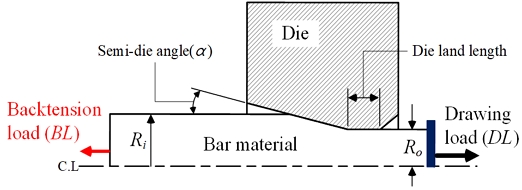
In the bar drawing process, as shown in Figure 1, backtension load is the load applied to the material at the die inlet in the direction opposite to drawing.
Backtension load in round bar drawing process
This study evaluated the effects of changes in backtension load on the bar drawing process. Backtension load was applied as a percentage of the drawing load without backtension. As stated in Table 1, backtension loads from 0% to 250% with a 20% increment were applied for a reduction area of 20%, and from 0% to 160% for a reduction area of 30%.

Applied backtension ratio(%)
2.2 Basic Theory of Bar Drawing
In the drawing process, the cross-sectional area decreases as it passes through the die, and the reduction area(RE) is calculated using Equation (1) as follows.
| (1) |
where, Ri and Ro are the radii of the material at the die inlet and exit, respectively. For industrial applications, the recommended reduction area range for steel bar drawing ranges from 20%a to 40%, depending on the quality of drawn material. In this study, two reduction area of 20% and 30% were applied.
Average drawing stress(DS) is the stress that occurs in the material at the die exit after drawing and is calculated as follows.
| (2) |
where, DL is drawing load at the die exit, and Ae is the cross-sectional area of the drawn material at the die exit.
2.3 Drawing Conditions
The materials for the bar and die are AISI1045 and H-11 tool steel, respectively. The radius of the initial bar is 8.0 mm. After drawing, the radii are 7.155 mm and 6.693 mm for each reduction area of 20% and 30%, respectively. The drawing speed is 0.5 mm/s, and the die land length is 4.8 mm, which is 0.3 times the initial diameter. The semi-die angle is 6.0o, and the friction coefficient between the material and the die is set to 0.073[14]. Table 2 shows the process conditions.
Process conditions of bar drawing process
3. Conditions for FE analysis
3.1 FE analysis Model
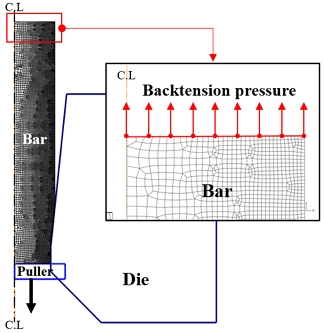
In order to evaluate the effects of backtension load, a FE analysis was conducted using DEFORM 2D (SFTC, Ohio, USA). The initial FE analysis model is shown in Figure 2. The bar material was set as an elastoplastic material, and the die was defined as a rigid body. The initial model contains 8,345 quadrilateral elements and 8,103 nodes, respectively.
Initial FE analysis with backtension load
In this study, as shown in Figure 2, to evaluated the effect of backtension load on the drawing process, a backtension load was applied to the cross-section of the bar using the backtension pressure(BP) calculated by the following equation.
| (3) |
where, BL is backtension load, and Ai is the cross-sectional area of the initial bar.
3.2 Materials Properties
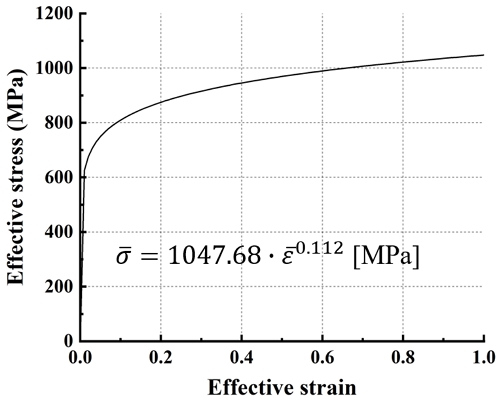
The mechanical properties and flow stress of the material used for the FE analysis was obtained from the previous study using tensile test[14]. The yield stress, ultimate tensile stress, modulus of elasticity and Poisson’s ratio of the bar material are 586.0 MPa, 842.0 MPa, 206.0 GPa and 0.3, respectively.
Figure 3 shows the flow stress curve and the equation derived from the tensile test.
Flow stress curve of AISI1045 [14]
3.3 Drawing Load without Backtension
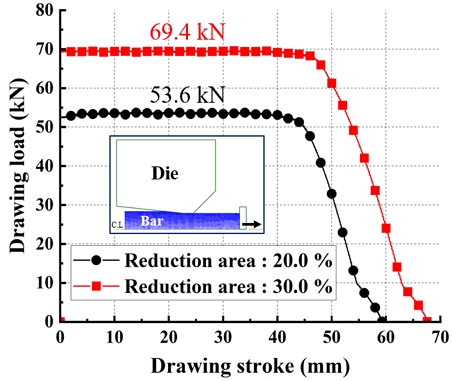
In this study, backtension was applied based on the drawing load without backtension. Therefore, a FE analysis of the drawing process without backtension was first conducted to evaluated the drawing load. Fig. 4 shows the drawing load for two different reduction area without backtension. As shown in Figure 4, at steady state, the drawing loads were 53.6 kN, and 69.4 kN, respectively.
Drawing loads without backtension
4. Result of FE Analysis
4.1 Drawing Load according to Backtension Ratio
Figure 5 and 6 show the drawing load and backtension load according to the backtension ratio for two different reduction areas. The drawing load is the sum of the load required for the bar to pass through the die and the backtension load. Therefore, as shown in these graphs, an increase in backtension load also results in an increase in drawing load. However, it can be seen that when the backtension load exceeds a critical value, plastic deformation occurs in the material passing through the die, leading to necking and making drawing impossible. In this study, the critical backtension ratio for reduction areas of 20% and 30% were found to be 250% and 160%, respectively.

Drawing load and backtension load for the 20% reduction area
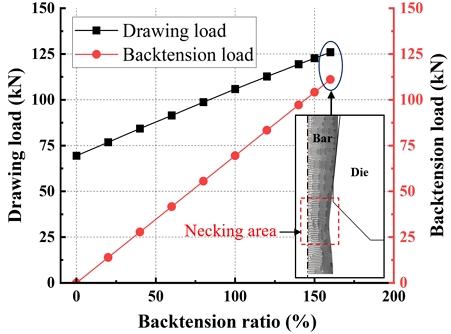
Drawing load and backtension load for the 30% reduction
4.2 Radius variation and drawing stress
Figure 7 illustrates the radius variation of the drawn bar according to the backtension ratio. As shown in Figure 7, the radius was taken as the average of five points on the surface after the drawing was completed. It can be observed that as the backtension ratio increases, the radius of the drawn bar gradually decreases due to the increase in drawing load. The target radii for the two reduction areas(20% and 30%) are 7.155 mm and 6.695 area mm, respectively. It is observed that for a 20% of reduction area, deviations from the target radius start to increase from a backtension ratio of 160, and for a 30% of reduction area, from a backtension ratio of 100%. Finally, it can be seen that at the critical value, the radius decreases sharply due to the occurrence of necking(see Figure 5 and 6).
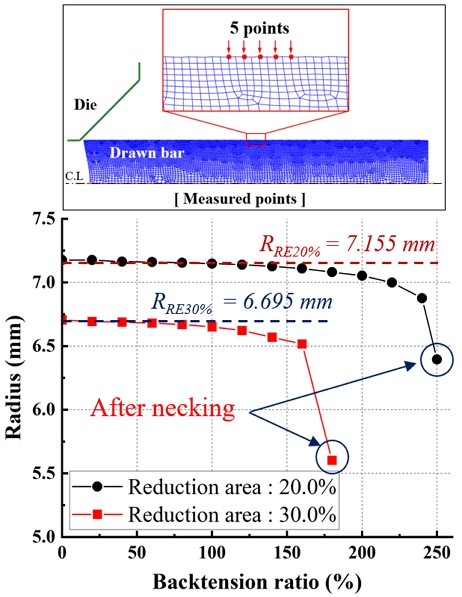
Radius variation with respect to backtension ratio
Figure 8 shows the average drawing stress at the die exit according to the backtension ratio. As the backtension increases, the drawing load also increases, resulting in a rise in average drawing stress. Furthermore, when the backtension ratio exceeds the critical value, the average drawing stress rapidly increases due to a sudden reduction area caused by necking.
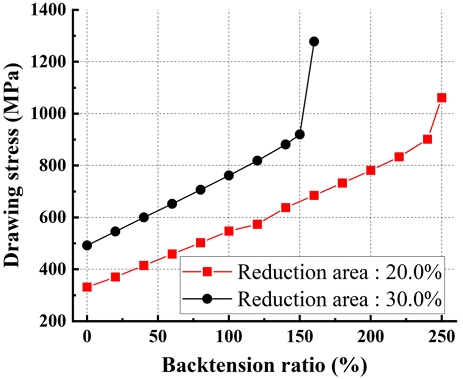
Average drawing stress with respect to backtension ratio
4.3 Die Contact Length
Figure 9 shows the contact length between the material and the die according to the backtension ratio. As shown in Figure 9, an increase in backtension ratio gradually reduces the contact length between the material and the die in the deformation region. Furthermore, the reduction in contact length is expected to decrease the contact pressure on the die surface within the deformation region, which suggests that the wear life of the die will be relatively improved.
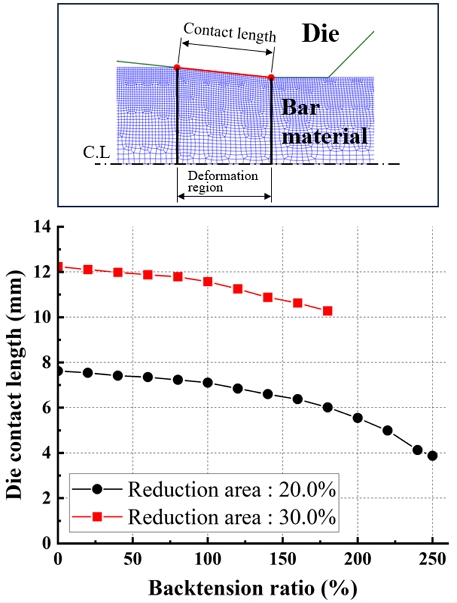
Contact length with respect to backtension ratio
4.4 Distribution of Effective Strain in Drawn Bar
Figure 10 shows the distribution of effective strain from the center to the surface within the drawn bar according to variations in backtension ratio, with a reduction area of 20%. It can be seen that in the drawing process, the effective strain is higher due to the relatively greater deformation in the die contact region. It can be observed that the variation in effective strain differs depending on the value of the backtension ratio. Up to a backtension ratio of 160%, the effective strain in the central region gradually increases with rising backtension ratio due to the increased deformation in the drawing direction. And in the surface region, it can be seen that the effective strain gradually decreases as the backtension ratio increases, due to reduced contact length with the die. At backension ratio above 180%, the effective strain increases in both the central and surface regions, with both regions exhibiting nearly similar values at a backtension ratio of 240%. At a backtension ratio of 250%, the effective strain sharply increases due to the necking.
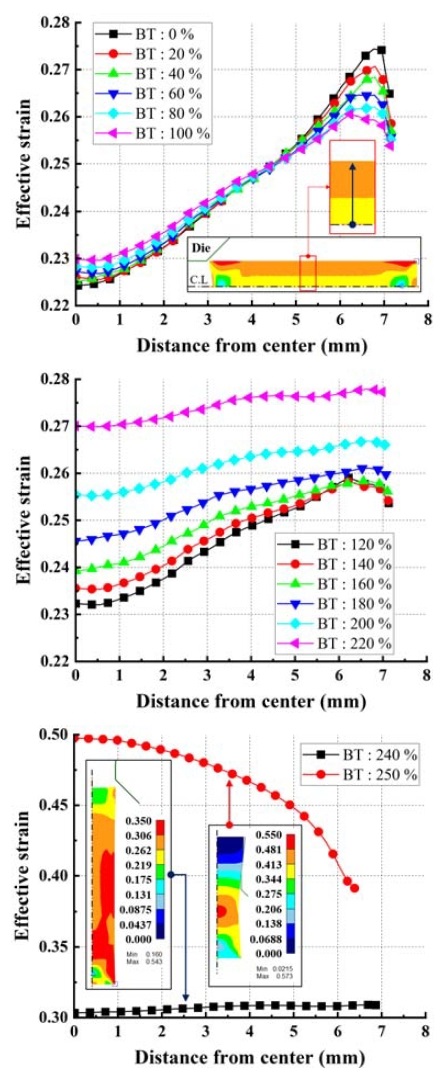
Distribution of effectives strain (reduction 20%)
Figure 11 shows the distribution of effective strain for reduction area of 30%. It can be seen that the trend is similar to that of the 20% reduction area. At a backtension ratio of 150%, the effective strain in the central and surface regions is nearly the same, and at a backtension ratio of 160%, the effective strain rapidly increases due to necking.

Distribution of effectives strain (reduction 30%)
4.5 Distribution of Residual Stress in Drawn Bar
In the drawing process, residual stress is generated due to non-uniform deformation, temperature rise, and so on[15][16]. In particular, tensile residual stress degrades the mechanical properties of the drawn material.
Figure 12 shows the distribution of the axial residual stress from the center to the surface for a reduction area of 20%. Compressive residual stress occurs at the center, while tensile residual stress occurs at the surface. As the backtension ratio increases, the residual stress at the center tends to increase, while the residual stress at the surface tends to decrease. However, when the backtension ratio exceeds 180%, the residual stress in both the center and the surface increases sharply, resulting in tensile residual stress in the center region as well. Therefore, to prevent the deterioration of mechanical properties due to residual stress, a backtension ratio of 180% or less is appropriate.
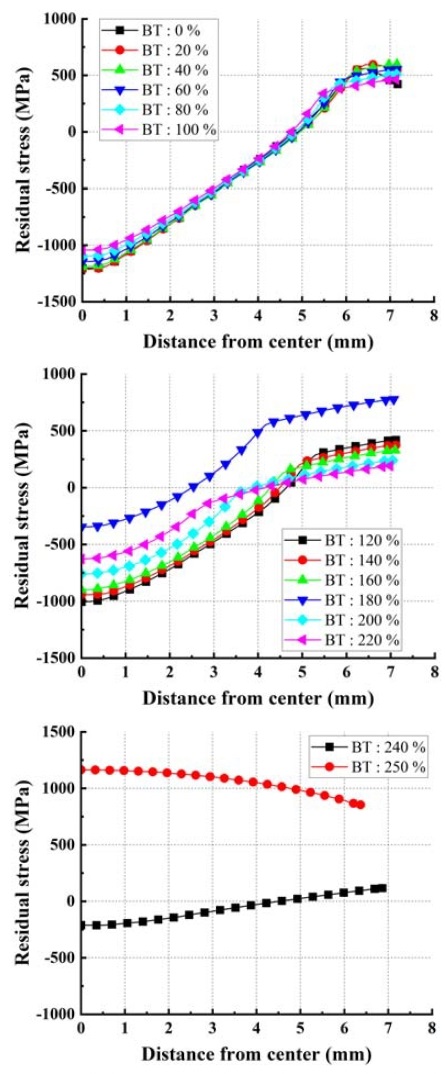
Distribution of axial residual stress (reduction 20%)
Figure 13 shows the distribution of residual stress for a reduction ratio of 30%. The distribution of residual stress is very similar to that at a reduction area of 20.0%, with a sharp increase in residual stress occurring at backtension ratio above 150.0%.
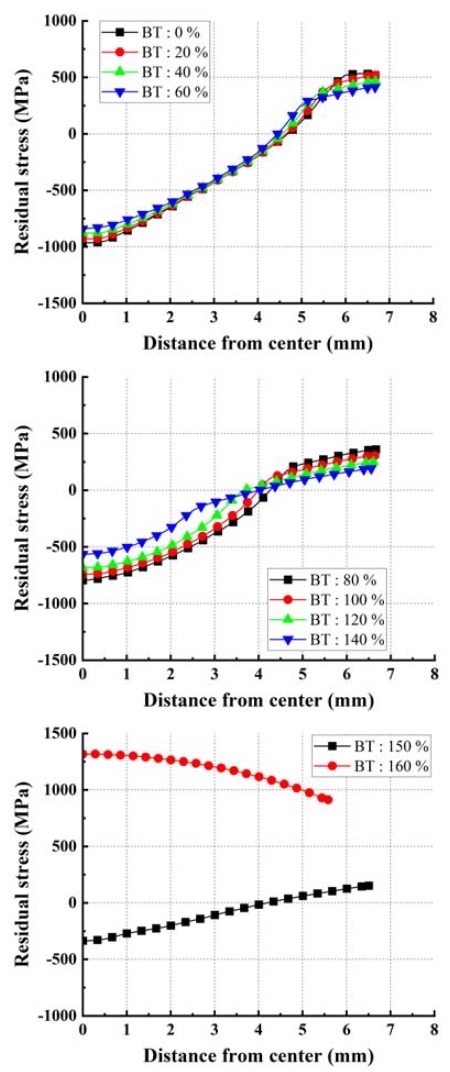
Distribution of axial residual stress (reduction 30%)
4.6 Distribution of Effective Stress in Deformation Region
Figure 14 and 15 show the distribution of effective stress for the material and die within the deformation region. Both results show that as the backtension ratio increases, the effective stress in the material increases while the effective stress in the die decreases. This is because as the backtension increases, the drawing load increases, while the contact length and contact pressure between the material and the die decrease. With a higher backtension ratio, the effective stress in the die is reduced, which can enhance die life; however, as shown in Figure 7, this may also result in a decrease in dimensional accuracy. Therefore, an appropriate backtension has to be set with consideration for the required dimensional accuracy of drawn bar.
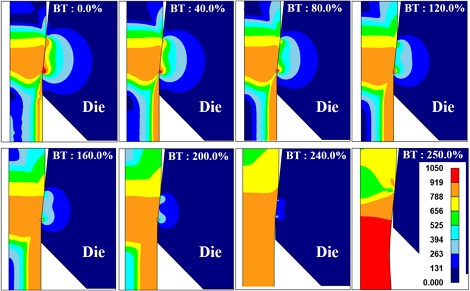
Distribution of effective stress (MPa, reduction 20%)
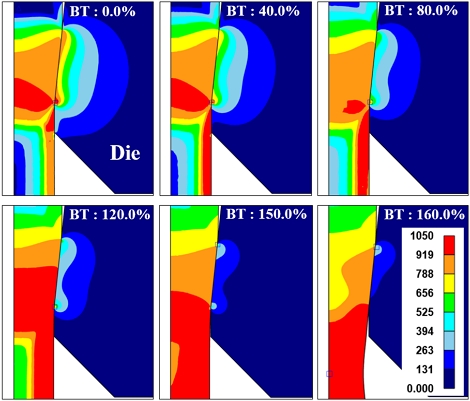
Distribution of effective stress (MPa, reduction 30%)
5. Conclusion
The study quantitatively evaluated the effects of backtension ratio on the bar drawing process through FE analysis. Through the application of various backtension ratios at two different reduction areas, the following conclusions were drawn.
1) An increase in backtension ratio significantly influences key factors in the bar drawing process, such as drawing load, drawing stress, radius of drawn bar, distribution of strain, die contact length, and distribution of residual stress.
2) Since backtension is included in the drawing load, an increase in the backtension ratio leads to an increase in the drawing load, which in turn raises the drawing stress of the drawn bar.
3) At both reduction areas, it was found that as the backtension ratio approached a critical threshold, necking and excessive plastic deformation made drawing impossible. In the applied drawing process, the critical backtension ratios for necking and plastic deformation were 250% and 160% for reduction areas of 20% and 30%, respectively.
4) The backtension ratio increases, the radius of the drawn bar decreases. In particular, it was observed that the radius decreases sharply when the backtension ratio exceeds 160% for a 20% reduction area and 100% for a 30% reduction area.
5) Since backtension is a load applied in the direction opposite to drawing, an increase in the backtension ratio reduces the contact length between the drawn bar and the die, thereby decreasing the stress on the die. This indicates that the wear life of the die can also be extended.
Backtension is one of the most importance process variables, and it is important to apply an appropriate backtension to ensure the desired quality of the dawn bar.
Acknowledgments
This study was conducted with the support of the Korea Institute of Industrial Technology(KITECH) as “Development of Transition Technologies for Future Mobility Components (KITECH-UR250107)” and “Daegu 2025 Future Mobility Leading Technology Development Project(DG-2025-21)”.
Author Contributions
Conceptualization, S. K. Lee and W. J. Yoon; Methodology, W. J. Yoon, I. K. Lee and S. K. Lee; FE analysis, I. K. Lee and S. Y. Lee; Data curation and Investigation, I. K. Lee, S. Y. Lee and S. K. Lee; Writing – Original draft preparation, I. K. Lee and S. K. Lee; Writing – Review & Editing, W. J. Yoon and S. K. Lee; Visualization, S. K. Lee; Supervision, W. J. Yoon and S. K. Lee.
References
-
S. M. Lee, I. K. Lee, S. Y. Lee, D. Y. Park, M. S. Jeong, H. Y. Moon, and S. K. Lee, “Prediction of strength of drawn bar considering non-uniform strain distribution,” Journal of Mechanical Science and Technology, vol. 36, no. 11, pp. 5713-5719, 2022.
[https://doi.org/10.1007/s12206-022-1033-6]

-
R. Badi, S. Bensassda, N. Tala-Ighil, and N. Lebaal, “Numerical analysis of the effects of incremental reduction rate in the wire drawing process,” International Journal of Advanced Manufacturing Technology, vol. 133, pp. 5197-5209, 2024.
[https://doi.org/10.1007/s00170-024-13982-1]
-
Y. M. Hwang, H. S. Tsui, and M. R. Lin, “Investigations on effects of forming parameters on product dimensions in cold drawing of AISI-316 stainless steel rods,” Metals, vol. 12, no. 4, pp. 1-10, 2022.
[https://doi.org/10.3390/met12040690]
-
N. A. Razail, J. B. Byun, M. S. Joun, “Novel finite element model of analyzing wall thickness during tube drawing considering raw tube’s thickness non‑uniformity and die misalignment,” International Journal of Materials Forming, vol. 17, no. 19, pp. 1-15, 2024.
[https://doi.org/10.1007/s12289-024-01813-3]
-
S. C. Park, S. P. Hong, E. B. Soe, and K. H. Lee, “Pass schedule design in multi-pass tube drawing process by advanced strain control model,” Journal of Advanced Marine Engineering and Technology, vol. 48, no. 5, pp. 296-301, 2024.
[https://doi.org/10.5916/jamet.2024.48.5.296]
-
S. K. Lee, S. K. Hwang, and Y. J. Cho, “Prediction of radial direction strain in drawn bar,” Journal of the Korea Society of Manufacturing Process, vol. 18, no. 9, pp. 100-105, 2019.
[https://doi.org/10.14775/ksmpe.2019.18.9.100]
-
D. C. Ko, S. K. Lee, B. M. Kim, H. H. Jo, and H. Jo, “Evaluation of copper ratio in steel/copper clad wire drawing,” Journal of Materials Processing Technology, vol. 186, pp. 22-26, 2007.
[https://doi.org/10.1016/j.jmatprotec.2006.11.131]
-
S. K. Lee, D. W. Kim, M. S. Jeong, and B. M. Kim, “Evaluation of axial surface residual stress in 0.82-wt% carbon steel wire during multi-pass drawing process considering heat generation,” Materials & Design, vol. 34, pp. 363-371, 2012.
[https://doi.org/10.1016/j.matdes.2011.06.036]
-
J. Toribio and M. Lorenzo, “Influence of the straining path during cold drawing on the hydrogen embrittlement of prestressing steel wires,” Metals, vol. 13, no. 7, pp. 1-14, 2023.
[https://doi.org/10.3390/met13071321]
-
I. K. Lee, S. K. Lee, and K. H. Lee, “Finite element analysis of multi-pass dry wire drawing process of steel cord for tire reinforcement considering Al2O3 inclusion,” Journal of Advanced Marine Engineering and Technology, vol. 47, no. 4, pp. 202-207, 2023.
[https://doi.org/10.5916/jamet.2023.47.4.202]
-
A. Haddi, A. Imad, and G. Veda, “Analysis of temperature and speed effects on the drawing stress for improving the wire drawing process,” Materials & Design, vol. 32, pp. 4310-4315, 2011.
[https://doi.org/10.1016/j.matdes.2011.04.010]
-
A. M. Camacho, R. Domingo, E. Rubio, and C. González, “Analysis of the influence of back-pull in drawing process by the finite element method,” Journal of Materials Processing Technology, vol. 164-165, pp. 1167-1174, 2005.
[https://doi.org/10.1016/j.jmatprotec.2005.02.130]
-
A. Skolyszewski, and M. Paćko, “Back tension value in the fine wire drawing process,” Journal of Materials Processing Technology, vol. 80-81, pp. 380-387, 1998.
[https://doi.org/10.1016/S0924-0136(98)00116-2]
- S. M. Lee, I. K. Lee, S. Y. Lee, M. S. Jeong, Y. H. Moon, and S.-K. Lee, “Evaluation of radial direction non-uniform strain in drawn bar,” Transaction of Materials Processing, vol. 29, no 6, pp. 356-361, 2020.
-
J. M. Atienza, J. Ruiz-Hervias, M. L. Martinez-Perz, and F. J. Mompean, “Residual stresses in cold drawn pearlitic rods,” Scripta Materialia, vol. 52, no. 12, pp. 1223-1228, 2005.
[https://doi.org/10.1016/j.scriptamat.2005.03.003]
-
S. K. Lee, D. W. Kim, M. S. Jeong, and B. M. Kim, “Evaluation of axial surface residual stress in 0.82-wt% carbon steel wire during multi-pass drawing process considering heat generation,” Materials & Design, vol. 34, pp. 363-371, 2012.
[https://doi.org/10.1016/j.matdes.2011.06.036]