
Simulation study on regulatory compliance costs of alternative marine fuels under IMO GHG mid-term measures

Copyright © The Korean Society of Marine Engineering
This is an Open Access article distributed under the terms of the Creative Commons Attribution Non-Commercial License (http://creativecommons.org/licenses/by-nc/3.0), which permits unrestricted non-commercial use, distribution, and reproduction in any medium, provided the original work is properly cited.
Abstract
This study quantitatively compares and analyzes the regulatory compliance costs of alternative marine fuels based on mid-term measures for greenhouse gas (GHG) reduction approved at the 83rd session of the Marine Environment Protection Committee (MEPC) of the International Maritime Organization (IMO) in April 2025. The IMO mid-term measures introduce GHG Fuel Intensity (GFI) standards along with the Remedial Unit (RU) and the Surplus Unit (SU), thereby creating a regulatory framework that directly impacts the economics of fuel transition in the shipping industry. This study evaluated key marine fuels, including HFO, LNG, biofuels, and e-methanol, by calculating the attained GFI values based on their respective GHG intensities and lower calorific values (LCV). We further assessed the annual RU and SU revenue associated with each fuel. Simulation results indicate that high-carbon fuels such as HFO, LFO, and MDO/MGO will face a significant increase in regulatory compliance costs after 2030, owing to escalating RU charges. In contrast, low-carbon fuels, such as Bio100, Bio-LNG, and e-methanol, maintain long-term cost stability despite higher initial fuel prices, mainly through revenues generated by SU trading.
Keywords:
International marine organization, Greenhouse gas, Mid-term measure, Remedial Unit, Surplus unit1. Introduction
In April 2025, the International Maritime Organization (IMO) officially approved mid-term measures for greenhouse gas (GHG) reduction during the 83rd session of the Marine Environment Protection Committee (MEPC) to accelerate carbon neutrality in international shipping [1]. The measures will be adopted in October 2025 and enter into force on March 1, 2027, when applied to ships engaged in international voyages with a gross tonnage of 5,000 tons or more.
Each ship's GHG Fuel Intensity (GFI) is calculated annually, and compliance is determined by comparing the results against two-tier targets set by the IMO: a Base Target and a more stringent Direct Compliance Target. Ships that fail to satisfy the Base Target are required to pay a penalty of USD 380 per tCO2eq, whereas those that fail to satisfy the Direct Compliance Target must pay USD 100 per tCO2eq. The collected contributions are allocated to the IMO’s net-zero fund.
Conversely, ships that exceed the Direct Compliance Target are awarded Surplus Units (SUs), which can either be sold to other ships that fall short of the Base Target or carried over for their own future compliance needs.
The introduction of the RU and SU mechanisms creates not only additional cost burdens but also economic incentives, establishing a new market-based regulatory structure. Unlike previous IMO frameworks, it fundamentally transforms the compliance dynamics. This is expected to significantly impact shipowners, fuel suppliers, and policymakers.
Tomi et al. [2] analyzed the cost-effectiveness of four alternative marine fuels (LNG, methanol, green hydrogen, and green ammonia) using a Net Present Value (NPV) approach and identified LNG as the most economically favorable. However, their study did not consider the RU and SU mechanisms introduced under the new regulatory framework.
Nguyen et al. [3] conducted a comparative analysis of alternative marine fuels and technologies. Using a life cycle cost approach, they suggested that ammonia could achieve long-term cost competitiveness.
Venkatakrishnan [4] assessed the economic impact of the European Union’s Fit for 55 regulations on maritime fuel costs and carbon pricing through simulation analysis. Nevertheless, this study focused on regional EU policies and did not align with the global framework established by the IMO.
Roux et al. [5] performed a comprehensive review of life cycle assessment (LCA) studies on alternative fuels and identified significant methodological gaps and a lack of transparency, particularly regarding emerging fuels such as methanol, ammonia, and hydrogen. While offering critical insights, their review did not address the practical implications of the new compliance standard under the IMO’s mid-term measures.
Psaraftis and Kontovas [6] provided a comprehensive review of decarbonization efforts in the maritime sector, evaluated the progress following the IMO's 2018 Initial GHG Strategy, and discussed future challenges. The study also analyzed the interactions between IMO policies and the EU Green Deal.
Previous studies have explored the economic, environmental, and technical feasibility of using alternative marine fuels. However, most studies did not consider the new GFI targets and RU/SU mechanisms introduced by the 2025 IMO mid-term measures. This study addresses these gaps by quantitatively analyzing the compliance costs of alternative fuels based on the updated IMO framework, thereby providing practical guidance for shipowners in planning fuel transitions.
2. Mid-term Measures Framework
2.1 Calculation of GHG Fuel Intensity
The IMO’s mid-term measures adopt a regulatory framework based on the GFI of the fuels used by ships. As shown in Equation (1), GFI is defined as the well-to-wake greenhouse gas emissions per unit of energy, measured in grams of CO₂-equivalent per megajoule (gCO2eq/MJ).
| (1) |
𝐸𝐼𝑗 represents the GFI of fuel type 𝑗 (gCO2eq/MJ), 𝐸𝑛𝑒𝑟𝑔𝑦𝑗 denotes the energy consumption of fuel type 𝑗 (MJ), and 𝐸𝑛𝑒𝑟𝑔𝑦𝑡𝑜𝑡𝑎𝑙 is the total energy consumption of the ship (MJ).
These values were calculated based on annual fuel consumption data reported by the IMO Data Collection System (DCS). The denominator, 𝐸𝑛𝑒𝑟𝑔𝑦𝑡𝑜𝑡𝑎𝑙, includes not only the energy derived from fossil fuels but also zero- and low-carbon energy sources such as shore power, wind propulsion, and solar power. Thus, this GFI calculation approach evaluates the vessel’s overall energy mix, serving as a metric to drive actual decarbonization efforts beyond the simple assessment of direct GHG emissions.
The GFI calculation method differs fundamentally from the IMO Carbon Intensity Indicator (CII). While CII measures CO₂ emissions per ton-nautical mile based on tank-to-wake, GFI considers the full lifecycle (well-to-wake) emissions, including contributions from shore power, wind, and solar energy.
To quantitatively assess the GHG emissions performance of ships and apply differentiated penalties, the IMO introduced a two-tiered structure consisting of a Base Target and a Direct Compliance Target. The Base Target represents the minimum decarbonization requirement, whereas the Direct Compliance Target sets a strict compliance threshold. Each year's GFI target was determined based on a reduction factor (ZT, %) applied to the 2008 reference GFI value of 93.3 gCO2eq/MJ, as shown in Equation (2).
| (2) |
In this context, GFIT represents the target GFI for year T (gCO2eq/MJ), ZT denotes the reduction factor (%) relative to the 2008 baseline year, and GFI2008 is the reference GFI value, set at 93.3 gCO2eq/MJ. The IMO specifies the annual ZT for each target year, as summarized in Table 1 and Figure 1[7].

Annual GFI reduction factors (%) for the target annual GFI relative to the GFI reference value
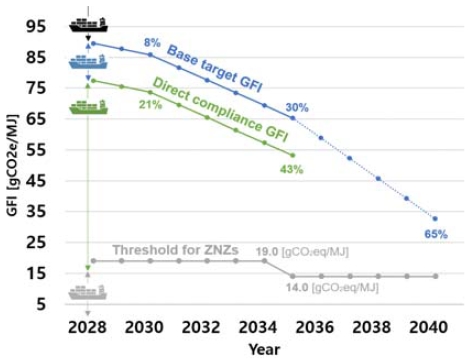
Annual GHG fuel intensity reduction two-tiers targets under IMO mid-term measures
2.2 RU Payment Mechanism
An RU is a nontransferable unit designed to financially compensate for excess emissions beyond the ship’s target GFI, with payments made to the IMO Net-Zero Fund. Figure 2[7] schematically illustrates the transaction mechanisms of RU and SU based on the GFI compliance framework.
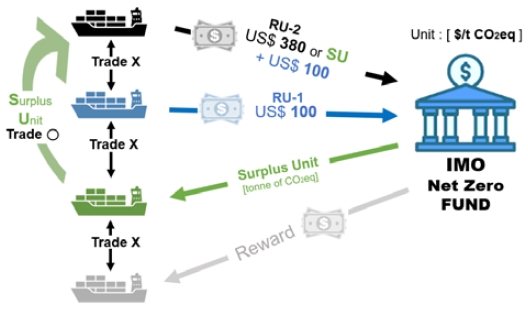
Compliance mechanism of remedial unit and surplus unit in the IMO GHG Regulation Framework
The IMO Net-Zero Fund will be established to collect RU from ships exceeding their GHG emission targets and allocate funds to promote decarbonization in maritime transport. Specifically, the Fund will support the use of zero- and near-zero-emission (ZNZ) fuels, assist developing countries, advance technology development and dissemination, and finance the necessary infrastructure.
The RU system categorizes compliance deficits into two tiers with differentiated pricing: USD 100/tCO2eq for Tier 1 and USD 380/tCO2eq for Tier 2. These rates apply during the initial phase, from 2028 to 2030, and may be revised thereafter.
The RU system functions as a regulatory variable that directly affects costs, depending on factors such as the choice of fuel type, speed, and routing of ship operations. Unlike a conventional carbon levy, an RU imposes a precise cost based on excess greenhouse gas (GHG) emissions, directly linking a ship’s annual environmental performance to its financial outcomes. Consequently, shipowners must strategically consider the impact of RU systems when planning energy transitions and making long-term investments.
2.3 SU Trading Mechanism
This measure introduces an SU mechanism to incentivize ships that exceed the regulatory requirements. This unit is recorded in the IMO GFI Registry and can serve as a market-based tool to reward higher environmental performance.
SU can be utilized in three ways: transferred to another ship to offset Tier 2 compliance deficits, banked for up to two years for future use, or voluntarily canceled as an environmental contribution. Unlike the RU, the SU functions as a tradable carbon credit, offering potential revenue opportunities for ship operators. However, each SU can only be used or transferred once and will expire after two years.
The introduction of the SU system serves not only to ensure regulatory compliance, but also to incentivize additional GHG reductions, enabling economic benefits through trading. By allowing ships to choose diverse compliance strategies rather than mandate specific technologies, the SU mechanism creates a flexible market-based framework that promotes a more practical and efficient transition to decarbonization.
3. Simulation Conditions
3.1 Comparison of GHG Intensity by Fuel
This study utilizes the key physical properties of alternative marine fuels to quantitatively compare and analyze their GHG emission performance based on the IMO mid-term measures approved in April 2025. GHG emissions were calculated on a well-to-wake basis, considering both fuel consumption and associated energy use. The attained GFI for a ship is determined by the GHG intensity (gCO2eq/MJ) and the amount of energy used for each fuel type, as shown in Figure 3. Therefore, fuel-specific properties such as GHG emission factors, lower calorific values (LCV), and typical usage rates are critical comparative indicators.

GHG fuel intensity of key alternative marine fuels
Accordingly, Table 2 summarizes the GHG emission factors and physical properties of the major alternative marine fuels based on the EU Fuel Maritime regulation [8].
Key physical properties of conventional and alternative marine fuels
In this study, the Usage Rate was applied to account for the differences in the lower calorific value (LCV) of alternative marine fuels, enabling a fair comparison. The Usage Rate represents the relative amount of each fuel required to produce the same energy output, using heavy fuel oil (HFO) as a baseline (set to 1.0). For instance, the Diesel Cycle (LNG) required approximately 82% of HFO to generate an equivalent energy output corresponding to a Usage Rate of 0.82. Conversely, e-methanol, with its lower LCV, required approximately twice the amount of HFO, resulting in a Usage Rate of 2.04. Throughout the simulation, this Usage Rate was consistently applied to calculations of fuel costs and RU and SU rewards, thereby accurately reflecting the actual operational energy demand for each fuel type.
3.2 Calculation of RU and SU
This section outlines the methodology for calculating compliance costs by fuel type under the IMO Mid-term Measures. In this study, the "compliance cost" is defined as the total monetary value comprising fuel costs, RU penalties, and SU trading revenues. Calculations were performed using a MATLAB-based simulation model with five main steps.
The target GFI for each year was calculated by applying the annual reduction factor (Z-factor) to the baseline GFI2008 of 93.3 gCO2eq/MJ. Two levels were defined: ZBase for the Base Target and ZDirect for the Direct Compliance Target.
| (3) |
Exceedance is categorized into two tiers: RU1 applies when the Direct Compliance Target is not met but the Base Target is satisfied, whereas RU2 applies when the Base Target is exceeded.
| (4) |
Since the GFI exceedance (ΔGFI) is expressed per unit of energy, the actual excess emissions per ton of fuel are calculated by multiplying ΔGFI by the lower calorific value (LCV) of the fuel. The results were then converted from grams to tons by a factor of 106.
| (5) |
GHG emissions exceeding the target GFI are subject to differentiated pricing based on the two tiers. The total annual RU charge was calculated by multiplying the corresponding excess emissions by the applicable unit price. Table 3 presents the RU charges by fuel type normalized to the energy equivalent of one ton of HFO.
Annual expenditure for GHG Non-Compliance (RU-1 + RU-2) by Fuel Type [$]
Additionally, if a ship surpasses the Direct Compliance Target, it generates an SU. In this study, the trading price of SU is assumed to be 304 USD/tCO2eq, representing approximately 80% of the RU2 price. This assumption reflects the expectation that the SU will be traded at a discount compared to the RU2 price. Table 4 summarizes the annual SU values by fuel type
Annual revenue from Surplus Units by Fuel Type [$]
For each fuel type, the net compliance cost (ΔCostnet) was calculated by summing the basic fuel cost (unit price × consumption) and the carbon surcharge from required RU purchases, and subtracting the SU revenues generated from over-compliance.
| (6) |
This method integrates both the RU and SU rewards, providing a more realistic assessment of fuel economics.
4. Simulation Results
This study assessed the economic viability of alternative marine fuels by evaluating the compliance costs associated with the generation of RU and SU. To ensure a fair and consistent comparison, the GHG emissions for each fuel were normalized to the total energy output equivalent to the combustion of one ton of HFO, thereby eliminating distortions caused by differences in LCV among the fuels.
4.1 Annual RU Expenditure
Figure 4 presents the annual carbon charges (RU1 and RU2) calculated by fuel type. High-carbon fossil fuels such as HFO, LFO, and MDO/MGO exhibit a steady increase in RU2 charges over time as the GFI targets become more stringent, with a sharp escalation after 2030. This indicates that the continued use of high-carbon fuels will lead to a substantial increase in regulatory costs over the long term.
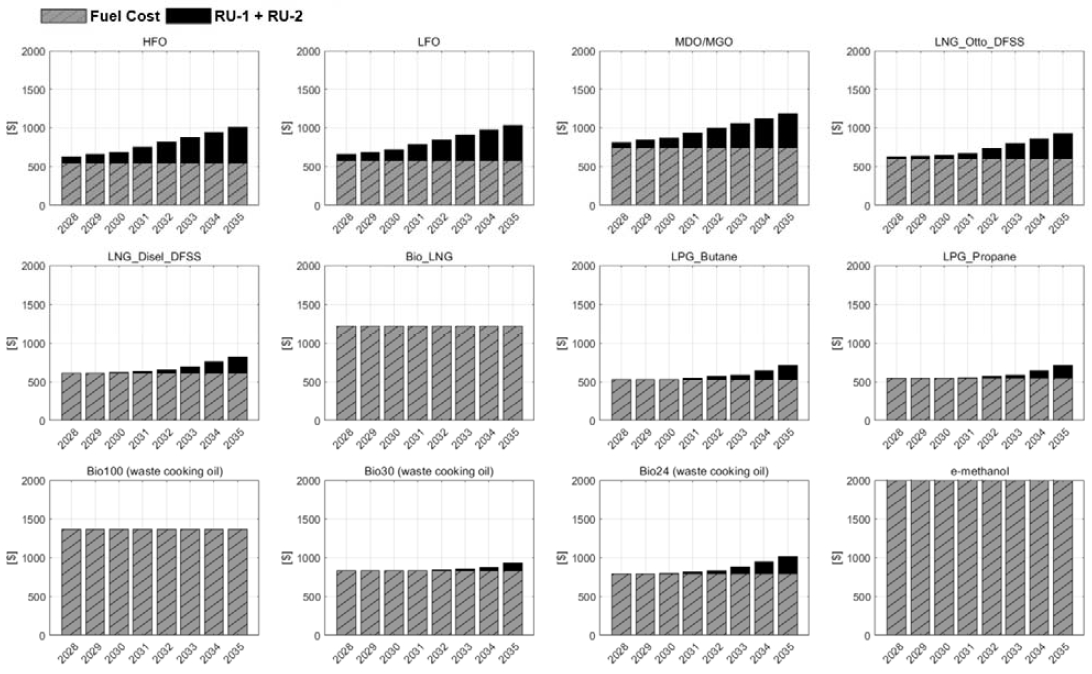
Annual trends of GHG non-compliance charges (RU1 and RU2) by fuel type under IMO mid-term measures
In contrast, LNG and LPG fuels, with lower GHG intensities, initially experienced limited RU charges, but gradually faced increased RU2 charges as regulations tightened after 2032. Biofuels such as Bio100, Bio30, Bio24 (based on waste cooking oil), and e-methanol consistently outperformed the GFI targets in most years, resulting in minimal or negligible RU charges. This highlights their strong potential not only for GHG reduction but also for long-term economic competitiveness under the regulatory framework.
4.2 Total Annual Fuel Expenditure
Figure 5 depicts the total annual fuel expenditure for each fuel type obtained by adding the base fuel cost (USD/ton) to the carbon surcharges from RU1 and RU2. Although HFO initially had the lowest unit price, its high GHG intensity caused carbon charges to increase steadily over time, causing the total expenditure to nearly double the original fuel price by 2035. In contrast, bio-blended fuels, such as Bio30 and Bio24, experience moderate increases in total cost depending on the proportion of biofuel blended because their RU liabilities are partially mitigated.

Annual fuel expenditure by fuel type including expenditure costs (Fuel Cost + RU1 + RU2)
This demonstrates the significant influence of biofuel content on both the total and compliance costs. Notably, bio-LNG shows a balanced profile between fuel cost and regulatory burden, suggesting its potential as a viable mid- to long-term alternative. Blended biofuels also offer strategic value by partially mitigating the RU charges during the fuel transition phase.
4.3 Annual SU Revenue
Figure 6 shows the simulated annual revenue from the SU for each fuel type. An SU is generated only when the GFI of the fuel surpasses the Direct Compliance Target. e-Methanol, Bio100, and Bio-LNG consistently produced significant SU revenue throughout the simulation period, with e-methanol showing particularly high generation levels, positioning it as both compliant and economically advantageous.

Annual revenue from Surplus Units (SU) by fuel type under IMO mid-term measures
4.4 Comparison of Net Costs Relative to HFO
Figure 7 shows the calculated net compliance costs for each fuel type, considering the sum of the unit fuel costs and RU charges minus SU revenues. Figure 8 illustrates the annual trends of these costs relative to Heavy Fuel Oil (HFO), with the $0 baseline representing the HFO benchmark.
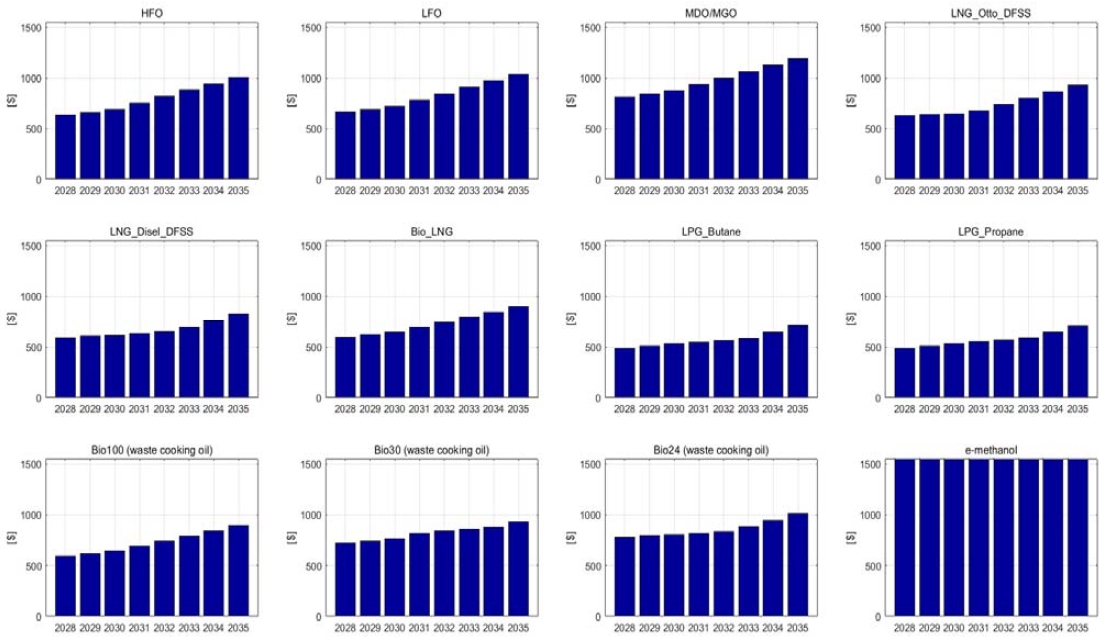
Annual Total Regulatory Compliance Costs by fuel type including RU and SU Costs (Fuel Cost + RU1 + RU2 – SU)
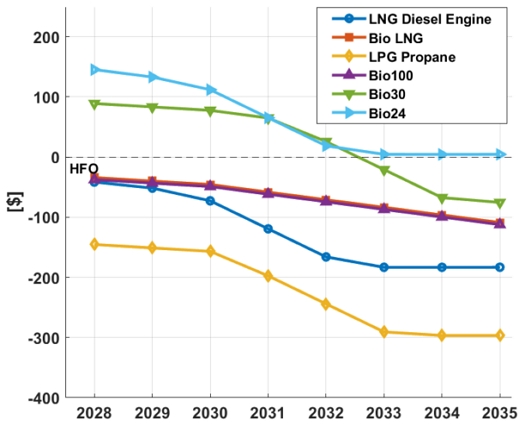
Annual Differential Compliance Costs of Alternative Fuels Relative to HFO (2028–2035)
High-carbon fossil fuels, such as HFO, LFO, and MDO/MGO, exhibit steadily rising compliance costs over time due to the strengthening of GFI targets and increasing RU charges. In contrast, low-carbon and ZNZ fuels, such as Bio100, Bio-LNG, and e-methanol, maintain relatively stable net costs owing to SU revenues that partially offset their higher initial fuel prices.
Notably, Bio24 and Bio30 exhibited a crossover point around 2032, where their net compliance costs fall below those of HFO.
This finding highlights the importance of ship operators to consider not only initial fuel prices, but also the long-term GHG intensity and the cumulative effects of RU and SU when developing fuel transition strategies. Although HFO remains cost-competitive until approximately 2031, its economic advantage will diminish rapidly thereafter, emphasizing the strategic benefit of transitioning to low-carbon fuels at an early stage.
Notably, Bio24 and Bio30 exhibited a crossover point around 2032, where their net compliance costs fall below those of HFO. This finding highlights the importance of ship operators to consider not only initial fuel prices, but also the long-term GHG intensity and the cumulative effects of RU and SU when developing fuel transition strategies. Although HFO remains cost-competitive until approximately 2031, its economic advantage will diminish rapidly thereafter, emphasizing the strategic benefit of transitioning to low-carbon fuels at an early stage.
Additional simulation results comparing Bio30 and Bio100 showed that the latter offers greater economic efficiency although it is more expensive. This advantage stems primarily from the significant revenue generated through Surplus Units (SUs), which effectively offset the higher upfront fuel costs. These findings suggest that, provided the SU market becomes sufficiently liquid and trading mechanisms are well established, ship operators may opt for fuels with higher bio-content to reduce net compliance costs. Additionally, LNG consistently outperforms HFO in terms of compliance costs across the entire simulation period, indicating its robustness as a mid-term, low-carbon compliance solution under the IMO regulatory framework. Although LNG is not a zero-emissions fuel, its lower GHG intensity and reduced exposure to RU penalties enhance its strategic value.
4. Conclusion
This study quantitatively assessed the regulatory compliance costs associated with major alternative marine fuels, based on mid-term measures approved by the IMO in April 2025. The key conclusions are as follows:
(1) The clarification of GFI targets and the establishment of pricing structures for RU and SU under the IMO mid-term measures now enable shipowners to estimate the optimal timing for fuel transitions by analyzing their fleet's fuel usage patterns and operational profiles.
(2) Although LNG offers only a 15% reduction in GHG intensity compared to conventional HFO, it remains a more economically viable compliance option than biofuels under the new regulatory environment owing to its relatively favorable cost and energy efficiency characteristics.
(3) In the case of biofuels, a higher bio-content resulted in lower GHG intensity, which reduced RU surcharges and enhanced the potential for SU-related revenues. As a result, shipowners are likely to increasingly prefer fuels with higher biocontent to minimize compliance costs and regulatory incentives.
This study has several limitations. While it quantitatively evaluates compliance costs under the IMO ’s mid-term measures, it does not fully consider real-world constraints such as fuel supply, bunkering infrastructure, and retrofit requirements. In particular, advanced fuels, such as e-methanol and Bio100 face challenges due to their immature supply chains and limited port facilities. These factors warrant further investigation and should be considered in practical fuel-transition planning.
Author Contributions
Conceptualization, D. J. Hwang and C. Oh; Methodology, D. J. Hwang and C. Oh; Software, D. J. Hwang; Analysis, D. J. Hwang; Investigation, D. J. Hwang; Writing – Original Draft Preparation, D. J. Hwang.
References
- International Maritime Organization (IMO), Reduction of GHG emissions from ships – Report of the nineteenth meeting of the Intersessional Working Group on Reduction of GHG Emissions from Ships (ISWG-GHG 19) and the Working Group on Reduction of GHG Emissions from Ships, MEPC 83/WP.11, International Maritime Organization, 2025.
-
T. Solakivi, A. Paimander, and L. Ojala, “Cost competitiveness of alternative maritime fuels in the new regulatory framework,” Transportation Research Part D: Transport and Environment, vol. 113, 103500, 2022.
[https://doi.org/10.1016/j.trd.2022.103500]

-
D. Nguyen, R. J. Fernandes, J. W. Turner, and D. R. Emberson, “Life cycle assessment of ammonia and hydrogen as alternative fuels for marine internal combustion engines,” International Journal of Hydrogen Energy, vol. 112, pp. 15-30, 2025.
[https://doi.org/10.1016/j.ijhydene.2025.02.331]
- S. Venkatakrishnan, Impact of Fit for 55 regulations on Short sea shipping (SSS) in the European Union, M.Sc. Thesis, Department of Maritime Economics and Logistics, Erasmus University Rotterdam, 2022.
-
M. Roux, C. Lodato, A. Laurent, and T. F. Astrup, “A review of life cycle assessment studies of maritime fuels: critical insights, gaps, and recommendations,” Sustainable Production and Consumption, vol. 50, pp. 69-86, 2024.
[https://doi.org/10.1016/j.spc.2024.07.016]
- H. -N. Psaraftis and C. -A. Kontovas, “Decarbonization of maritime transport: Is there light at the end of the tunnel?,” Sustainability, vol. 13, no. 1, 237, 2021.
- J. Y. Lee, “Key contents and implications of the draft new regulation under IMO mid-term measures and MARPOL,” International Trend for Maritime Decarbonization, vol. 15, pp. 4–7, Jun. 2025. [Online]. Available: https://www.imokorea.org/upfiles/decarbonization/Vol.15-%ED%83%88%ED%83%84%EC%86%8C%ED%99%94%20%EA%B5%AD%EC%A0%9C%ED%95%B4%EC%82%AC%20%EB%8F%99%ED%96%A5_KMC(25-6%EC%9B%94%ED%98%B8).pdf, .
-
European Parliament and Council, Directive (EU) 2018/2001 of the European Parliament and of the Council of 11 December 2018 on the promotion of the use of energy from renewable sources, 2018.
[https://doi.org/10.19195/1733-5779.35.6]