
Fault detection and prediction according to the location of vibration occurrence in motors

Copyright © The Korean Society of Marine Engineering
This is an Open Access article distributed under the terms of the Creative Commons Attribution Non-Commercial License (http://creativecommons.org/licenses/by-nc/3.0), which permits unrestricted non-commercial use, distribution, and reproduction in any medium, provided the original work is properly cited.
Abstract
Torsional vibration occurring in a motor can cause not only simple mechanical damage but also severe problems in the entire connected operating system. To prevent this and maintain operational efficiency, preemptive fault detection and prediction technology using motor vibration data is emerging as an important field in automation. However, existing studies primarily focus on fault detection techniques based on data collected in a specific RPM range and have limitations in sufficiently reflecting the environmental variability and data collection constraints of the actual industry. To solve these problems, in this paper, we propose a new classification model that can operate effectively even under various RPM conditions and limited data environments. The proposed model complements the limitations of existing approaches and improves the accuracy and reliability of fault detection by combining similarity-based analysis and machine-learning techniques based on vibration data collected in the time and frequency bands. In addition, various algorithms that are widely used in multi-class classification problems were applied to compare the performance of each technique and select an optimal fault detection model.
Keywords:
Motor, Torsional Vibration Fault Detection, Similarity Analysis, Machine Learning1. Introduction
In the modern industry, electric motors are key devices for maximizing automation and efficiency and play an essential role in various fields, such as manufacturing, transportation, home appliances, and robotics. The performance and stability of electric motors are important factors that determine the reliability and productivity of an entire system and directly affect industrial efficiency and cost reduction. However, motors are exposed to the risk of wear and defects when handling continuous rotation and loads. Various defects such as bearing damage, rotor imbalance, and shaft misalignment are highly likely to occur under high-speed rotational conditions [1]-[3].
These defects appear as subtle vibration pattern changes in the initial stage. However, if left untreated, they can result in severe mechanical damage and production stoppage. In particular, productivity losses and maintenance costs owing to unexpected motor defects are emerging as severe problems at industrial sites. Therefore, the technology for continuously monitoring motor conditions and detecting defects early is becoming an essential element in industrial operations.
Most existing studies have developed defect detection techniques by collecting and analyzing data under stable operating conditions (a fixed RPM range). However, in actual industrial environments, motors operate over a wide RPM range and under variable operating conditions, and this variability significantly affects the vibration characteristics of the motor and accuracy of fault detection [4][5].
Most vibration problems that occur in motor-based rotating machines are classified as unbalanced vibrations, shaft misalignment, resonance, or bearing problems [1]. In previous vibration analysis and defect detection studies, a representative method involves checking the vibration data through a frequency band spectrum and determining whether characteristics appear according to the defect type. For the mass imbalance of a rotating shaft, a high amplitude occurs in the same frequency component as the rotation speed in the frequency band spectrum. Previous studies have focused on performing analyses limited to specific RPM or fixed operating conditions; thus, they have limitations in sufficiently reflecting various scenarios occurring in actual industrial environments. Therefore, a new analysis technique that can comprehensively cover various RPM ranges and effectively reflect vibration characteristics under variable operating conditions is required [6][7].
Recently, deep-learning techniques have been actively adopted for vibration analysis and fault detection [8][9]. Chen et al. [8] used convolutional neural networks (CNNs) to classify various fault types in rotating machinery. Although the study achieved a high classification accuracy across multiple fault categories, it was limited to experiments conducted under fixed rotational speeds and stable operating conditions. Tama et al. [9] comprehensively reviewed recent advancements in deep-learning-based condition monitoring using vibration signals. Although their study provided valuable insights into numerous proposed approaches and discussed the applicability of deep-learning models in industrial scenarios, they did not consider the variability and complexity of real-world operating environments, particularly regarding RPM fluctuations and sensor placement differences. Therefore, this study aimed to address these limitations by proposing a method that better reflects the variability inherent in actual industrial settings.
To overcome these limitations, we propose a vibration detection and prediction technique that can be universally applied in various RPM ranges based on vibration data occurring at three locations of the motor. Vibration signal characteristics in the normal and defective states are identified, and the differences in vibration patterns according to measurement locations are analyzed to clearly identify the defect signs. Additionally, by analyzing data across time and frequency bands, we utilize machine learning and similarity-based techniques to precisely learn data patterns and detect signs of defects.
Thus, similarity-based approaches enable the clear identification of fault symptoms. In addition, the application of machine-learning techniques enables effective fault diagnosis by learning and distinguishing data patterns. Therefore, by combining these two methods, accurate data analysis and reliable diagnosis can be performed for fault detection.
2. Related Works
2.1 Fault Analysis Techniques Based on Motor Vibration
Vibration data analysis methods are divided into time-domain analysis (TDA), orbit analysis, phase analysis, and frequency-domain analysis (FDA). TDA is a method for evaluating machine operation and the presence of faults by observing changes in the amplitude, periodicity, and variation patterns of vibration signals over time. In TDA, the sampling rate, which is based on the Nyquist sampling theorem, plays a critical role in determining the accuracy of the analysis. The Nyquist theorem states that to accurately reconstruct a signal, the sampling frequency must be at least twice the maximum frequency present in the signal. Therefore, setting an appropriate sampling rate is essential for obtaining accurate vibration signals. This analysis method can detect changes in machine conditions and early fault indications.
Orbit analysis is a technique that visually represents the shaft motion of rotating machinery to identify faults based on irregular movement patterns. It uses two sensors to simultaneously measure the vibration displacement along the X- and Y-axes of the shaft and constructs an orbital trajectory from these measurements. This provides a visual understanding of the vibration displacement and is particularly effective for identifying imbalance, misalignment, and abnormal vibration patterns in rotating machinery.
Phase analysis determines the time relationship between signals, enabling the identification of when specific vibrations occur.
TDA is a technique that analyzes vibration signals on the time axis to evaluate the operating status and defects of a machine based on the amplitude, period, and change patterns of a signal. Because the judgment is made based on changes in the vibration data measured in real time, the sampling rate setting based on the Nyquist sampling theorem is an important factor that affects the accuracy of the analysis. This analysis technique has the advantage of capturing machine-status changes and defect signs at an early stage [10]-[12].
Orbit analysis visually represents the shaft movement of a rotating machine. It uses two sensors to simultaneously measure the displacement of the X- and Y-axes of a shaft and then generates the shaft trajectory based on this. This technique is effective in identifying imbalances, alignment problems, or abnormal vibration patterns of rotating machines, and determines shaft problems through elliptical trajectories or irregular movements.
Phase analysis evaluates the condition of a machine by comparing the temporal relationships between signals. It is used to check the alignment condition or identify the location of a fault by comparing the phases of the signals collected at various points of a rotating machine. For example, if the signal phase at a specific location does not match that at other locations, this indicates the possibility of a local fault.
Frequency band analysis evaluates the frequency components and corresponding amplitudes of a signal by converting time data into the frequency domain using a Fourier transform. Because the amplitude change at a specific frequency appears as a distinct peak in the spectrum, it is an important factor for fault diagnosis and condition assessment. Representative forms include the discrete Fourier transform (DFT) and fast Fourier transform (FFT), both of which are used to effectively calculate frequency components [13][14]. In particular, FFT is widely used in environments that require large amounts of data or real-time analysis because it significantly reduces computational complexity.
2.2 Machine-Learning for Determination
Machine learning, a powerful technique that is widely used to analyze and predict complex data patterns, effectively solves classification and prediction problems by learning the structure of data. The data covered in this paper are vibration sensor data, including normal and four fault states, which represent complex and irregular characteristics related to various types of faults in rotating machinery. These data contain mixed linear and nonlinear relationships, and various machine-learning algorithms should be applied and their performances compared for effective analysis. This is to select the optimal algorithm and accurately detect faults in complex data structures.
Softmax logistic regression is useful for evaluating linear relationships, and a support vector machine (SVM) can effectively handle high-dimensional data and nonlinear relationships. The random forest provides stable performance and an overfitting prevention effect in complex data through ensemble learning, and the K-nearest neighbor (KNN) reflects data density with a simple distance-based approach. Artificial neural networks (ANNs) can analyze complex data by applying a multilayer structure and activation function and are particularly effective in large-scale data. In this study, five machine-learning algorithms (softmax logistic regression, SVM, random forest, KNN, and ANN) were applied to perform data analysis [15]-[17]. By comparing the learning results based on the characteristics of the above algorithms, we can better understand the structure and characteristics of the data and select an optimal algorithm to improve the accuracy of defect detection and prediction.
2.3 Similarity Analysis
Similarity analysis, which quantitatively measures the relationship between data, effectively solves problems such as pattern recognition, data classification, clustering, and anomaly detection by quantifying the similarity of data. In particular, for continuous and periodic data, such as vibration data, similarity analysis is useful for globally comparing data patterns to understand the data structure and detect state changes or anomalies.
Typical similarity-analysis techniques include cosine similarity (CS) and integral similarity (IS). CS, which measures similarity based on the angle between vectors, is suitable for comparing the directionality of the data. The formula for calculating it is as follows:
| (1) |
where A and B represent two vectors. CS value ranges from -1 to 1, and the closer the value is to 1, the more vectors have the same direction. This technique ignores the difference in data size and compares only directionality; therefore, it is not suitable for data where the difference in size is important.
IS, a method for measuring the similarity in terms of area by integrating the difference between two signals, is useful for comparing continuous signal data. It reflects the overall pattern and energy of the data, and is expressed as follows:
| (2) |
where f(x) and g(x) represent the two signals to be compared, and a and b represent the domains of the signals. This technique is suitable for evaluating the overall magnitude and change in a signal. However, it is inefficient for large-scale data because of its high computational cost.
CS is primarily used for text data analysis, clustering, or comparing the relationships between vector data, whereas IS is utilized in signal processing and continuous data analysis (e.g., biometric or time series data). The two techniques are appropriately selected or combined depending on the characteristics of the data and purpose of the analysis. For example, when directional and size information must be evaluated simultaneously, the results of the two techniques can be comprehensively analyzed to derive highly accurate results.
3. Proposed Algorithm
3.1 Experimental Environment and Data Configuration
This study used a rotating shaft vibration dataset provided by the Fraunhofer Institute in Germany (Fraunhofer IIS/EAS) used for the fault diagnosis and vibration characteristic analysis of rotating machinery [17]. This dataset was collected from a testbed designed to replicate conditions similar to those of industrial electric motors. Vibration data were collected under various imbalance conditions by artificially designing a mass-imbalance situation when the motor was driven. It reflects commonly observed faults in real-world settings, such as imbalance, misalignment, and bearing defects, thereby ensuring high industrial relevance. Furthermore, the data include measurements at various rotational speeds and sensor positions, allowing the dataset to capture the operational variability and structural complexity representative of actual industrial environments.
Figure 1 shows the configuration of the device used to obtain the experimental data. To reproduce various unbalanced conditions, we attached an unbalance holder to the end of the motor rotation shaft and adjusted the radius and mass to implement an unbalanced situation. The experimental device consisted of an electronic DC motor (WEG GmbH, UE 511 T) with a torque of 0.95 Nm and output of 130 W and a W2300 motor controller to control it. This motor is a representative specification used in various fields such as small home appliances, automotive parts, robotics, industrial equipment, and precision medical devices, and provides practical meaning to experimental data. The motor was firmly fixed to an aluminum base plate with a zinc-plated steel bracket to maintain stable rotational conditions. Vibration data were measured at the vertical and horizontal positions of the motor mounting and bearing blocks using the M607A11 vibration sensor of PCB Synotech GmbH and recorded at a sampling rate of 4,096 samples per second using a four-channel data acquisition system (FRE-DT9837) of PCB Synotech GmbH.
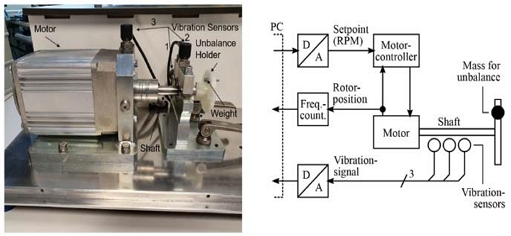
Configuration of the experimental equipment
The experimental data were divided into two groups (D and E). Group D experiments were conducted under conditions of a wide RPM range (630–2,330 rpm) and a small voltage increase (∆V = 0.05 V), whereas Group E experiments were conducted under conditions of a relatively narrow RPM range (1,060–1,900 rpm) and a large voltage increase (∆V = 0.1 V). In each environment, the voltage was increased once every 20 s and the experiments were conducted twice per experimental condition to increase the reliability of the collected data. The total number of data points collected was 128,767,426, with an average of 25,753,485 per ID.
Table 1 lists the detailed conditions for each data group. The data in each group were divided into details according to the imbalance condition (radius and mass) and could be easily identified through the ID. The ID comprised the group (D or E) and a number (0, 1, 2, 3, or 4) indicating the degree of imbalance.

Experimental conditions according to each data
Therefore, each data point collected based on this experimental environment consisted of the motor input voltage (V_in), rotation speed (Measured_RPM), and vibration signals (Vibration_1, Vibration_2, and Vibration_3). The motor input voltage and rotation speed were measured using the motor controller and collected using the vibration sensor data. These values were not measured by attaching sensors to the experimental equipment but were recorded based on the control status of the motor. The vibration signal was recorded from each sensor and provided important information for analyzing the imbalance condition.
3.2 Proposed Fault Detection and Determination Algorithm
Figure 2 shows the structure of the proposed algorithm. The time-domain data were converted into frequency bands by applying FFT to analyze the frequency-domain data. Subsequently, a DC offset removal process was performed to increase the reliability of the analysis. The DC offset indicates the state in which the average value of the signal is not 0. This is caused by various factors such as the nonlinearity of the sensor or instability of the power supply. Because this value can cause a large energy near 0 Hz during the frequency band analysis and distort the data analysis results, it was removed by calculating and subtracting the average value of the signal.
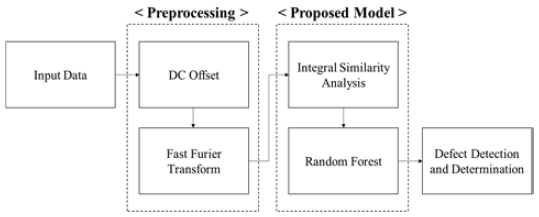
Structure of the proposed algorithm
After the DC offset was removed, five statistical (absolute mean, mean, variance, skewness, kurtosis) and four physical characteristics (peak-to-peak, root mean square (RMS), impulse factor, and shape factor) were extracted from the FFT results. These characteristics quantitatively represent the average tendencies, variability, asymmetry, and amplitude. The extracted characteristics were set as features for each sensor, and each “Case” was used as a label. The data frame was divided into 80% training data and 20% test data, and a standard scaler was applied to adjust the mean of the data to 0, with a standard deviation of 1. This standardized the data distribution to a normal distribution, thereby improving the learning efficiency and prediction performance of the machine-learning model.
The similarity between the remaining imbalanced and defect data was evaluated based on the normal state (Case 0). Similarity analysis quantitatively evaluates the difference between the normal and defect states and is applied to systematically analyze the degree of defect aggravation. The applied integral similarity effectively reflects the size and energy distribution of the signal by comparing the entire area. It is superior to the cosine similarity in analyzing the degree of defect aggravation or evaluating the overall trend.
To reflect the vibration characteristics according to the RPM change of the vibration signal as precisely as possible when creating the model training data frame, we examined a method of dividing it into 1 rpm units. However, some RPM values did not continuously exist in the original data, which resulted in missing values in certain sections. To solve this problem, various interval sizes were tested, and the analysis results, which increased the interval size by 1 rpm, confirmed that the smallest effective interval size was 5 rpm. The meaningful operating range (630–2,330 rpm) of the D group motor was divided into 5-rpm units, and each section data was converted into time-domain data into frequency-domain data using FFT, and similarity and similarity change characteristics were extracted by performing integration-based similarity analysis. The corresponding characteristics were set as features, and each case was designated as a label. The data were separated into training and test data, and the model was applied after learning.
3.3 Artificial Neural Network (ANN) Baseline
Figure 3 shows the structure of the ANN. A fully connected multilayer perceptron was constructed using Keras 3 running on TensorFlow 2.18. The network comprises five successive hidden layers with 24, 16, 12, 8, and 6 neurons, respectively, each employing the ReLU activation function to introduce nonlinearity. Its final layer is a softmax classifier whose size N matches the number of classes in each task: four output nodes for the radius dataset and two for the mass dataset. All parameters were learned with the Adam optimizer while minimizing categorical cross-entropy using mini-batches of 65,536 samples for a total of 1,000 training epochs; no early-stopping or learning-rate scheduling mechanisms were applied.
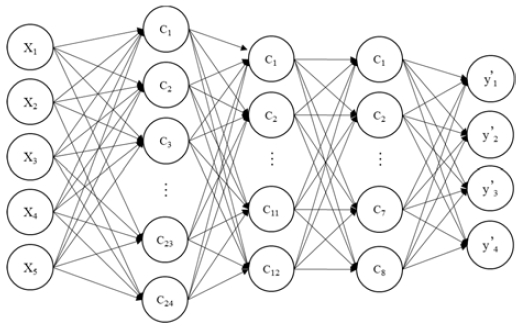
Structure of the ANN
4. Experimental Results
To analyze the data, we extracted the numerical features of the signals and subsequently applied them to the machine-learning models. Five statistical features (absolute mean, mean, variance, skewness, and kurtosis) and four physical features (peak-to-peak, RMS, impulse factor, and shape factor) were extracted. These features quantitatively represent various characteristics of the signal such as its central tendency, variability, asymmetry, energy level, and impulsive behavior.
Figure 4 shows the results after removing the DC offset. The presence of a DC offset can result in a significant energy concentration near 0 Hz when using frequency-domain transformation techniques such as the FFT, which poses a critical issue by degrading the reliability of data analysis. Therefore, removing the DC offset is essential. A common method to address this issue involves calculating the mean value of the signal and subtracting it from the original signal to eliminate the DC offset.
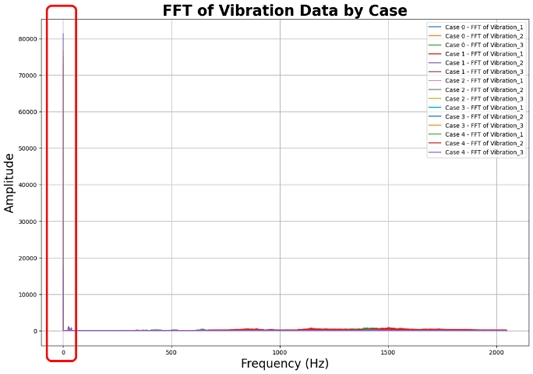
Result after the removal of the DC offset
The experimental data were extracted based on the vibration and RPM measurements taken at Vibration_1, Vibration_2, and Vibration_3 according to the measurement locations of the vibration sensors. Figure 5 presents the results of the cosine similarity analysis of the frequency domain. The x-axis represents the RPM, and the y-axis represents the similarity analysis value. Based on the normal state (Case 0), the results indicated the vibration measurements for each case from Cases 1 to 4.
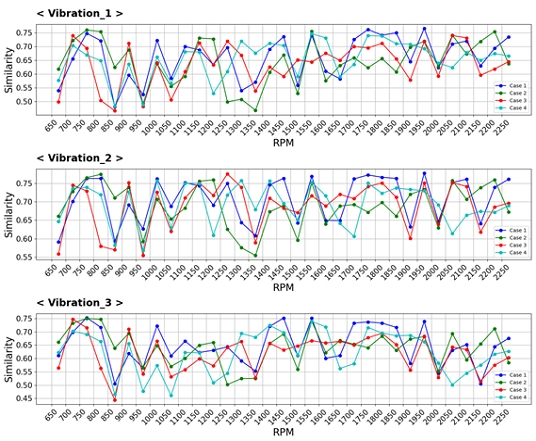
Results of the cosine similarity analysis of the frequency domain
The experimental results showed that the similarity of each case exhibited a certain relationship within specific RPM sections, with some differences observed between the similarity values.
However, compared with the results of the frequency-band integral similarity analysis, the similarity values between the cases tended to intersect or overlap more frequently in specific RPM sections, and the correlation of Vibration_3 was relatively weak. This indicated that although frequency-band cosine similarity is useful for identifying specific patterns based on the presence or absence of defects, it does not sufficiently capture characteristics such as signal amplitude or energy density. Consequently, it has limitations in clearly distinguishing the boundaries between defect states or in analyzing the degree of intensification in detail.
Figure 6 shows the results of the integral similarity analysis in the frequency domain. The x-axis represents RPM, whereas the y-axis represents the similarity value. The similarity of each case exhibited a clear relationship within specific RPM sections, and the difference in the similarity values between the defective and normal states was evident. Additionally, the variation in similarity values across different RPM sections within the defective state confirmed that the frequency-band integral similarity can effectively distinguish not only the presence of a defect but also the degree of defect aggravation.
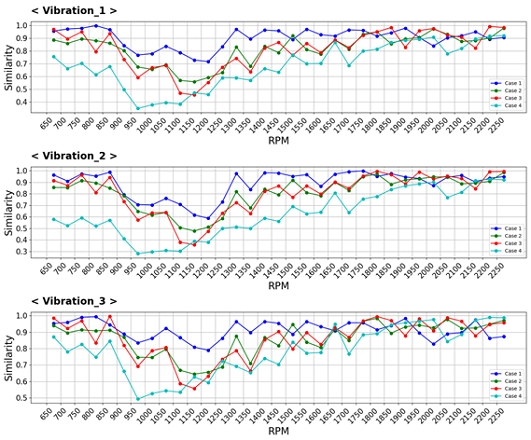
Results of the integral similarity analysis in the frequency domain
This is significant because it demonstrates that the frequency-band vibration data form a systematic and reliable pattern in response to changes in the RPM. When comprehensively evaluating the results of both time- and frequency-band similarity analyses, the frequency-band integral-based similarity analysis was considered to be the most suitable method for model learning and prediction. This is because it provides the clearest relationships and distinctions in the similarity values across different cases throughout the entire motor operating range.
Table 2 presents the results of machine learning based on the frequency-domain integral similarity analysis. Random Forest exhibited the best performance, with a high accuracy of 93%. This was interpreted as the result of an ensemble model combining multiple decision trees to learn the overall structure of the data and effectively utilize the interaction between features to stably reflect complex data patterns. The SVM recorded a high performance with an accuracy of 82% and effectively learned the nonlinear trend appearing in the similarity and the amount of change in the similarity by utilizing the RBF kernel.
Prediction performance of data learning models based on frequency-domain integration similarity analysis
Table 3 presents the evaluation results of the ANN using these indicators. In addition to overall accuracy, the ANN baseline was evaluated using class-balanced metrics. On the four-class radius task, it achieved a macro-averaged F1-score of 0.44 (precision 0.51 and recall 0.77 for the normal class, but only 0.40 and 0.25 for the most severe defect). For the two-class mass task, the scores increased to a macro- and weighted F1-score of 0.73, with precision/recall of 0.71/0.80 for class 0 and 0.77/0.67 for class 1. The internal analysis of confusion matrices showed that most misclassifications occur between neighboring severity levels, indicating that similarity-based features preserve a consistent gradation of fault intensity even when errors occur. Additionally, the headline ANN accuracy of 60% in Table 2 is simply the unweighted arithmetic mean of the separate radius (46%) and mass (73%) accuracies.
Evaluation results for each indicator of the ANN
The above results show that the random forest and SVM effectively learned global patterns and nonlinear relationships from similarity-based data and are particularly suitable algorithms for similarity-based fault detection and prediction models. In contrast, KNN, logistic regression, and ANN with multilayer perceptron structures exhibited limitations in learning the global features of similarity-based data. In addition, the prediction accuracy for each fault type of the random forest model with the highest accuracy was evaluated using the RPM. Through this, we analyzed whether the model is reliable and maintains stable performance throughout the entire motor operating range, and confirmed the change in classification performance according to the RPM section.
5. Conclusion
This study thoroughly analyzed the feasibility of detecting faults in rotating machinery based on the vibration data collected under various RPM conditions in an accelerated environment. Additionally, a new direction for data-driven maintenance technology is proposed. This study successfully enhanced the dynamic stability of rotating machinery and improved the reliability of fault detection by quantitatively evaluating the vibration characteristics and fault conditions across the entire motor operating range. This was achieved by integrating a similarity analysis-based approach with machine-learning techniques. The results of both the time- and frequency-domain analyses highlighted the significant impact of RPM variations on the vibration characteristics. Specifically, the increase in the amplitude and shift in the energy distribution associated with an imbalance in the high-RPM region provided crucial insights for early fault detection.
Furthermore, the proposed similarity analysis-based approach maintains computational efficiency and simplicity, requiring significantly less computational power than traditional numerical characteristic-based methods. This suggests that the proposed technique has potential for real-time applications in the future.
Acknowledgments
This paper was supported by the Technology development Program (G21002245633) funded by the Ministry of SMEs and Startups (MSS, Korea), and it improves upon Ui-Jin Kim's Master thesis (A Study on fault detection and prediction based on vibration data of motors, National Korea Maritime and Ocean University Graduate School).
Author Contributions
Conceptualization, U. -J. Kim and J. -H. Seong; Methodology, M. -S. Kim; Software, M. -S. Kim and U. -J. Kim; Validation, U. -J. Kim and J. -H. Seong; Formal Analysis, U. -J. Kim and J. -H. Seong; Investigation, M. -S. Kim and U. -J. Kim; Resources, U. -J. Kim; Data Curation, M. -S. Kim and U. -J. Kim; Writing—Original Draft Preparation, U. -J. Kim; Writing—Review & Editing, U. -J. Kim and J. -H. Seong; Visualization, M. -S. Kim and U. -J. Kim; Supervision, J. -H. Seong; Project Administration, J. -H. Seong; Funding Acquisition, J. -H. Seong.
References
- J. H. Jeong and J. U. Kim, “Equipment diagnosis through vibration measurement,” Fire Protection Technology, vol. 44, pp. 30-43, 2008.
- S. Durgam, L. N. Bawankule, and P. S. Khindkar, “Prediction of fault detection based on vibration analysis for motor applications,” 2021 4th Biennial International Conference on Nascent Technologies in Engineering (ICNTE), IEEE, pp. 1-5, 2021.
- K. Wang, Y. Yao, Y. Liu, X. Guan, Y. Yu, et al. “Self-powered system for real-time wireless monitoring and early warning of UAV motor vibration based on triboelectric nanogenerator,” Nano Energy, vol. 129, 110012, 2024.
-
S. Aguayo-Tapia, G. Avalos-Almazan, and J. J. Rangel-Magdaleno, “Entropy-based methods for motor fault detection: a review,” Entropy, vol. 26, no. 4, 299. 2024.
[https://doi.org/10.3390/e26040299]

-
M. Ertargin, O. Yildirim, and A. Orhan, “Mechanical and electrical faults detection in induction motor across multiple sensors with CNN-LSTM deep learning model,” Electrical Engineering, vol. 106, no. 6, pp. 6941-6951, 2024.
[https://doi.org/10.1007/s00202-024-02420-w]
-
A. D. Djordjevic, M. B. Milovanovic, M. T. Milojkovic, J. G. Petrovic, and S. S. Nikolic, “Endocrine CNN-based fault detection for DC motors,” Elektronika ir Elektrotechnika, vol. 30, no. 3, pp. 4-14, 2024.
[https://doi.org/10.5755/j02.eie.36747]
-
C. E. Sunal, V. Velisavljevic, V. Dyo, B. Newton, and J. Newton, “Centrifugal pump fault detection with convolutional neural network transfer learning,” Sensors, vol. 24, no. 8, 2442, 2024.
[https://doi.org/10.3390/s24082442]
-
H. Fan, C. Xue, X. Zhang, X. Cao, S. Gao, and S. Shao, “Vibration images‐driven fault diagnosis based on CNN and transfer learning of rolling bearing under strong noise,” Shock and Vibration, vol. 2021, no. 1, 6616592, 2021.
[https://doi.org/10.1155/2021/6616592]
-
B. A. Tama, M. Vania, S. Lee, and S. Lim “Recent advances in the application of deep learning for fault diagnosis of rotating machinery using vibration signals,” Artificial Intelligence Review, vol. 56, no. 5, pp. 4667-4709, 2022.
[https://doi.org/10.1007/s10462-022-10293-3]
-
S. J. Loutridis, “Self-similarity in vibration time series: application to gear fault diagnostics,” Journal of Vibration and Acoustics, vol. 130, no. 3, 031004, 2008.
[https://doi.org/10.1115/1.2827449]
- Y. W. Song, H. S. Lee, H. Park, Y. J. Kim, and J. Y. Jung “A signal processing technique for predictive fault detection based on vibration data.” Journal of Society for e-Business Studies, vol. 23, no 2, 2019.
-
S. Aburakhia, T. Tayeh, R. Myers, and A. Shami, “Similarity-based predictive maintenance framework for rotating machinery,” 2022 5th International Conference on Communications, Signal Processing, and their Applications (ICCSPA), IEEE, p. 1-6, 2022.
[https://doi.org/10.1109/iccspa55860.2022.10019121]
- S. Aburakhia, I. Hamieh, and A. Shami, “Joint instantaneous amplitude-frequency analysis of vibration signals for vibration-based condition monitoring of rolling bearings,” arXiv preprint arXiv:2405.08919, , 2024.
-
S. Misra, S. Kumar, S. Sayyad,A. Bongale, P. Jadhav, K. Kotecha, A. Abraham, and L. A. Gabralla, “Fault detection in induction motor using time domain and spectral imaging-based transfer learning approach on vibration data,” Sensors, vol. 22, no. 21, 8210, 2022.
[https://doi.org/10.3390/s22218210]
-
X. Guo, L. Chen, and C. Shen. “Hierarchical adaptive deep convolution neural network and its application to bearing fault diagnosis.” Measurement, vol. 93, pp. 490-502, 2016.
[https://doi.org/10.1016/j.measurement.2016.07.054]
-
H. Pan, X. He, S. Tang, and F. Meng, “An improved bearing fault diagnosis method using one-dimensional CNN and LSTM,” Journal of Mechanical Engineering/Strojniški Vestnik, vol. 64, 2018.
[https://doi.org/10.5545/sv-jme.2018.5249]
-
O. Mey, W. Neudeck, A. Schneider, and O. Enge-Rosenblatt, “Machine learning-based unbalance detection of a rotating shaft using vibration data,” 2020 25th IEEE International Conference on Emerging Technologies and Factory Automation (ETFA), IEEE, vol. 1, 2020.
[https://doi.org/10.1109/etfa46521.2020.9212000]