
A simplified modelling method using idealized structural elements for conceptual design of the scaffolding system of LNG carrier cargo

Copyright © The Korean Society of Marine Engineering
This is an Open Access article distributed under the terms of the Creative Commons Attribution Non-Commercial License (http://creativecommons.org/licenses/by-nc/3.0), which permits unrestricted non-commercial use, distribution, and reproduction in any medium, provided the original work is properly cited.
Abstract
LNG carriers require a membrane insulation system in the cargo hold to maintain cargo at cryogenic temperatures and protect the hull. To facilitate this installation, a large temporary scaffolding system is used inside the cargo hold, which have been continuously used since the early days of membrane LNG carrier construction. However, with the increasing diversity of cargo hold designs, the need for structural improvements and safety evaluations of scaffolding systems has grown. Shipyards are striving to enhance scaffolding structures and installation methods to maximize productivity. However, challenges arise due to the lack of performance data for the current scaffolding and discrepancies with domestic design standards. Additionally, some existing scaffolding systems do not fully meet local performance evaluation criteria, making structural safety assessments difficult. To address these issues, this study establishes a design and evaluation guideline that reflects the characteristics and usage conditions of LNG cargo scaffolding. Furthermore, an efficient and rapid idealized structural element assessment method is developed to evaluate scaffolding strength. The results confirm that the proposed method ensures structural safety and compliance with allowable standards. This approach and application enable quick structural strength assessments for initial design and modifications and is expected to be an applicable to the future development of new cargo hold scaffolding systems.
Keywords:
System scaffolding, LNG carrier cargo, Idealized structural element, Strength assessment, Membrane insulation system1. Introduction
LNG (Liquefied Natural Gas) carriers are specially designed vessels for transporting LNG at cryogenic temperatures. To maintain the LNG in its cryogenic state and protect the ship’s structure from heat, membrane insulation systems such as Gaztransport & Technigaz MARK III and NO96 [1] are employed on the cargo containment system. These insulation systems require the installation of temporary scaffolding inside the cargo holds to facilitate complex tasks, including the attachment of insulation materials, membrane welding, material transportation, and insulation system inspection.
The system scaffolding used for the installation of the MARK III insulation system in domestic shipyards has remained unchanged since the construction of the first membrane-type LNG carrier (Figure 1). Typically, approximately 2,000 tons of cargo hold system scaffolding is installed per 174K LNG carrier, forming a large-scale structure. Since such a large-scale structure undergoes various loads and environmental conditions, including installation, use, and dismantling over a six-month period, a structural safety assessment must be conducted under diverse conditions.
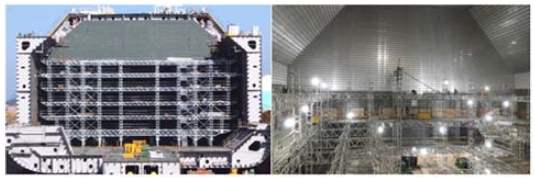
A Typical membrane-type LNG cargo hold system scaffolding
Furthermore, with the increasing number of LNG carrier orders in recent years, efforts have been made to improve scaffolding structures and installation/dismantling methods to maximize shipyard productivity. As the construction of fuel tanks and cargo holds with various geometries increases due to technological demands in the shipbuilding and offshore sectors—such as LNG FPSOs, fuel tanks for eco-friendly ships, and cargo holds—continuous advancements in design and safety assessments are required.
The previous studies related to the design and structural safety assessment of LNG cargo hold system scaffolding were reviewed as follows.
Oh et al. [2] studied the vibration characteristics of LNG carrier Cargo hold system scaffolding structures. Lee et al. [3] Developed automated design and evaluation software using equivalent stiffness element to improve the efficiency of LNG cargo hold scaffolding design. Shin et al. [4] developed a scaffold lifting method that allows shipyards to quickly erect scaffolding. Park and Shin [5] investigated securing methods for the maritime transportation of large-scale scaffolding modules. These studies primarily focus on shipyard practices and improvements in construction methods. However, they do not provide detailed procedures and methods for the structural safety evaluation of scaffolds under actual insulation installation working conditions, nor does it establish a methodology for the development of new scaffolds. Moreover, there are also inconsistencies in evaluation methods and criteria, emphasizing the need for regulatory analysis to establish consistent evaluation methods and criteria.
The following are representative studies that analyze the design criteria for scaffolding and temporary structures and develop new products. Lee [6] proposed a new concept for replacing existing temporary scaffolding used in power plant maintenance to enhance safety and verified its applicability through real-site implementation. Kim [7] developed temporary floor post structure using high-strength materials based on domestic design regulations and performance standards. The structural performance of existing product and the developed product was analyzed. Park et al. [8] developed a new bracing product and evaluated its strength using domestic design regulations. Kim and Roh [9] reviewed the domestic design standards for scaffolding and presented a reasonable wind load calculation and load combination for the strength evaluation of steel pipe scaffolding.
Lastly, previous studies have been conducted on the simplification of FE modeling using idealization methods such as equivalent stiffness element [10][11]. Most of these studies focused on modeling complex structures—such as truss structures in bridges, framed buildings, and sandwich panels—using equivalent stiffness elements to evaluate their strength and natural frequencies.
Most of the previous research has focused on system scaffolding for buildings or on the transportation of LNG cargo hold system scaffolding. As scaffolds of various shapes are required, and rapid design is required, research on evaluation procedures for the use conditions of fundamental LNG cargo hold system scaffolds, research for new product development, and research on rapid evaluation methods are necessary.
Therefore, this study established a standardized design and evaluation procedure for existing cargo hold system scaffolding. Additionally, to improve the inefficiencies of FE modeling using commercial finite element analysis methods, idealized structural elements for LNG cargo hold system scaffolding were developed and validated to enable more accurate and efficient structural strength assessments.
2. Establishment of Structural Evaluation Procedure for Cargo Hold System Scaffolding
2.1 Key Characteristics of System Scaffolding
To establish a strength evaluation procedure for the cargo hold system scaffolding, it is first necessary to analyze the structural features that are important when evaluating scaffolding strength and the work conditions that are crucial from a structural strength perspective. The basic information of the cargo hold system scaffolding is presented in Table 1. The main components include horizontal members, vertical members, diagonal members, brackets, legs, central work platforms, floor, and wooden plywood. Unlike system scaffolding used in building construction, the insulation panels are larger, requiring wider column spacing. To support heavy loads, the horizontal and vertical members are designed as a combination of two high-strength truss structures. Additionally, the system scaffolding includes a sliding structure that allows for length adjustment at each stage of insulation installation.

Characteristics of LNGc CCS’s system scaffolding
The scaffolding system of the cargo containment system in LNG carriers has the following three unique structural characteristics for the installation of the insulation system.
① Scaffolding Structure with Irregular Shape Due to Cargo Hold Configuration
The cargo hold of an LNG carrier has an octagonal cross-sectional shape designed to suppress the sloshing load of the liquid cargo. The system scaffolding, which is installed inside the cargo hold to attach insulation, must also have the same shape. Consequently, the system scaffolding in the cargo hold experiences load concentration in the lower lateral structures due to its irregular shape, making strength evaluation of these areas crucial. Recently, the octagonal shape has been undergoing various modifications depending on the size and type of the vessel, leading to frequent design changes.
② Central Work platform Structure for Equipment and Material Storage
A spacious work area, such as the central section shown in Figure 2, is required for stacking insulation materials and placing equipment. This area is designed to maximize work efficiency by providing sufficient space for stacking, storing, transporting, and installing insulation materials, as well as accommodating the necessary equipment for insulation installation. Additionally, since insulation materials must also be installed on the upper surface of the cargo hold, typically two large central work areas are needed for each cargo hold. The structure of the central area must be designed to support heavy material stacking and operational loads due to the large working area, with the connections and overall structure designed to adequately support these loads.

Key Characteristics of System Scaffolding
③ Scaffolding Leg Structure with Lifting Function
The cargo hold consists of a total of ten surfaces, with the corners and the bottom of the cargo hold requiring the most time for the installation of insulation material. Since the legs of the scaffolding support the cargo hold bottom, physical interference occurs during the insulation installation process. To avoid this interference, the scaffolding legs need to be lifted repeatedly as shown in Figure 2, which causes the weight of the scaffolding and the working load to be concentrated on the surrounding legs. Therefore, the leg structure of the scaffolding must be designed to effectively withstand and distribute the concentrated load. Additionally, the lifting conditions of the legs located under the lateral and center structures mentioned in features 1 and 2 should be prioritized for strength evaluation.
2.2 Structural Safety Assessment
The design and performance standards for system scaffolding, which is a temporary structure, must comply with the regulations of the country where the structure is fabricated and operated. In South Korea, design loads, load combinations, safety factors, design procedures, and allowable stress design are established based on government regulations (e.g., KDS 21 10 00[12], KDS 21 60 00[13], KDS 14 31 10[14]). However, these standards are generally intended for building construction and are insufficient for application to the currently used cargo hold system scaffolding in South Korea. Therefore, there is a need for the establishment and study of regulations suitable for the cargo hold system scaffolding of LNG carriers.
This study has established a system scaffolding strength evaluation procedure by referencing the domestic allowable stress design method for steel structures, scaffolding design regulations, and AISC/API standards. The process from selecting the design target to evaluating the scaffold components and assessing the overall scaffolding arrangement is presented in Figure 3.

Procedures for structural safety assessment of the system scaffolding
After selecting the design target and load, strength calculations and tests of the scaffold components are carried out based on the conceptual design of the scaffold arrangement. Once the assessment of each component is complete, a detailed design of the scaffold arrangement is carried out. Before evaluating the full model of the scaffolding structure, which can weigh up to 500 tons, finite element analysis (FEA) is performed on both typical part models and irregularly shaped part models. If the analysis results of the part models satisfy the allowable criteria, a final evaluation is performed to assess the stress of the full-scale scaffolding structure and the reaction force under leg-lifting conditions.
2.3 Numerical Analysis Model and Analysis Conditions
The structural strength analysis of the cargo hold system scaffolding was conducted using a commercial finite element software specialized for system structural behavior, SACS Offshore Structure [15], employing one-dimensional beam-column elements.
The part and full models of the 180K LNG cargo hold system scaffolding were selected for strength evaluation. The model was developed considering the connectivity of hinge-connected components at the nodes between the one-dimensional beam elements. The full model is a large-scale truss structure, consisting of approximately 120,000 elements and 50,000 nodes.
The part model and full model, along with their conditions, were selected based on domestic scaffolding design regulations and considering the characteristics of the system scaffolding. The modeling and analysis conditions are illustrated in Figure 4 and Table 2.
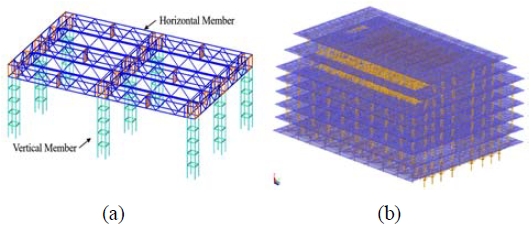
3D Modeling of the Cargo hold System Scaffolding: (a) Part Model, (b) Full Model
Analysis Model Information
As shown in Figure 4(a), the part model, consisting of a basic combination of horizontal and vertical members, was selected. The full model, as illustrated in Figure 4(b), represents the scaffolding model for a single cargo hold of a 180,000m³ LNG carrier. The analysis of the full model considers two boundary conditions: one where all legs are supported and another representing a severe condition from a strength perspective, in which the legs in the first row of the outermost section are lifted.
Table 3 presents the analysis results of Maximum Unit Check (UC), stress, and reaction forces for both the part model and the full model. In the part model, the maximum UC occurs at the connection points of vertical and horizontal members, where the stress is higher compared to the horizontal members. In the full model, the maximum UC is observed in the lower structure where the load is concentrated. In the case of leg lifting, the maximum UC increases by 1.43 times and the leg reaction force increases by 1.82 times compared to the full leg supported condition. This confirms that the leg lifting condition is the most critical from the structural strength perspective of the system scaffolding. Therefore, the evaluation of the leg lifting condition is essential and should be prioritized in the design and structural safety assessment of the system scaffolding.
Analysis Results
The structural strength evaluation results for both the part model and the full model confirm compliance with the domestic allowable stress design standards for steel structures. In the part model, the maximum UC of the horizontal members is 0.31, indicating a sufficient margin compared to the allowable limit (1.0). Similarly, in the full model, the structural response of the upper structure is found to be smaller than that of the lower structure. Therefore, due to the sufficient safety margin, it is considered possible to optimize the weight of the upper scaffolding structure, thereby reducing the self-weight of the upper scaffolding and consequently decreasing the stress and reaction forces in the lower scaffolding structure. Ultimately, reducing the overall weight of the system scaffolding is expected to provide various benefits in terms of installation and dismantling efficiency.
3. Idealized Structural Element Full Model Evaluation Method
3.1 Determining of Idealized Structural Element
Using a full-scale model requires significant time and effort for member definition and modeling, increasing the risk of human errors. Additionally, since the highest structural response occurs in the lower structure of the scaffolding under the leg-lifting condition, applying idealized structural elements to the upper structure—where stress evaluation is less critical—is an efficient and practical modeling approach.
To overcome the inefficiencies of full-model evaluation, a new finite element (FE) analysis method was developed using idealized structural elements with equivalent mass and stiffness to those of a unit truss structure composed of two members. First, the behavioral characteristics were analyzed based on FE analysis results and beam theory, determining the section properties and shear stiffness coefficients of the idealized elements. Through this analysis, idealized structural elements for horizontal and vertical members were derived.
As shown in Figure 5(a), the unit truss structure composed of four steel pipes was transformed into an idealized one-dimensional structural element with equivalent stiffness in the form of a beam. This idealized structural element must accurately represent the self-weight distribution of the scaffolding model and the stress and reaction forces in the lower structure under the leg lifting condition. In the full-scale model, the dominant load is approximately 500 tons, which is the self-weight of the scaffolding. Particularly under the leg lifting condition, the cumulative self-weight of the scaffolding from the upper structure to the lower structure induces bending, compression, and shear deformation behavior throughout the entire system, as illustrated in Figure 5(b). Therefore, this idealized structural element must precisely simulate these stiffness characteristics to ensure an accurate representation of the structural response.

Unit truss model and deformation full model
To define the stiffness of the idealized structural element, a finite element analysis (FEA) was conducted on a unit cantilever truss structure under simplified cantilever beam conditions. When only a moment load is applied to the truss structure, bending deformation occurs, and when a concentrated load is applied, both shear deformation and bending deformation occur. The deformation amounts for the two load cases with different deformation modes were calculated respectively.
The difference between the finite element analysis (FEA) results of the unit cantilever truss structure and the Bernoulli-Euler beam theory calculations (which do not account for shear deformation) was computed to quantify the shear deformation. Based on this, the area moment of inertia (𝐼) and the shear stiffness factor (𝐾) of the idealized structural element were defined for each unit element and its corresponding structural members. In other words, the shear stiffness factor (𝐾) is a coefficient applied to the shear modulus (𝐺) as defined in beam theory, serving as a parameter to adjust the effective shear area of the structure.
The cross-section properties of the idealized structural element are defined in the following sequence:
- ① Calculate the mass, cross-sectional area, area moment of inertia (𝐼), and length of the unit truss structure (composed of four steel pipes).
- ② Develop the finite element model of the unit truss structure.
- ③ Compute the deflection of a cantilever beam using beam theory equations and finite element analysis (FEA).
- ④ Compare the deflections obtained from beam theory equations and FEA under moment loading.
- ⑤ Determine the difference in deflection.
- ⑥ Define the area moment of inertia (𝐼) for the idealized structural element.
- ⑦ Compare the deflections obtained from beam theory equations and FEA under concentrated loading.
- ⑧ Compute the difference in deflection to determine the shear deformation.
- ⑨ Define the shear stiffness factor (𝐾) for the idealized structural element to match the computed shear deformation.
3.2 Definition of Sectional Properties
The sectional properties of the idealized structural elements were derived for three representative horizontal members and two vertical members among the scaffolding components of the cargo containment system. Figure 6 illustrates the cross-sectional model of the unit truss structure composed of four steel pipes, and the cross-sectional properties of the five-unit trusses are presented in Table 4.

Cross-Section of Unit Truss structure
Geometrical and Sectional Properties
Using the truss cross-section data and the finite element model, deflections under a unit moment load (M=100 MN·mm) and a concentrated load (F=10 kN) in a cantilever beam condition were calculated, and the deformation results are presented in Figure 7. The deflection in the section Z-direction, which is the same direction as the direction of the scaffold's self-weight and work load, as shown in Figure 6(a), was calculated. The differences in deflection between the finite element analysis (FEA) results and the theoretical beam equations (EBB: Euler-Bernoulli Beam) were compared and analyzed.

Analysis Results of Unit Truss Structure
The results of deflection in the section Z-direction are presented in Table 5. Under moment loading, the difference between the FEA results and the EBB results is less than 0.1 mm, indicating bending deformation similar to that of a uniform cross-section beam. However, under concentrated loading, shear deformation varies depending on the truss configuration and length, leading to differences in deflection. Therefore, the bending stiffness of the idealized structural element is determined by applying the area moment of inertia of the four steel pipe cross-sections, while the shear stiffness is derived by calculating the shear stiffness factor (𝐾), which is linearly related to the difference in deformation between the FEA and EBB results.
Results of Cantilever Deflection for Unit Truss
The sectional properties of the idealized structural elements, determined based on the sectional properties and deformation results of the unit truss structure, are summarized in Table 6 for both the Z-direction and Y-direction. These properties include cross-sectional area, weight, area moment of inertia, and shear stiffness factor. To validate these defined idealized structural elements, finite element analysis (FEA) of a cantilever beam condition was performed. The results confirmed that the idealized structural elements possess equivalent stiffness with a discrepancy of less than 0.01 mm. The analysis results for the vertical and horizontal members are presented in Figure 8.
Definition of Sectional Properties of Idealized Structural Elements

Results of the cantilever beam condition with concentrated load analysis for the idealized structural elements
3.3 Evaluation of the Cargo Hold System Scaffolding Model Using Idealized Structural Elements
To verify the effectiveness of the idealized structural element method, the analysis results of the full model incorporating the idealized structural elements were compared and analyzed with those of the conventional full model.
The full modeling of the cargo hold system scaffolding was performed using the previously defined cross-sectional properties of the idealized structural elements. As shown in Figure 9, The idealized structural elements were applied to the upper portion of the full-system scaffolding model, while the sections from the legs, which are the lowest parts of the scaffolding, to the level 1 upper vertical member height were modeled using the conventional method.
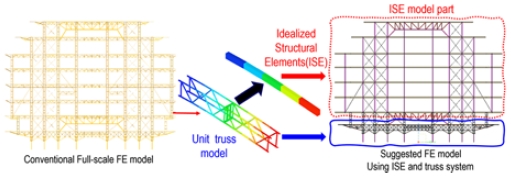
Full Model with applied Idealized Structural Element
The full-scale model incorporating the idealized structural elements consists of 18,000 elements and 7,000 nodes, significantly reducing the degrees of freedom. The stress and reaction forces of the lower structure were evaluated using the same methodology as in Chapter 2.
The maximum combined stress results for each condition are shown in Figure 10. Under the full leg support condition, a combined stress of 130.5 MPa was observed, while under the leg lifting condition, the combined stress increased to 181.7 MPa (Figure 10(a)). These maximum stresses occurred at the same scaffolding component as in the conventional FEA analysis. Similarly, the maximum reaction force values were found to be at comparable levels. However, when examining the overall distribution of leg reaction forces across the cargo containment system, significant differences were observed in areas where the scaffolding geometry changes abruptly or around the lifted legs (Figure 10(b)).
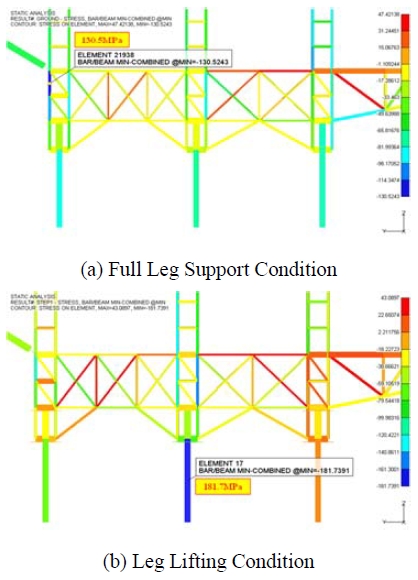
Maximum Stress Results for Each Support Condition
Along with the comparison of the maximum stress and maximum reaction force results, the changes in the scaffold leg reaction forces due to the application of idealized structural elements were summarized in Table 7 by comparing the reaction forces at identical locations. The error rates for each result value were calculated as follows:
| (1) |
Comparison of Analysis Results for the Idealized Structural Element (ISE) Model
The error rate for the maximum combined stress was -10.6%, while the error rate for the maximum reaction forces was 3.7%. Although the error rates for the maximum values are small, when calculating the error rate for the leg reaction force at the same location, it was observed that under the leg lifting condition, the error rate for the reaction force at the same leg position reached a maximum of -16.9%. Therefore, when applying idealized structural elements to the full-scale model evaluation, an additional safety margin of more than 16.9% must be considered.
Notably, the primary advantage of the ISE approach lies not in reducing solution time alone, but rather in significantly enhancing modeling efficiency. For example, while the full model requires considerable time for detailed geometry generation, mesh refinement, and boundary condition setup, the ISE model simplifies these tasks, resulting in a reduction in modeling and preprocessing time by more than 92% (based on engineering workflow).
When applying the idealized structural elements, differences in stress and reaction force distribution at certain leg positions are expected to result from variations in mass distribution and stiffness in the idealized scaffolding model. In particular, the significant differences in reaction forces around the lifted legs suggest that these discrepancies arise from differences in the overall stiffness representation of the complexly assembled system scaffolding.
In this study, idealized structural elements were applied to five representative components. However, incorporating additional components into the calculation and applying them to the model would likely reduce the error rate and enable more accurate evaluations. Furthermore, instead of considering only the stiffness of vertical and horizontal members, future studies should include the stiffness of the assembled system, including vertical, horizontal, diagonal, and connecting members. Additionally, investigating and incorporating the rotational stiffness of uniquely designed connection components would further improve the accuracy of simulating the actual behavior of the scaffolding structure.
4. Discussion
4.1 Implementation of the ISE
It is noted that the current implementation of the Idealized Structural Element (ISE) model is limited to three horizontal and two vertical components, which were selected to effectively demonstrate the proposed methodology in a simplified framework. Other structural members such as diagonal braces and connector regions have not been included at this stage. Future developments of the ISE approach may consider these components by incorporating equivalent stiffness elements for diagonal bracing systems or spring-based models to simulate connector behavior, thereby enhancing the model's comprehensiveness without altering its core formulation
While the present study focuses on static self-weight and working load conditions to establish a baseline for evaluating the mechanical behavior of the scaffolding system, it is important to recognize that additional dynamic or transient loads may occur in actual shipbuilding environments. In particular, scenarios such as towing operations with scaffolding installed inside the cargo hold, motion induced by typhoons, or inclining tests performed during construction can impose significant lateral loads on the temporary scaffolding structures. These lateral forces may cause structural responses different from those under longitudinal loading, emphasizing the importance of careful design and placement of critical components such as side support members and diagonal bracing elements. Although such loading conditions were not explicitly modeled in this study, they represent important considerations for future work. The proposed methodology may be extended to incorporate these realistic load cases, thereby improving the reliability and applicability of the scaffolding system under various ship construction scenarios.
The efficiency of ISE becomes particularly valuable in repetitive design tasks commonly encountered in shipbuilding environments, such as: (1) iterative refinement of structural layout in early design phases, (2) parametric optimization of scaffolding geometry for various cargo hold shapes, and (3) scenario-based evaluation across multiple bays or cargo hold configurations. In such cases, repeatedly constructing or modifying full models is time-consuming, whereas the ISE model allows for rapid adjustments and analysis, making it far more suitable for iterative workflows.
Therefore, the ISE approach contributes not only to improved computational performance but also to overall engineering productivity. It serves as a practical and flexible tool, especially beneficial during conceptual design or when multiple design iterations are required under time constraints.
4.2 Limitation and Outlook of the ISE
In this study, the boundary condition applied to the partial model using the ISE method was defined as simple supports, considering that the ISE approach is intended for use during the early conceptual design stage. This conservative assumption is commonly adopted in preliminary analyses to avoid overestimating structural stiffness, and it was found that the global structural behavior under this condition reasonably reflected the expected response trends.
However, a more comprehensive evaluation involving alternative boundary conditions and quantitative comparison with full-model analysis should be conducted during the detailed design phase. These aspects are recognized as important future research topics, and their limitations are clearly acknowledged within the scope of this study.
It should be noted that the idealized structural element (ISE) model used in this study is intended for evaluating global structural behavior, and thus does not account for localized stress effects, such as punching shear at member connections or bolts. As such, punching shear checks (PS) were not explicitly performed in the current framework.
However, in practical scaffolding equipment design, connection regions and bolt areas are identified as structurally critical zones and are generally designed with higher strength margins than standard members. This ensures that potential vulnerabilities, such as punching shear failure, are inherently addressed during the hardware design phase. For applications requiring detailed verification of joint performance, local connection modeling and punching shear evaluation should be conducted as a supplementary step, particularly in advanced design or certification stages.
5. Conclusion
In this study, the structural strength evaluation of the LNG carrier cargo hold system scaffolding was conducted by considering domestic regulations and actual operating conditions. Additionally, to improve the inefficiencies in modeling and evaluation during the structural strength assessment of the cargo hold system scaffolding, a full-scale model evaluation method using idealized structural elements was proposed. For this purpose, idealized structural elements were derived to represent the bending and shear stiffness of the truss structure. The effectiveness of the proposed evaluation method was examined by comparing and analyzing the results with those obtained from conventional analysis methods. Based on the research process, the following conclusions were drawn:
- • To efficiently evaluate the structural strength of the cargo hold system scaffolding, the part model and full-scale model evaluations were sequentially performed according to the procedures presented in Chapter 2. As a result, it was confirmed that the currently used system scaffolding meets the allowable stress criteria for steel structures, both domestically and internationally.
- • In the part model, the maximum Unit Check (UC) occurs at the vertical members connected to the horizontal members, indicating higher stress compared to the horizontal members. In the full-scale model, the maximum UC is observed in the lower structure. When the legs are lifted, the maximum UC increases by 1.43 times, and the leg reaction force increases by 1.82 times. This confirms that the leg lifting condition for installing the insulation system on the bottom surface of the cargo containment system is the most critical condition in terms of structural strength.
- • The difference between the finite element analysis (FEA) results of the unit truss structure and the Bernoulli-Euler beam theory results (which do not account for shear deformation) was calculated to determine the shear deformation. Based on this, the area moment of inertia and shear stiffness factor of the idealized structural elements were defined for each component.
- • By applying the idealized structural elements, the full-scale model was reduced to 18,000 elements and 7,000 nodes, significantly decreasing the degrees of freedom. Compared to the results of the conventional model, the maximum combined stress exhibited an error rate of -10.6%, while the maximum lower reaction force showed an error rate of 3.7%. The change in reaction force at the same leg position reached 16.9% under the leg lifting condition.
The structural strength evaluation method for the cargo hold system scaffolding and the assessment approach using idealized structural elements, as developed in this study, are expected to serve as valuable reference data for the future development of cargo hold system scaffolding.
Acknowledgments
This work was supported by the National Research Foundation of Korea (NRF) grant funded by the Korea government. (MSIT) (RS-2024-00348014).
Author Contributions
Conceptualization, S. Oh; Methodology, S. Oh and J. K. Seo; Formal Analysis and Investigation, S. Oh; Resources, J. S. Park; Data Curation J. K. Seo; Writing-Original Draft Preparation, S. Oh; Writing-Review & Editing, J. K. Seo; Visualization, S. Oh; Supervision, J. K. Seo; Funding Acquisition, J. K. Seo and J. S. Park.
References
- GTT technology for a sustainable world, https://gtt.fr/technologies/markiii-systems, , Accessed February 22, 2025.
- B. J. Oh, B. J. Ryu, and Y. S. Lee, “Structural and vibration characteristics for the scaffolding system of LNG cargo containment,” Transactions of the Korean Society for Noise and Vibration Engineering, vol. 20, no. 6, pp. 546-554, 2010 (in Korean).
-
H. T. Lee, S. B. Shin, and Y. K. Park, “Development of the automatic design program for scaffolding system of the membrane LNG carrier,” Journal of the Society of Naval Architects of Korea, vol. 47, no. 2, pp. 233-241, 2010 (in Korean).
[https://doi.org/10.3744/snak.2010.47.2.233]

- S. H. Shin and D. E. Ko, “A study on 8-stage loading method of the scaffolding module for LNG carriers,” Journal of the Korea Academia-Industrial Cooperation Society, vol. 21, no. 11, pp. 78-85, 2020 (in Korean).
- M. C. Park and S. H. Shin, “A study on lashing plan for marine transport of large scaffolding module for LNG carriers,” Journal of Social Convergence Studies, vol. 6, no. 3, pp. 25-35, 2022 (in Korean).
- T. H. Lee, Development of Scaffolding System for Furnace Maintenance of Large Supercritical Power Plants Considering Structural Performance, Master's Thesis, Chungnam National University, Deajeon, 2016.
- G. M. Kim, Field Application Evaluation of System Support using High Strength Steel, Ph. D. Dissertation, Cheongju University, Chungcheongbuk-do, 2020.
- J. D. Park, H. S. Lee, W. S. Shin, Y. J. Kwon, S. E. Park, S. S. Yang, and K. Jung, “Structural Capacity Evaluation of System Scaffolding using X-Type Advanced Guardrail,” Journal of the Korean Society of Safety, vol. 35, no. 5, pp. 49-58, 2020.
- S. N. Kim and Y. S. Roh, “An analytical study for safety check of steel pipe scaffolding - analysis of wind load and load combinations,” Journal of the Architectural Institute of Korea, vol. 39, no. 9, pp. 195-203, 2023.
- M. Y. Kim and S. Y. Jung, “Stability and free vibration of plane truss structures using the shear flexible beam element,” Journal of the Korean Society of Steel Construction, vol. 8, no. 2, pp. 193-203, 1996 (in Korean).
- I. S. Choi and I. H. Ye, “Static and free vibration analyses of hybrid girders by the equivalent beam theory,” Journal of the Korean Society for Railway, vol. 10, no. 5, pp. 600-606, 2007.
- KDS 21 10 10 : 2022, General Provisions for Temporary Structures Design Ministry of Land, Infrastructure and Transport, 2022 (in Korean).
- KDS 21 60 00 : 2022, Design Standard for Scaffolding and Safety Facilities, Ministry of Land, Infrastructure and Transport, 2022 (in Korean).
- KDS 14 31 10 : 2024. Design Standard for Steel Structure Members (Allowable Stress Design), Ministry of Land, Infrastructure and Transport, 2024 (in Korean).
- SACS User's manual, Introduction of linear and nonlinear analysis and its application of shell modelling. Bently systems, 2018.