
Study on the application of engine performance check and combustion analysis practices to improve CII attained on existing vessels

Copyright © The Korean Society of Marine Engineering
This is an Open Access article distributed under the terms of the Creative Commons Attribution Non-Commercial License (http://creativecommons.org/licenses/by-nc/3.0), which permits unrestricted non-commercial use, distribution, and reproduction in any medium, provided the original work is properly cited.
Abstract
The IMO MEPC 80th session set a goal for net-zero emissions by 2050, with additional CII enhancement measures expected after 2027. While measures such as slow-down operation and energy-saving devices (ESD) are required to improve the CII of existing ships, reducing fuel consumption is a top priority. In this study, we analyzed the P-𝛳 diagram and rate of heat release information obtained through engine performance checks to validate the potential for CII improvement by reducing fuel consumption and improving the combustion efficiency of the engine without any external measures such as retrofitting. After measuring the main engine output of two merchant ships and adjusting the VIT, the CII rating of one ship was improved from D2 to D1 by increasing ⊿P by 6.2 bar and reducing fuel consumption by about 3.7%, and the CII rating of the other ship was improved from D3 to D2 by increasing ⊿P by 8.4 bar and reducing fuel consumption by approximately 4.6%. This confirms that the CII rating can be improved through engine performance checks and combustion analysis, and future research will be expanded to consider external factors.
Keywords:
CII attained, Engine Performance, Combustion Analysis, Variable injection timing (VIT), Environmental Regulations1. Introduction
At the 72nd session of the Maritime Environment Protection Committee (MEPC) (April 2018), member states of the International Maritime Organization (IMO) approved the IMO's initial strategy for reducing greenhouse gas emissions and agreed to continue to revise the strategy until its adoption in 2023. However, at the 80th MEPC, the carbon intensity index (CII) is expected to be significantly strengthened after 2027, in line with the resetting of the IMO's goal to reach net-zero emissions by 2050.
Two main types of measures can be taken to improve the CII rating: operational and technical. Typical operational measures include slowing down, using biofuels, and using shore power supplies, each of which is characterized by the following:
First, a slow-down operation is an effective and simple way to improve the CII rating because it increases the operating time but reduces CO2 emissions by reducing fuel consumption. The use of biofuels has a significantly lower carbon emission factor, as the life cycle assessment of the fuel considers the carbon absorbed by the feedstock during its production; however, biofuels must meet stringent certification requirements and are expensive. Finally, the use of shore power supplies can be somewhat favorable for improving the rating, as it can reduce CO2 emissions during berthing in ports if the power required by the ship is supplied from the shore instead of onboard generators.
Technical measures include air lubrication systems, rotor sails, propeller modifications, and main engine fuel efficiency improvements. The air lubrication system blows air on the bottom of the hull to form an air layer between the hull surface and the seawater to reduce frictional resistance, and previous studies have shown energy savings of 2 to 5% for BDR, 8 to 14% for ALDR, and 16 to 22% for PCDR (Kim Young Rong et al., 2023).
Rotor sails are a type of wind-assisted propulsion system that utilizes the Magnus effect, and energy savings of 6–8% can be expected (sun et al., 2020). A previous study simulated a 3-m-class rotor sail on a 17-k bulk carrier, yielding savings of approximately 10.12% (kim et al., 2024).
Propeller part modification improves the efficiency by applying various types of structures to the stern boss to complement the propeller's wake resistance. A prior study showed that WAFon and WAFon-D reduced the transmitted power by approximately 3.0% and 6.1%, respectively (Kim et al., 2015), and the ring stator reduced the transmitted power by approximately 3.4% (Kang et al., 2021).
Representative technologies for improving the fuel efficiency of the main engine include engine part-load optimization (EPLO), turbocharger cut-out, and exhaust waste gate. In particular, a previous study showed a fuel economy saving effect of approximately 4.2% owing to improved combustion conditions by adjusting the fuel injection timing, turbocharger, and fuel injection amount (Jung et al., 2019).
As shown above, various methods are being researched and applied to improve the CII rating of existing ships, but it can be seen that the operational measures are not permanent improvement methods, and the technical measures require additional systems to be applied through the physical modification of equipment. Therefore, it is necessary to bear significant costs and physical losses, such as time. Based on these previous studies, it can be seen that the main engine fuel efficiency improvement method does not require modification to install energy saving devices (ESD), is cost-effective, and can be implemented immediately to improve the CII rating without time loss.
This study analyzes the calculation formula of the CII and the important operational factors of the main engine to determine the variables that can be adjusted through the improvement of the main engine fuel efficiency among the CII, and to study how to improve the CII rating by improving the adjustable CII variables by improving the fuel efficiency through engine performance check and combustion analysis of the ship.
2. Methodology of the Study
As mentioned in the introduction, this section first analyzes the calculation formula for the CII to identify variables that can be adjusted to improve main engine fuel efficiency. Subsequently, we analyze the correlation of important operating factors using main engine shop test performance report. The study then explores methods to improve the CII rating by determining potential areas for fuel efficiency improvement through engine performance check and combustion analysis of existing vessels, followed by the adjustment and optimization of the corresponding factors.
2.1 Carbon Intensity Index Formula
The attained CII is calculated based on IMO DCS data, and the calculation formula is shown in Equation (1).
| (1) |
where FCj is the annual fuel consumption by fuel type, and Cfi is the conversion factor by fuel type for converting fuel consumption to CO2 emissions, as specified in the EEDI calculation guidelines (Res.MEPC.308(73)). Capacity is applied as gross tonnage (GT) or deadweight tonnage (DWT), depending on the type of ship.
Meanwhile, the formula for calculating the reference CII is shown in Equation (2):
| (2) |
where “-a” and “-c” are parameters derived based on the individual ship's capacity and CII attainment using IMO DCS data, with values varying by ship type and capacity.
In addition, the Required CII is calculated by applying the annual reduction rate to the ship’s reference value, as shown in Equation (3).
| (3) |
where “Z” is the CII reduction factor for each year, the same reduction factor is applied to all ships regardless of type and size.
The levels of the CII range from A to E, and the boundary for each level is a range that reflects the dd vectors of the allowable CII values, with the dd vector values varying by ship type and size.
This implies that, among the Attained CII, Referenced CII, and Required CII, the only variables that can be adjusted during operation without retrofitting are the Attained CII values—specifically, fuel consumption and distance traveled in the formula.
2.2 Fuel Consumption
The relationship between main engine fuel consumption and power output was first compared and reviewed by comparing the engine shop test reports conducted prior to engine delivery to the ship.
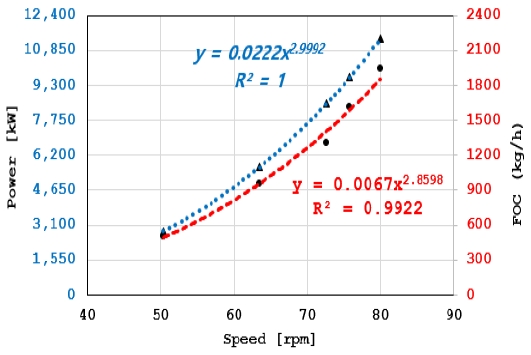
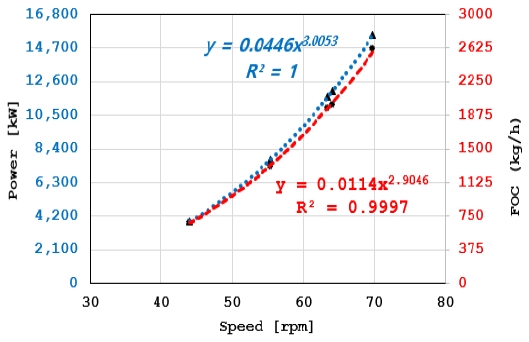
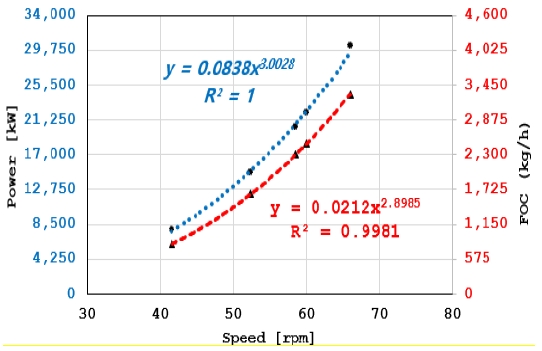
Tables 1–4 and Figures 1–4 present the results of the review of the engine shop test reports for the 6G50ME-C, 6G60ME-C, 6G70ME-C, and 6G80ME-C engines. The 6G50ME-C is a 50,000 DWT chemical carrier, and the 6G60ME-C is a 115,000 DWT product carrier. The 6G70ME-C is a 180,000 DWT bulk carrier, and the 6G80ME-C is a 300,000 DWT crude oil tanker. The relationship between fuel consumption and power output varies depending on the ship’s type, form, and size.

Fuel Consumption Table by Load, 6G50ME-C
Fuel Consumption Table by Load, 6G60ME-C
Fuel Consumption Table by Load, 6G70ME-C
Fuel Consumption Table by Load, 6G80ME-C

Relation between Fuel Consumption, Speed, and Power for 6G50ME-C
Relation between Fuel Consumption, Speed, and Power for 6G60ME-C
Relation between Fuel Consumption, Speed, and Power for 6G70ME-C
Relation between Fuel Consumption, Speed, and Power for 6G80ME-C
The slightly different indices in the graphs of Tables 1-4 and Figures 1–4 result from the varying correlations between the speed (rpm) and power (kW) allowed for the normal operation of each engine based on the ship load diagram and engine layout diagram, and are also related to the efficiency of the propeller.
From the graphs of Tables 1–4 and Figures 1–4, it can be observed that the engine load (kW) is proportional to the third power of the speed (rpm), and that the fuel consumption (FOC) of the engine is an exponential function of speed (rpm)—almost proportional to the third power of the speed (rpm) as well.
Moreover, both engine power and fuel consumption increase at a similar rate (i.e., with the third power of speed).
These data indicate that the fuel consumption of the engine is directly related to rpm and load. Therefore, fuel consumption can be reduced by reducing either the rpm of the engine or the engine load.
3. Results of the Study
To reduce the load of the engine, the reduction of external resistance factors such as weather and sea conditions, cargo loading, and hull fouling should be fully considered; however, in this study, only the reduction of fuel consumption at the same load was considered by improving the combustion performance through engine performance check and combustion analysis.
The engine performance measurement device used in this study was MECATECH's i-MEP, which enabled offline communication based on an angle-based performance check.
The ships used for the study were Ships J and D of Korea Flag Shipping Company K, which were subjected to performance check and combustion analysis. This study was based on the actual results obtained by acquiring the output information of the main engine during the actual operation of Ships J and D, analyzing the combustion, and applying the measures to the ship.
3.1 Analyzing the Results of Ship J
Ship J is a container ship of 90,479 DWT, equipped with a MAN 7S60MC-C main engine. The rated speed is 105 rpm, and the maximum power is 21,490 ps. The test was conducted at 30% load and 80 rpm.
Figure 5 plots the P-𝛳 diagram identified during the initial performance check. The P-𝛳 diagram can be used to diagnose Pcomp (compression pressure), Pmax (maximum combustion pressure) magnitude and location, and cylinder tightness by comparing with other cylinders. Moreover, it presents the approximate ignition time of the fuel. The most effective combustion of a diesel engine occurs when ignition takes place at TDC, allowing full utilization of thermal energy during the expansion stroke. Ignition after TDC reduces the efficiency of thermal energy utilization, resulting in a decrease in thermal efficiency. Therefore, we adjusted the variable injection timing (VIT) to ensure that ignition occurs at TDC, and we checked the change by advancing the fuel injection time.
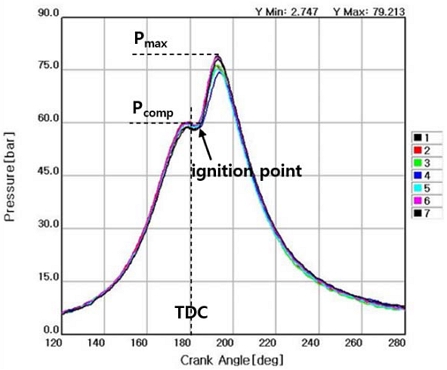
P-𝛳 Diagram (Initial)
The VIT is a device that allows the adjustment of the start time of fuel injection in low-speed two-stroke engines to obtain the best relationship between Pcomp and Pmax over a wide load range. Additionally, it is used to prevent excessive Pmax; thus, the ship’s engine can use VIT to improve the combustion efficiency.
The simple principle of F.O. injection timing adjustment by VIT is the operation of the “VIT timing rack” integrated into the fuel pump, which rotates the “timing guide” to move the pump barrel up and down. Consequently, the height of the spill hole changes, the plunger alters the time required to block the spill hole, and the injection timing is adjusted.
The Pmax range for VIT advance adjustment recommended by engine manufacturers is 35 bar for MC engines and 45 bar for ME engines. The VIT operates in a load range above 50% of the engine, reaches the breaking point at 85%, and then reverses to maintain the maximum combustion pressure at higher loads.
Figure 6 shows the results after the VIT adjustment. It can be seen that the ignition of the fuel after the VIT adjustment occurred at the TDC. Additionally, it is observed that Pmax increased while Pcomp decreased. This occurred because the fuel injection timing was adjusted to advance, and as a result, with an increase in Pmax, less fuel was burned due to increased combustion efficiency. This led to a decrease in turbocharger revolutions, and a reduction in Pcomp due toa decrease in scavenging air pressure.
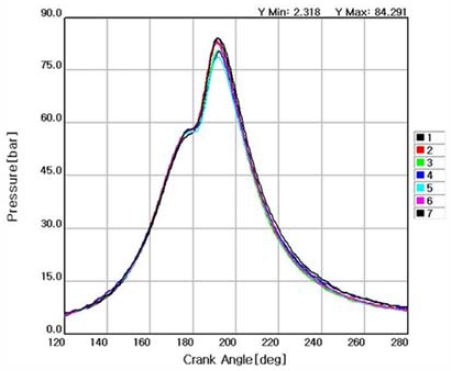
P-𝛳 Diagram (after VIT adjustment)
The rate of heat release (ROHR) diagram shows the combustion process from the time of fuel injection and ignition to the afterburning state. The area of the line is the sum of the calorific values of the fuel used and can be used to determine the amount of fuel consumed.
Figures 7 and 8 present the rate of heat release before and after the VIT adjustment, respectively, and the red circle in the above line shows the ignition point of the fuel, which shows that before the adjustment, the ignition of the fuel occurs near the TDC, and the heat is released from - to + after the TDC. After the VIT adjustment, both ignition and the start of heat release occurred before TDC, the point where the peak heat release of combustion occurred. This means that the released heat has a longer escape period before the exhaust valve opens, allowing heat to be used efficiently.
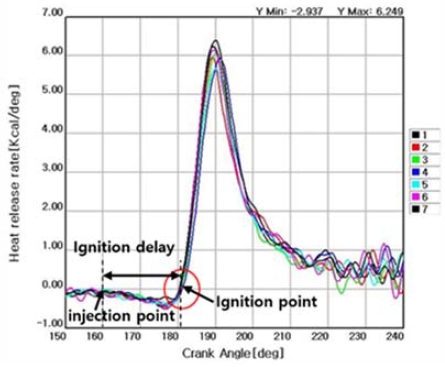
ROHR (before VIT adjustment)

ROHR (after VIT adjustment)
Table 5 lists the performance of the main engine before and after the VIT adjustment; Pcomp decreases and Pmax increases before and after the adjustment. In particular, ⊿P increased by 6.2 bar from 18,7 bar initially to 24.9 bar after the adjustment. In addition, the fuel consumption measured by the flowmeter showed an improvement of 3.7%, from 245 L/10 min (35.28 ton/day) before the adjustment to 236 L/10 min (34.0 ton/day).
Ship J Performance Table
The reported IMO DCS data for year 23 of Ship J are shown in Table 6, and an arbitrary 3.7% improvement in fuel oil consumption was applied to this reported value.
Ship J IMO DCS Data
A comparison of the Attained CII, Required CII, and rating, as shown in Tables 7 and 8, indicates an improvement in rating from D2 to D1.
Ship J Rating of CIIunit: gCO2/t.nm
Ship J Comparison TableCII Unit : gCO2/t.nm
3.2 Analyzing the results of Ship D
Ship D is a Bulk carrier of 72,867 DWT, and the main engine is MAN 6S60MC-C, with a rated speed of 85 rpm and a maximum power of 12,060 ps. The tests were conducted under a load of 50% at 68 rpm.
Similar to Ship J, Ship D exhibited delayed ignition, with ignition occurring at almost 185°, as shown in Figure 9. The VIT was slightly advanced for ignition around TDC, as shown in Figure 10, confirming the change. Similar to ship J, ship D showed an increase in Pmax and a decrease in Pcomp after adjusting the VIT.
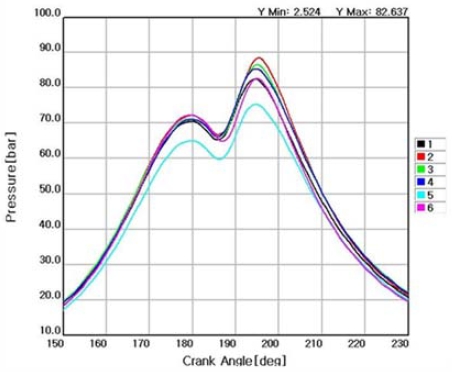
P-𝛳 Diagram(initial)
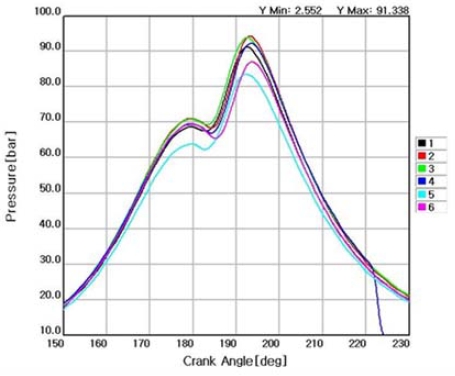
P-𝛳 Diagram (after VIT adjustment)
Figures 11 and 12 show the rate of release before and after the VIT adjustment, and the red circles in the above line show the ignition point of the fuel, indicating that fuel ignition occurs at–184°–185° before the adjustment and at–182°–183° after the adjustment.
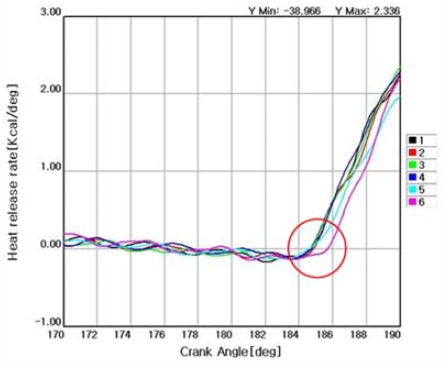
ROHR(before VIT adjustment)
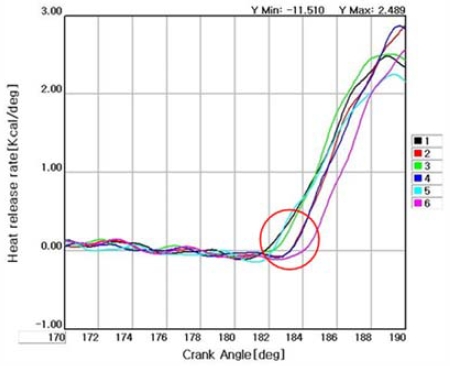
ROHR (after VIT adjustment)
Table 9 shows the performance of the main engine before andafter VIT adjustment, and it can be seen that Pcomp decreases and Pmax increases before and after adjustment. It is observed that ⊿P increased by 8.4 bar from 14.5 bar initially to 22.9 bar after the adjustment, resulting in an improvement in fuel efficiency. The fuel consumption measured by the flowmeter shows an improvement of 4.6% from 147 L/10 min (21.12 ton/day) before the adjustment to 140 L/10 min (20.16 ton/day).
Ship D Performance Report
The reported IMO DCS data for 2023 for ship D are listed in Table 10. An arbitrary 4.6% improvement in fuel oil consumption was applied to this reported value. A comparison of the Attained CII, Required CII, and rating, as shown in Tables 10 and 11, indicates an improvement in rating from D3 to D2.
Vessel D IMO DCS Data
Ship D Rating of CIIunit: gCO2/t.nm
Ship D Comparison TableCII Unit : gCO2/t.nm
4. Conclusion
In this study, we investigated how the CII rating can be improved by improving engine performance and reducing fuel consumption by adjusting the operating factors through main engine performance check and combustion analysis without any external measures, such as retrofitting ESD to improve the CII rating.
Through comparison with the engine shop test report, it was found that among the various operating factors, the engine load (kW) is proportional to the third power of the rotation speed (rpm) and the FOC is proportional to the third power of the rotation speed (rpm).
To reduce the load on the engine, the reduction of external resistance factors, such as weather conditions, sea conditions, and hull conditions, should be fully considered; however, only the reduction in fuel consumption by reducing the engine load by improving the combustion performance of the engine was considered. It can be observed that Pmax increases and Pcomp decreases by adjusting the fuel injection timing (VIT).
In this study, the VIT adjustment was adjusted within the ⊿P max range (Pmax-Pcomp), within which the recommended engine manufacturers can operate stably and continuously to avoid other influences.
In the case of Ship J, the initial ⊿P increased by 6.2 bar from 18,7 bar to 24.9 bar after the adjustment, which improved the fuel efficiency, and when this improvement value was applied to the 2023 CII formula, it was found that the CII rating improved from D2 to D1. Moreover, it yielded an annual fuel savings of 267 tons.
In the case of Ship D, the initial ⊿P of 14.5 bar was increased by 8.4 bar to 22.9 bar after adjustment, which improved fuel efficiency, and when this improvement value was applied to the 2023 CII formula, the CII rating improved from D3 to D2, yielding approximately 186 tons of fuel savings per year.
In this study, we were able to identify changes in the Attained CII by adjusting the VIT. This is the most accessible and realistic engine operation factor, which can be identified through engine performance check and combustion analysis during the same voyage.
However, a closer examination of other operational factors, such as the cylinder liner condition, piston ring condition, turbocharger efficiency condition, vibration condition, and other factors that can check the performance and output of the engine, will help derive the best measures for more efficient engine management and improvement of the CII rating.
Although there are limitations to the study, such as not considering factors external to the ship that affect the load other than the engine, such as weather and sea conditions that are not the same as the test conditions, cargo loading, hull fouling, the failure to monitor performance changes over a long period of time after VIT changes, and the lack of results measured under normal working load (NCR), it was found that the CII rating can be improved with minimal measures on board the ship.
Many existing ships in operation are making great efforts to improve the CII rating, increase energy efficiency, and improve fuel efficiency. This study is expected to improve the CII rating and energy efficiency through fuel efficiency, performance check, and combustion analysis of the most realistic and accessible engines.
In the future, research on engine performance improvement through performance check and combustion analysis is needed not only for large low-speed engines but also for diesel engines for small ships and generators, as well as for identifying and improving the actual energy used in ships.
Acknowledgments
This research was supported by Korea Institute of Marine Science & Technology Promotion(KIMST) funded by the Ministry of Oceans and Fisheries(20220630)
Author Contributions
Conceptualization, S.J.PARK and J.W.LEE; Methodology, S.J.PARK and J.W.LEE; Software, K.S.JUNG; Formal Analysis, K.S.JUNG Investigation, S.J.PARK; Resources, S.J.PARK; Data Curation S.J.PARK and J.W.LEE; Writing-Original Draft Preparation, S.J.PARK and T.H.KIM; Writing-Review & Editing, J.W.LEE; Visualization, S.J.PARK and T.H.KIM; Supervision, J.W.LEE; Project Administration, S.J.PARK and J.W.LEE; Funding Acquisition, J.W.LEE.
References
-
K. S. Jung, “Improvement of combustion efficiency for marine auxiliary diesel engine,” Journal of the Korean Society of Marine Engineering, vol. 38, no. 3, pp. 233–239, 2014.
[https://doi.org/10.5916/jkosme.2014.38.3.233]

-
Y. H. Ryu, K. S. Jung, and J. G. Nam, “Improvement of combustion performance and exhaust emissions through engine initialization in small marine diesel engines,” Journal of the Korean Society of Marine Engineering, vol. 43, no. 7, pp. 504–510, 2019.
[https://doi.org/10.5916/jkosme.2019.43.7.504]
-
J. W. Lee, G. S. Jung, and W. J. Lee, “Causes of top dead center error in marine generator engine power-measuring device,” Journal of the Korean Society of Marine Environment and Safety, vol. 26, no. 4, pp. 429–435, 2020.
[https://doi.org/10.7837/kosomes.2020.26.4.429]
-
K. S. Jung, “Influences of the surface pollution caused by marine growth on ship hulls on engine performance and output,” Journal of the Korean Society of Marine Engineering, vol. 39, no. 4, pp. 399–404, 2015.
[https://doi.org/10.5916/jkosme.2015.39.4.399]
- Y. J. Yun, J. K. An, J. E. Lee, and K. Y. Lee, “A study on the validity of Green-ship certification scheme considering carbon intensity indicator,” Journal of Shipping and Logistics, vol. 40, no. 3, pp. 373–390, 2024.
-
S. J. Yun, K. -H. Park, J. -H. Kim, T. -H. Kim, and S. -D. Kim, “Analysing aerodynamic characteristics of conical rotor sail for ship operation efficiency,” Journal of the Korean Society of Marine Environment and Safety, vol. 30, no. 6, pp. 668-676, 2024.
[https://doi.org/10.7837/kosomes.2024.30.6.668]
- Korean Register, Guide Book for CII, 2021.
- Ministry of Oceans and Fisheries, Korea Maritime Cooperation Center, Guide Book for CII Upgrading Rating, Korea.
-
S. D. Kim, S. -J. Yun, and J. -H. Kim, “Study on physical modeling and simulation of maritime substantiation vessel for verifying the operational efficiency of a rotor sail,” Journal of Advanced Marine Engineering and Technology, vol. 48, no. 6, pp. 480-486, 2024.
[https://doi.org/10.5916/jamet.2024.48.6.480]
-
W. Sun, X. Liu, and L. Yang, “An optimization method for economical ship-routing and ship operation considering the effect of wind-assisted rotors,” in Proceedings of ASME 2020 39th International Conference on Offshore Mechanics and Arctic Engineering, 2020.
[https://doi.org/10.1115/omae2020-18776]
-
J. H. Kim, J. E. Choi, B. J. Choi, S. H. Chung, and H. W. Seo, “Development of energy-saving devices for a full slow-speed ship through improving propulsion performance,” International Journal of Naval Architecture and Ocean Engineering, vol. 7, no. 2, pp. 390-398, 2015.
[https://doi.org/10.1515/ijnaoe-2015-0027]
-
Y. -R. Kim and S. Steen, “Potential energy savings of air lubrication technology on merchant ships,” International Journal of Naval Architecture and Ocean Engineering, vol. 15, 2023.
[https://doi.org/10.1016/j.ijnaoe.2023.100530]
-
J. G. Kang, T. Y. Byun, and M. C. Kim, “Design and performance analysis of ring stator for crude oil carrier,” Journal of the Korean Society of Marine Environment and Safety, vol. 27, no. 2, pp. 369-376, 2021.
[https://doi.org/10.7837/kosomes.2021.27.2.369]