
Legal and institutional frameworks for the deployment of automated anti-sinking devices on small fishing vessels

Copyright © The Korean Society of Marine Engineering
This is an Open Access article distributed under the terms of the Creative Commons Attribution Non-Commercial License (http://creativecommons.org/licenses/by-nc/3.0), which permits unrestricted non-commercial use, distribution, and reproduction in any medium, provided the original work is properly cited.
Abstract
Capsizing and sinking of small fishing vessels often result in severe casualties owing to limited rescue time. Anti-sinking devices that maintain vessel buoyancy and delay sinking have been proposed to address this issue. However, current regulations lack the provisions to accommodate such emerging technologies. This paper presents an analysis of the legal and institutional challenges in the application of anti-sinking devices in Korea. Key issues include the lack of equipment classification, approval procedures, and safety standards. On this basis, regulatory improvements, including legal definitions, type approval systems, and the use of regulatory sandboxes, are proposed. These findings support the safe deployment of innovative safety devices and enhance maritime accident response.
Keywords:
Anti-sinking device, Small fishing vessels, Maritime safety regulation, Type approval system, Regulatory sandbox1. Introduction
In recent years, coastal fishing vessels operating in nearshore environments have been increasingly exposed to the risks of capsizing and sinking owing to sudden weather changes, loss of stability, and structural vulnerabilities. These accidents often result in rapid submersion of the vessel, severely limiting the survival chances of crew members unless rescue is achieved within the so‑called “golden time” of 1–2 hone to two hours after the incident. However, the reality of marine rescue operations face substantial delays caused by adverse sea conditions, poor visibility, and limited communication, particularly during nighttime fishing activities [1]-[3]. Empirical performance data, such as field test outcomes or deployment records that verify reliability under real maritime conditions, must be provided to obtain regulatory and operational approval for anti-sinking devices.
Efforts to address these constraints have been increasingly focusing on automated inflatable buoyancy systems that actively delay capsizing and sinking to extend the survival window until external rescue is feasible. A previous study proposed a design in which multiple airbags are installed around the hull’s outer wall. These airbags can be manually or automatically inflated upon damage to provide uniform buoyancy and delay sinking, thereby extending the rescue time [4]. Another study on buoyancy support systems, compliant with ISO 23121 series standards, demonstrated that subdividing watertight areas and integrating inflatable chambers effectively maintains the flotation of small vessels following critical flooding [5].
Development of modular-type inflatable buoyancy systems, which can be standardized across various hull types and tonnage classes, has been considered a promising solution. Such systems offer the advantage of retrofitting without significant structural modifications and the potential for widespread deployment in small vessels. However, despite its technological feasibility, the current Korean legal and regulatory frameworks do not support the integration or certification of such active safety equipment in coastal fishing vessels. Existing laws such as the Ship Safety Act, Fishing Vessel Act, and related ministerial notices primarily focus on conventional life-saving appliances such as lifejackets and life rafts; no provisions for automated, AI-driven safety modules or criteria for their performance verification have been stipulated [6]-[9].
Therefore, practical implementation of these technologies requires a comprehensive regulatory framework that accommodates new classes of intelligent safety devices. This includes defining the equipment within legal categories, establishing technical certification protocols, and developing installation and inspection standards. The lack of such regulatory support severely constrains the commercialization and deployment of advanced buoyancy modules [10][11].
The objective of this study was to comprehensively evaluate the underlying causes and patterns of capsizing and sinking incidents of coastal fishing vessels, while identifying the limitations of the current legal and institutional frameworks that hinder the adoption of advanced safety equipment. This study sought to identify technical blind spots and regulatory deficiencies through a detailed review of Korean maritime safety laws and related enforcement regulations. Legal and policy recommendations were then proposed based on this analysis to facilitate the practical deployment of intelligent safety devices, including the formal legal recognition of such equipment, establishment of performance certification standards, and revision of installation and operational guidelines.
2. Overview of Anti-Sinking Device Technology and Operational Scenarios
2.1 Structure and Operating Principles
A typical anti-sinking device for small vessels comprises an automatic inflatable buoyancy system or a sensor-based automatic activation mechanism. This system is triggered upon the detection of abnormal conditions, such as capsizing or flooding, including those caused indirectly by fire. Once activated, the airbag modules immediately inflate to delay the sinking of the vessel or to maintain its buoyancy for a certain period [12]. Figure 1 shows the operating mechanism. Key components include gas cartridges that store high-pressure carbon dioxide (CO2) or nitrogen (N2), trigger mechanisms that automatically activate upon detecting abnormal conditions, airbag modules that provide buoyancy, and electronic control units for monitoring and regulating the operating conditions. The trigger mechanism employ various sensing techniques, including moisture sensors, microelectromechanical systems-based tilt sensors, and hydrostatic pressure sensors. If the vessel experiences conditions such as excessive heeling or significant water ingress, the gas valve automatically opens, causing the airbags to inflate. The entire system is generally installed at fixed locations on the outer hull or within the internal bilge compartments of the vessel. It is designed for independent operation using a battery-powered system and requires no external power supply. As the device automatically activates without manual intervention, it significantly enhances the likelihood of rescue, even in situations wherein occupants are unable to respond after an accident.
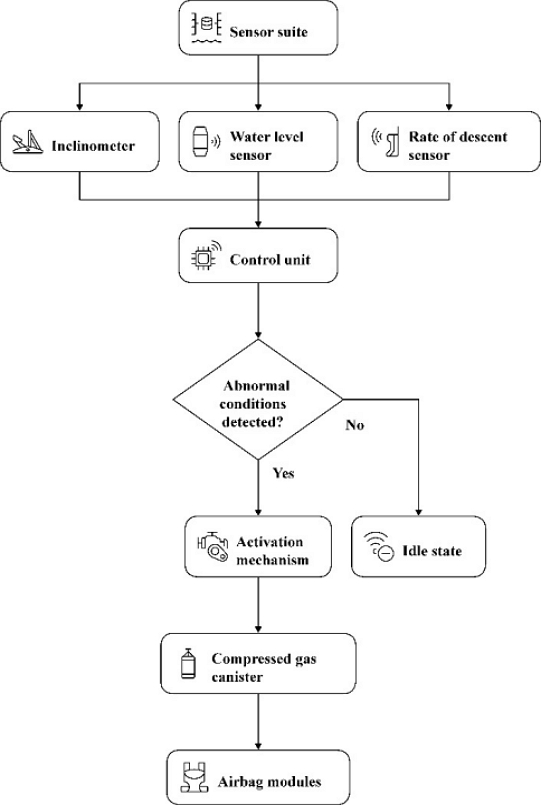
Operating mechanism of typical anti-sinking device
2.2 Practical Application Scenario
The anti-sinking device is suitable for use in various small vessels including coastal fishing boats, recreational fishing vessels, and small passenger ships. When applied to actual vessels, the specifics of installation, activation conditions, and emergency operation flow must be tailored to the design and operating environment of the vessel. Generally, the device is securely installed on the lower sides of the hull, under the aft deck, or within the upper structural compartments. Priority is typically given to areas close to the center of the vessel or those considered vulnerable to flooding [13][14]. The system is designed to automatically activate when predefined conditions are met [15]. These conditions include excessive roll angles and abnormal water ingress levels. Once triggered, high-pressure gas is released from the cartridge into the airbag module, causing it to rapidly inflate. The inflated airbag aids in delaying the sinking of the vessel by maintaining buoyancy for a limited duration. During this period, the occupants can remain in contact with the hull or move to the upper part of the vessel while awaiting rescue. In a typical emergency sequence, the built-in sensors can detect dangerous conditions when a vessel capsizes or floods. The inflation system is then automatically activated, releasing compressed gas to inflate the airbag. This response slows the descent of the vessel or helps maintain buoyancy, thereby extending the available rescue time and providing a visible marker that aids rescuers in locating the vessel.
2.3 Regulatory Implications of Key Technological Components
The anti-sinking device incorporates various advanced technologies, including high-pressure gas systems, electronic control units, sensors, and inflatable structures [16]. Because of this complex configuration, the application of the device to actual vessels is likely to involve multiple overlapping legal and regulatory frameworks. However, current maritime regulations in Korea are primarily designed for conventional life-saving appliances and structural safety equipment. Consequently, they often lack clear criteria for multifunctional safety devices such as anti-sinking systems. The regulatory standards for the device vary according to its classification, necessitating clear categorization to avoid legal ambiguity and conflicts. Table 1 presents the major technological components of the anti-sinking device and the relevant laws that may apply, along with the anticipated regulatory constraints. This mapping enables a preliminary review of the legal applicability of each component and helps identify areas wherein institutional or regulatory improvements may be necessary.

Legal implications based on the technical components of the anti-sinking device
Inflatable devices that utilize high-pressure gases may be classified as pressure vessels under the High-Pressure Gas Safety Control Act, thereby requiring compliance with specific storage and usage standards [17]. The automatic activation triggers and control modules may fall within the inspection scope defined by the Ship Safety Act [18]. However, because these components are not explicitly included in the existing categories of structural or life-saving equipment, the regulatory interpretation remains ambiguous. In addition, electronic components can be subject to the Electrical Appliances and Consumer Products Safety Control Act, which may require compliance with technical standards, such as Korea Certification (KC) and electromagnetic compatibility (EMC) testing [29][20]. Commercialization of the anti-sinking device necessitates the clarification of the legal applicability of each technological component and revision of relevant inspection, certification, and administrative procedures. In particular, for components not currently defined within the existing life-saving or structural equipment categories, new regulatory provisions or improvements to the type of approval system must be established.
3. Analysis of Relevant Korean Laws and Regulations
The anti-sinking device is a multifunctional safety system comprising fixed structural components, automatic inflatable buoyancy modules, high-pressure gas containers, and electronic control units. Therefore, it is subject to multiple overlapping legal and regulatory frameworks. However, the current legal system in Korea is largely based on standards designed for conventional life-saving equipment or structural installations. Consequently, the application of existing laws to these new types of devices remains unclear, and institutional gaps or ambiguities may arise in regulatory interpretations.
3.1 Vessels Structure and Equipment-Related Legislation
Because the anti-sinking device is fixed to either the interior or exterior of the hull, it can be structurally considered as a part of the vessel. Therefore, it falls under the provisions of the Ship Safety Act [18]. The Ship Safety Act outlines safety standards related to the design, construction, equipment, and operation of ships; any structural equipment installed in a vessel must comply with the technical standards and seaworthiness requirements specified in this law. Additionally, ships are subjected to periodic inspections (regular, intermediate, and temporary) to verify their legal compliance and safety. The installation of new equipment generally requires revised design drawings and approval from ship inspectors. However, the anti-sinking device differs from conventional equipment in terms of both structure and operational principles. Therefore, it is not clearly categorized under the legally defined terms such as “structural equipment” or “emergency equipment.” In particular, the Fishing Vessel Act, which governs the registration, does not currently recognize such devices as approved equipment [21]. This regulatory ambiguity may lead to confusion during field applications and hinder practical deployment of the device.
3.2 Legislation related to Emergency and Rescue Equipment
As the anti-sinking device is designed to activate in emergency situations and performs functions similar to life-saving or rescue equipment, it can be interpreted in relation to the Marine Rescue and Salvage Act and relevant notifications issued by the Ministry of Oceans and Fisheries [22]. The Marine Rescue and Salvage Act defines the responsibilities of government in maritime search and rescue, as well as the operational systems for the equipment and personnel involved in such missions. It also includes performance standards and requirements for onboard life-saving appliances. However, this legislation primarily focuses on conventional rescue equipment such as life rafts, life jackets, and search-and-rescue tools. It does not explicitly define or provide technical requirements for new types of systems, such as automated anti-sinking devices. Consequently, although the anti-sinking device serves a life-saving function during emergencies, it may not receive formal legal recognition or protection as emergency equipment. Furthermore, there is currently no established protocol on how such devices should be integrated into actual maritime rescue operations or coordinated with the response procedures of the Coast Guard and other rescue agencies.
3.3 Regulations on high-pressure gas and electronic devices
The anti-sinking device includes high-pressure gas cartridges and electronic control modules, each of which may be subject to different regulatory frameworks. Inflatable components that use compressed gas may fall under the provisions of the High-Pressure Gas Safety Control Act, which governs devices and containers that store or utilize gases at pressures above 1 MPa or in specified quantities [17]. In such cases, users may be required to undergo type approval, safety confirmation procedures, or manufacturing notifications. If the gas cartridge used in the device qualifies under these conditions, it must comply with the relevant certification and safety inspection requirements. In addition, components such as electronic control units, sensors, and battery modules may be subject to the Electrical Appliances and Consumer Products Safety Control Act and the Framework Act on National Standards [19][23]. These laws require compliance with technical standards including KC certification, electromagnetic compatibility testing, and waterproofing levels [20]. As these devices are installed directly on vessels, their impact on the vessel’s seaworthiness must be evaluated through additional inspection or verification procedures.
3.4 Issues related to type Approval and Certification
Currently, anti-sinking devices are not explicitly designated as subject to type approval under existing maritime regulations. Article 18 of the Ship Safety Act stipulates a type approval system for specific equipment and devices installed on vessels. Based on this system, inspection agencies such as the Korea Maritime Transportation Safety Authority (KOMSA) and the Korean Register (KR) assess whether a device may be legally installed on a ship [24]. However, because anti-sinking devices do not fall within the scope of conventional life-saving or emergency equipment as defined in the current legislation, they are not recognized as subject to type approval, and no established inspection criteria exist for these devices. Consequently, vessels equipped with such devices may fail official inspections. Although the safety and effectiveness of the equipment have been demonstrated, there remains a structural limitation within the legal framework that prevents it from being accepted as a standard component of vessel design.
4. Regulatory Evaluation and Comparative Analysis Overview of Anti-Sinking Device Technology and Operational Scenarios
4.1 Limitations of the Current Regulatory Framework
Emerging structural safety devices, such as anti-sinking systems that incorporate automated functions and a combination of advanced technologies, are not fully accommodated within the existing maritime safety regulatory framework. Current laws and regulations have primarily been designed around conventional life-saving and structural equipment, and revisions reflecting recent technological advancements have been slow to materialize. Ship inspection standards mainly focus on ensuring the seaworthiness and fundamental structural stability of fixed installations. Consequently, devices that do not fall under the conventional classification of fixed equipment or those that employ novel activation mechanisms are often not clearly addressed in the inspection criteria. Even when a device's technical effectiveness has been demonstrated, its legal admissibility may remain uncertain, potentially leading to inspection failures. This gap between existing standards and new equipment highlights a structural mismatch within the inspection regime, raising concerns regarding the balance between regulatory reliability and the acceptance of innovative technologies.
4.2 Institutional Cases of Similar Equipment
Among the structural devices installed on ships, various systems are in operation to ensure survivability in capsizing or sinking scenarios, such as liferafts, life jackets, and automatically inflatable rescue pods. Most of these devices are type-approved under the International Maritime Organization (IMO)’s SOLAS Convention, as well as Koreanregulations such as the Ship Safety Act and relevant notices issued by the Ministry of Oceans and Fisheries [25][26]. The installation standards and performance inspection criteria are clearly defined. Automatically inflatable life jackets exhibit technical similarities to anti-sinking devices in that they activate automatically in response to water ingress or hydrostatic pressure. However, life jackets are classified as portable equipment intended for individual use by passengers or crew, whereas anti-sinking devices are fixed buoyancy aids installed on vessels. This distinction results in different legal classifications and approval procedures. In contrast, countries such as the United States and Japan have adopted more flexible regulatory approaches to emerging technologies with similar functions. The United States Coast Guard (USCG) operates an "Innovation Approval" system that allows for conditionally approved deployment of equipment not yet covered by existing standards, based on empirical testing and verification [27][28]. Similarly, Japan permits the installation and approval of experimental or purpose-specific devices through agencies under the Ministry of Land, Infrastructure, Transport and Tourism (MLIT), provided that design objectives and safety criteria are satisfied [29]-[31]. These equipment systems demonstrate regulatory flexibility, facilitating the integration of new technologies once a certain level of technical verification is achieved, even outside the framework of existing standards. These aspects are organized and presented in Table 2.
Comparison of international systems for anti-sinking devices
4.3 Impact of Regulatory Gaps on Commercialization
The anti-sinking device is designed to maintain vessel buoyancy for a certain period following an accident, thereby extending the available rescue window and reducing the risk of fatalities. However, despite its clear safety benefits, the current regulatory framework imposes several constraints that hinder its commercial application in actual vessels. The device does not fall within the clearly defined categories of structural or life-saving equipment under existing legal instruments such as the Ship Safety Act. As a result, regulatory approval for onboard installation remains uncertain. If the device is not formally recognized as part of a vessel’s structural system or designated as subject to inspection, it may be excluded from seaworthiness assessments, thereby effectively preventing its deployment. Moreover, the components of the device are governed by separate legislative instruments; however, no integrated approval mechanism exists to address their combined use. For example, the high-pressure gas cartridge may fall under the High-Pressure Gas Safety Control Act, whereas electronic sensors and control modules may be subject to KC certification under the Electrical Appliances and Consumer Products Safety Control Act or the Industrial Standardization Act. When these components are integrated into a single on-board system, the absence of a unified review procedure increases the likelihood of overlapping regulatory requirements and administrative inconsistencies during certification. In addition, equipment not explicitly listed in type approval categories may be classified as unapproved during vessel inspections, resulting in failure to meet regulatory compliance. This reflects a fundamental limitation of the current item-specific approval system in which the adoption of functionally validated technologies is obstructed owing to institutional rigidity.
Consequently, complex structural equipment incorporating new technologies, such as the anti-sinking device, is not adequately accommodated within the existing regulatory framework. This gap represents a significant obstacle to the commercialization and advancement of maritime safety. Future regulatory measures should include the introduction of conditional approval systems based on verified performance trials, development of integrated certification schemes for multifunctional equipment, and establishment of interpretive guidelines to address conflicts between overlapping legal domains.
5. Institutional Reform Proposals
The practical application of safety equipment based on emerging technologies, such as anti-sinking devices, in small vessels, necessitates a multifaceted improvement in the regulatory framework is essential. Existing structural limitations within the current legal and institutional systems must be addressed to enhance regulatory acceptability. This section proposes directions for institutional reform in four key areas, namely revision of maritime safety legislation, restructuring of the type approval system, utilization of regulatory exemption mechanisms, and establishment of a phased institutional roadmap.
The current Ship Safety Act and its enforcement regulations primarily define safety standards based on conventional life-saving and structural equipment. Consequently, multifunctional safety devices such as anti-sinking systems are not currently captured within the existing legal framework. Defining these devices under a new category, for example, Emergency Buoyancy Devices, and establishing specific standards for their installation and operation are necessary to support their application. Furthermore, ship inspection criteria, including those specified by KOMSA, should explicitly recognize these devices as eligible for installation on small vessels or test ships. This will help prevent instances wherein the presence of such equipment leads to inspection failure.
Anti-sinking devices consist of multiple components, including high-pressure gas expansion systems, automatic sensors, and electronic control modules. These components fall under separate regulatory frameworks, such as the High-Pressure Gas Safety Control Act, the Electrical Appliances and Consumer Products Safety Control Act, and the Framework Act on National Standards, each requiring individual certifications. However, given the integrated nature of the device and its function as emergency equipment for vessels, a consolidated type-approval system tailored to maritime safety is needed. In particular, components that involve high-pressure gases should be evaluated under conditions that reflect marine environments and impact loads. Rather than calling for a fundamental overhaul of the regulatory regime, the proposed institutional reform focuses on improving the efficiency and relevance of the certification process by enhancing the operational testing and approval protocols for anti-sinking systems conducted by designated inspection bodies such as KOMSA and KR.
In cases wherein existing regulations hinder field deployment or early adoption, regulatory sandbox mechanisms should be actively utilized. These include the Regulatory Sandbox for Industrial Convergence under the Act on the Promotion of Industrial Convergence, the Special Act on Regulation-Free Zones and Local Specialized Development, and demonstration support programs provided by KOMSA under the Ministry of Oceans and Fisheries. These systems offer a flexible institutional pathway by allowing new technologies to be tested in real-world environments over a limited period, with formal institutionalization following performance verification. The successful implementation of such demonstration projects requires coordinated support from local governments, the Coast Guard, and KOMSA. Integrating equipment testing with emergency response drills and scenario-based evaluations is recommended to ensure operational readiness. A summary of the proposed institutional improvements is illustrated in Figure 2.
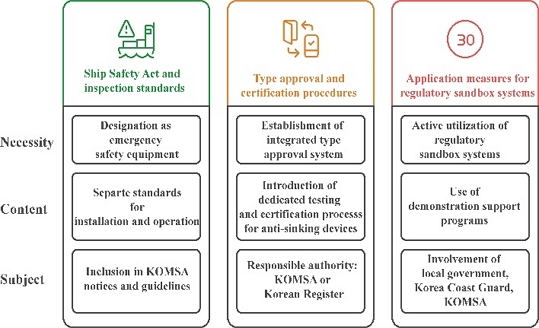
Institutional improvement framework focusing on inspection standards, certification procedures, and sandbox application for anti-sinking devices
6. Conclusion
This study entailed an analysis of the legal and institutional frameworks necessary for applying a novel technology-based device designed to delay or prevent the sinking of capsized small vessels to actual maritime operations and to propose institutional improvement measures. In recent years, capsizing and sinking incidents in coastal and nearshore waters have frequently resulted in limited rescue time and high casualties, underscoring the need for a device that can maintain vessel buoyancy for a certain period immediately after an accident.
This study first examined the technical structure and operational scenarios of the anti-sinking device and analyzed how its core components intersect with or conflict with existing legal provisions. A comprehensive review of key laws, including the Ship Safety Act, Fishing Vessel Act, Marine Rescue and Relief Act, and High-Pressure Gas Safety Control Act, revealed that the current legal framework is largely based on conventional life-saving and rescue equipment, which poses limitations in terms of accommodating emerging technologies. In particular, the absence of formal approval procedures, lack of safety inspection standards, and interpretive inconsistencies across statutes were identified as major institutional barriers to commercialization and regulatory integration.
To address these challenges, this study proposed institutional improvement measures across four key areas, namely legislative amendments, establishment of integrated approval systems, application of regulatory sandbox mechanisms, and development of a phased institutional roadmap. Specifically, it is necessary to formally categorize anti-sinking devices as emergency buoyancy devices, incorporate them into safety inspection standards, and improve their field applicability. In the short-term, temporary certification and demonstration-based regulatory exceptions should be actively utilized to support early-stage deployment. In the long-term, alignment with international standards must be pursued to establish a foundation for global diffusion.
This study contributes to the development of a proactive response system for coastal maritime accidents by exploring pathways for the stable institutional adoption of novel safety devices such as anti-sinking systems. Future research should focus on field-based demonstrations and performance validation along with the development of technical safety criteria for formal approval. Such efforts will facilitate the establishment of a sustainable maritime safety system wherein innovative technologies and institutional frameworks are effectively integrated.
Acknowledgments
This research was supported by a grant (RS-2025-06902968) from the Disaster Safety Industry Technology Commercialization Support (R&D) Program funded by the Ministry of the Interior and Safety (MOIS, Korea).
Author Contributions
Conceptualization, D. Youn; Methodology, D. Youn; Software, D. Youn; Formal Analysis, D. Youn; Investigation, D. Youn; Resources, D. Youn; Data Curation D. Youn; Writing-Original Draft Preparation, D. Youn; Writing-Review & Editing, D. Youn; Visualization, D. Youn; Supervision, D. Youn; Project Administration, D. Youn; Funding Acquisition, D. Youn.
References
-
C. -H. Park, B. -K. Jeong, W. -S. Choi, and N. -U. Lee, “A study on improvement of fishing vessel inspection methods and regulations,” Journal of Maritime Law Review, vol. 34, no. 2, pp. 295–317, 2022 (in Korean).
[https://doi.org/10.14443/kmilaw.2022.34.2.10]

- S. -J. Lee, H. -S. Kim, J. -G. Yong, and S. -G. Lee, “A study on analysis and countermeasures of marine accidents in Korea,” Proceedings of the Korean Institute of Navigation and Port Research Conference, vol. 2010, no. 1, pp. 24–25, 2010 (in Korean).
-
C. -W. Choi, Y. -N. Roh, D. -S. Shin, H. -M. Kim, and H. -C. Park, “Analysis of accident factors by type of marine accident in coastal waters,” Journal of Korean Society of Transportation, vol. 39, no. 4, pp. 540–554, 2021 (in Korean).
[https://doi.org/10.7470/jkst.2021.39.4.540]
- S.-T. Lee and Y.-B. Lee, A study on legislative improvement for marine safety management, Korea Legislation Research Institute, 2017 (in Korean).
-
K. -W. Kim, C. -M. Jang, J. -O. Park, and H. -J. Lee, “A study on the development of inflatable life raft performance criteria for small fishing vessels,” Journal of the Korean Society of Marine Environment & Safety, vol. 20, no. 5, pp. 558–563, 2014 (in Korean).
[https://doi.org/10.7837/kosomes.2014.20.5.558]
-
B. -H. Song, K. -H. Lee, and W. -K. Choi, “A study on the advancement of the legal system for small fishing vessels to ensure marine safety,” Journal of the Korean Society of Marine Environment & Safety, vol. 24, no. 7, pp. 875–888, 2018.
[https://doi.org/10.7837/kosomes.2018.24.7.875]
-
B. -K. Jung and N. -U. Lee, “Analyzing the current status and challenges of coastal and inshore fisheries: A review of the impacts and the legislative improvements,” Journal of Coastal Research, vol. 114, SI, pp. 604–608, 2021.
[https://doi.org/10.2112/JCR-SI114-122.1]
-
S. -G. Kim, S. Kim, J. Mugabi, and J. -H. Jeong, “Review of the regulatory challenges and opportunities for maritime small modular reactors in Republic of Korea,” Journal of Marine Science and Engineering, vol. 12, no. 11, 1978, 2024.
[https://doi.org/10.3390/jmse12111978]
-
Y. A. Ahmed, G. Theotokatos, I. Maslov, L. A. L. Wennersberg, and D. A. Nesheim, “Regulatory and legal frameworks recommendations for short sea shipping maritime autonomous surface ships,” Marine Policy, vol. 166, 106226, 2024.
[https://doi.org/10.1016/j.marpol.2024.106226]
-
J. Liu, F. Yang, S. Li, Y. Lv, and X. Hu, “Testing and evaluation for intelligent navigation of ships: current status, possible solutions, and challenges,” Ocean Engineering, vol. 295, 116969, 2024.
[https://doi.org/10.1016/j.oceaneng.2024.116969]
-
P. Corsi, S. Jakovlev, M. Figari, and V. Djackov, “Analysis and definition of certification requirements for maritime autonomous surface ship operation,” Journal of Marine Science and Engineering, vol. 13, no. 4, 751, 2025.
[https://doi.org/10.3390/jmse13040751]
-
C. T. Lee, L. B. Chen, H. M. Chu, and Y. Y. Lee, “A buoyancy device design for antisink ships,” IEEE Potentials, vol. 42, no. 3, pp. 43–50, 2023.
[https://doi.org/10.1109/MPOT.2021.3114642]
-
F. Obeng, V. Domeh, F. Khan, N. Bose, and E. Sanli, “Capsizing accident scenario model for small fishing trawler,” Safety Science, vol. 145, 105500, 2022.
[https://doi.org/10.1016/j.ssci.2021.105500]
-
S.-H. Kim, S. H. Lee, K.-J. Ryu, and Y.-W. Lee, “Applying formal safety assessment (FSA) to fishing vessels: An analysis of occupational injuries on Korean trap boats,” Fishes, vol. 10, no. 1, 30, 2025.
[https://doi.org/10.3390/fishes10010030]
-
B. Davis, B. Colbourne, and D. Molyneux, “Analysis of fishing vessel capsizing causes and links to operator stability training,” Safety Science, vol. 118, pp. 355–363, 2019.
[https://doi.org/10.1016/j.ssci.2019.05.017]
- D. P. Chodankar, “Inflatable airbag systems to improve ship’s attained subdivision index,” in SNAME Maritime Convention, pp. D043S021R002, 2016.
- High-Pressure Gas Safety Control Act, Korea Ministry of Government Legislation. https://elaw.klri.re.kr/eng_service/lawView.do?lang=ENG&hseq=6013, , Accessed August 5, 2025.
- Ship Safety Act, Korea Ministry of Government Legislation. https://elaw.klri.re.kr/kor_service/lawViewContent.do?hseq=51173, , Accessed August 5, 2025.
- Electrical Appliances and Consumer Products Safety Control Act, Korea Ministry of Government Legislation. https://elaw.klri.re.kr/eng_service/lawView.do?hseq=46477&lang=ENG, , Accessed August 5, 2025.
- KC Certification, Korea Agency for Technology and Standards. https://www.korea-certification.com/en/kc/what-is-kc-certification, , Accessed August 5, 2025.
- Fishing Vessel Act, Korea Ministry of Government Legislation, 2024. http://www.kosfa.org/hen/ss56.php?pp=1&bcidx=60&md=READ&idx=3742, , Accessed August 5, 2025.
- Act on the Search and Rescue in Waters, Korea Ministry of Government Legislation. https://www.law.go.kr/lsInfoP.do?lsiSeq=231447&urlMode=engLsInfoR&viewCls=engLsInfoR#0000, , Accessed August 5, 2025.
- Framework Act on National Standards, Korea Ministry of Government Legislation. https://elaw.klri.re.kr/kor_service/lawViewContent.do?hseq=16591, , Accessed August 5, 2025.
- Enforcement Decree of the Ship Safety Act, Korea Ministry of Government Legislation. https://elaw.klri.re.kr/eng_mobile/viewer.do?hseq=68993&type=part&key=42, , Accessed August 5, 2025.
-
D. Nam, “Identification and analysis of the legal status of international maritime organization instruments,” Journal of the Korean Society of Marine Environment & Safety, vol. 27, no. 3, pp. 421–428, 2021.
[https://doi.org/10.7837/kosomes.2021.27.3.421]
-
S. K. Kim, “The safety of passenger ships in korea and its implications for the maritime silk road initiative,” in The Belt and Road Initiative and the Law of the Sea, Brill Nijhoff, pp. 56–68, 2020.
[https://doi.org/10.1163/9789004422056_006]
- C. Kluckhuhn, An Examination of Four Successes in the Coast Guard's Innovation Program and Implications for Innovation Within Homeland Security, Ph.D. Dissertation, Naval Postgraduate School, Monterey, California, USA, 2008.
- Marine Safety: Inspection of engineering systems, equipment, and materials, https://media.defense.gov/2022/Feb/09/2002935706/-1/-1/0/CI_16000_72.PDF?utm_source=chatgpt.com, , Accessed August 5, 2025.
- K. Minami, “Recent Development of MASS and Guidelines in Japan,” Asian Business Lawyer, no. 31, pp. 93–110, 2023.
- Type Approval of Maritime Equipment, Ministry of Land, Infrastructure, Transport and Tourism (MLIT), Japan. https://www.mlit.go.jp/en/maritime/maritime_fr8_000002.html, , Accessed August 5, 2025.
- Marine Equipment Type Approval Flowchart, Ministry of Land, Infrastructure, Transport and Tourism (MLIT), Japan.