
Energy-efficient operation of LoRaWAN network server with immediate-acknowledgment for shipboard IoT applications

Copyright © The Korean Society of Marine Engineering
This is an Open Access article distributed under the terms of the Creative Commons Attribution Non-Commercial License (http://creativecommons.org/licenses/by-nc/3.0), which permits unrestricted non-commercial use, distribution, and reproduction in any medium, provided the original work is properly cited.
Abstract
As data-driven ship management requires shipboard data, the need for Internet of Things (IoT) technology to collect, transmit, and utilize various data types on ships continues to increase. When considering IoT onboard ships, technologies that improve the energy efficiency of deployed wireless devices and ensure stable communication are essential to sustainably collect various types of information and ensure the reliability of the acquired information. The long-range wide-area network (LoRaWAN) protocol is a favorable technology for shipboard IoT networking, supporting long-distance communication suitable for IoT applications. To apply the LoRaWAN protocol to shipboard IoT, energy-efficient operation is essential to ensure the continuity of data collection and the reliability of the collected data. To support the energy-efficient operation of the LoRaWAN protocol, the application of the Immediate-acknowledgment policy is proposed, and the energy-saving effect of the deployed wireless devices through the application of the acknowledgment policy is confirmed. However, the load of the LoRaWAN Network server operating the Immediate-acknowledgment—which underlines the energy-saving of wireless devices—should also be considered. Therefore, this study analyzes the energy consumption of the network server side of a LoRaWAN system by applying an acknowledgment policy and proposes an energy-efficient operation method.
Keywords:
Long-range wide area network (LoRaWAN), Energy consumption, Acknowledgment policy1. Introduction
As the Internet of Things (IoT) continues to advance, its applications and overall market value are expanding across a wide range of industries. To maintain reliable and long-term communication among wireless devices, various strategies have been proposed to extend the operational lifespan of each node by optimizing energy efficiency [1]. IoT devices with both communication and sensing functionalities must support broad communication coverage despite limited battery resources [2].
Interest in data-driven ship management is growing to improve both the efficiency and safety of maritime operations. To support this, implementing network solutions suitable for the unique operational conditions of vessels is essential. For instance, ships (both passenger and nonpassenger types) with a gross tonnage of 3,000 or more, constructed after July 1, 2002, must be equipped with Voyage Data Recorders (VDRs) to aid in maritime accident investigations [3]. A VDR is a type of data recording system that gathers various operational parameters through distributed onboard sensors and was developed to align with the International Maritime Organization (IMO)'s Safety of Life at Sea (SOLAS) regulations (IMO Res. A.861(20)) [4].
In shipboard IoT environments, employing technologies that enable distributed IoT devices to maintain stable connectivity while minimizing power usage for accurate and continuous data collection is essential. Among various IoT technologies, the long-range wide-area network (LoRaWAN) [5]-[6] is promising due to its low-power operation and optimized data transmission rates for long distances [2].
Previous studies [7]-[8] examined the energy inefficiencies of the LoRaWAN standard and proposed improvements using an acknowledgment (ACK) policy. However, these studies only considered energy efficiency from the perspective of wireless devices, which does not guarantee energy-efficient operation of LoRaWAN Network servers. Therefore, this study analyzes the energy consumption of network servers when applying an Immediate-ACK policy and proposes an efficient operation plan.
The study is organized as follows: Section 2 explains the LoRaWAN data frame exchanges per specifications. Section 3 analyzes the energy consumption of a LoRaWAN Network server with an energy-efficient acknowledgment policy. Section 4 provides a numerical evaluation of energy efficiency. Finally, Section 5 presents the concluding remarks.
2. LoRaWAN Data Exchange
Following the uplink transmission from an end device, the system opens one or two reception windows (designated RX1 and RX2) after a predefined time interval to allow the reception of downlink frames from the network server [5]. A new uplink packet cannot be sent until one of the following two conditions is satisfied [5]: 1) the device receives a downlink frame in either the RX1 or RX2 window corresponding to the previous uplink, or 2) the RX2 reception window linked to the previous transmission has completely timed out.
Figure 1 illustrates an example of an unconfirmed data frame exchange. In this example, the network server successfully receives the first uplink frame sent by the end device. The figure shows that no downlink response was transmitted in the corresponding RX1 and RX2 windows [7]. When no downlink frame is received from the network server, the end device must introduce a random delay period once the RX2 window ends, before attempting retransmission.
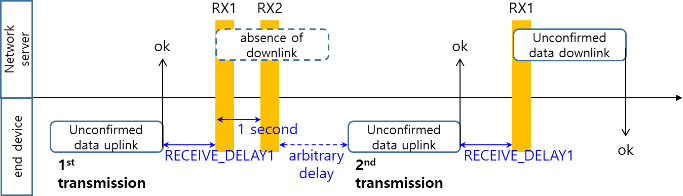
Timing diagram of LoRaWAN data exchange [7]
Ensuring energy-efficient behavior is essential because LoRaWAN end devices operate with limited power resources.
As illustrated in Figure 1, when the network server correctly receives an uplink frame but does not return a downlink message, the end device consumes additional energy through unnecessary retransmission and reception attempts. Therefore, an alternative scheme was proposed in [8], using a LoRaWAN MAC command that supports energy-efficient operation and complies with LoRaWAN standards.
3. Analysis of Energy Consumption with Immediate-ACK Policy
Automatic Repeat reQuest (ARQ) is an error control mechanism used in data communication systems that ensures reliable transmission by utilizing acknowledgment (ACK) messages, even over unreliable communication links. The acknowledgment policy operates in various ways depending on the communication protocol, and each policy has advantages and disadvantages. In the case of the Immediate-ACK policy, an ACK is sent for every MAC frame transmission, leading to a high transmission overhead. On the other hand, the no-ACK policy omits ACK at the MAC layer, resulting in zero overhead, but causes a reduction in throughput owing to the lack of delivery confirmation.
In the example in Figure 1, the no-ACK policy is applied. Consequently, when the Network server successfully receives an uplink message but has no downlink data to send back to the end device, the device performs redundant transmission and reception processes, leading to unnecessary energy consumption. In this case, such energy loss can be prevented if the network server transmits the downlink frame immediately.
The Network server can issue a LinkADRReq MAC command to instruct an end device to perform data-rate adaptation and to configure its maximum transmission power. This MAC Command has a 1-octet Redundancy field, consisting of the Reserved for Future Use (RFU), ChMaskCntl (Channel Mask Control), and NbTrans fields. The NbTrans indicates the maximum number of allowed uplink transmissions. A previous study [8] proposed a method for utilizing the bit-7 RFU field to avoid unnecessary transmission and reception activities, as illustrated in Figure 1. To implement this, the network server sets the bit-7 RFU field to 1 and sends the MAC command. Moreover, when the RFU field was set to 1, the end device was instructed not to send a LinkADRAns response, eliminating the uplink communication triggered by this command.
When the acknowledgment policy is changed to Immediate-ACK by applying the method using LinkADRReq, the ratio of the average receiving power consumption of the network server between the scenarios with and without the application of the Immediate-ACK policy is as follows:
| (1) |
where Prx and Pdetect are the powers consumed for packet reception and preamble detection, respectively. n is the number of uplink packet transmissions, and Trx represents the uplink dwell time.
4. Numerical Result
Figure 2 illustrates the relative average power consumption of the transmission (Ptx) and reception (Prx) components of the network server under the immediate-ACK policy, compared to the conventional LoRaWAN policy (No-ACK), as a function of the number of uplink transmissions (n). It is assumed that Pdetect is 50% of the uplink data frame reception power consumption.
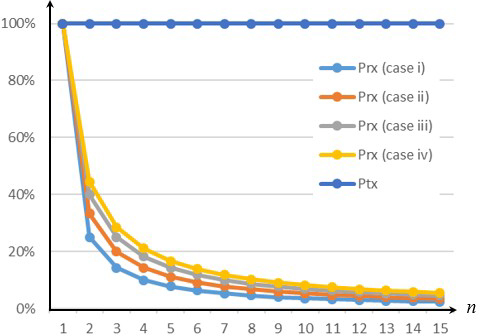
The ratio of the Network server’s average power consumption between scenarios with and without the application of the Immediate-ACK policy
As the number of uplink transmissions increases, the reception power consumption decreases significantly with the Immediate-ACK policy. Cases i-iv correspond to uplink dwell times of 0.5, 1, 2, and 4 s, respectively. However, transmission power remains the same as in the existing LoRaWAN method, as transmission of downlink frames is required in both cases.
As shown in Figure 2, employing the LinkADRReq MAC command to implement the Immediate-ACK mechanism improves LoRaWAN energy performance by reducing overall power usage in the network server. Accordingly, to minimize redundant energy usage at the end device, the network server, which has reliable power availability, should promptly transmit downlink frames without delay.
5. Conclusion
This study investigated the energy consumption of a LoRaWAN Network server when applying an Immediate-ACK scheme. The immediate-ACK policy combined with the LinkADRReq MAC Command enhances energy efficiency for both the LoRaWAN Network server and the end device. The proposed method is fully compliant with LoRaWAN specifications, and can be seamlessly integrated into existing commercial LoRaWAN systems.
Author Contributions
Conceptualization, Y. -I. Joo; Methodology, Y. -I. Joo; Writing-Original Draft Preparation, Y. -I. Joo; Validation, Y. -I. Joo; Writing-Review & Editing, Y. -I. Joo.
References
- J. de Carvalho Silva, J. J. P. C. Rodrigues, A. M. Alberti, P. Solic, and A. L. L. Aquino, “LoRaWAN — A low power WAN protocol for Internet of Things: A review and opportunities,” in Proceeding of 2017 2nd International Multidisciplinary Conference on Computer and Energy Science (SpliTech), pp. 1-6, 2017.
-
Y. -I. Joo, “Networking strategy for data-driven management in a ship: Requirements and applications,” Journal of Advanced Marine Engineering and Technology, vol. 46, no. 4, pp. 193-195, 2022.
[https://doi.org/10.5916/jamet.2022.46.4.193]

- Voyage Data Recorders, https://www.imo.org/en/OurWork/Safety/Pages/VDR.aspx, , Accessed May 11, 2022.
- Voyage Data Recorders, https://en.wikipedia.org/wiki/Voyage_data_recorder, , Accessed May 11, 2022.
- LoRa Alliance, LoRaWAN L2 1.0.4 Specification, TS001-1.0.4, October, 2020.
- SEMTECH, LoRa and LoRaWAN: A technical overview, Semtech Corporation, December, 2019.
-
Y. -I. Joo, “Analysis of energy consumption on deferred transmission of LoRaWAN downlink frame for IoT in a ship,” Journal of Advanced Marine Engineering and Technology, vol. 47, no. 4, pp. 208-210, 2023.
[https://doi.org/10.5916/jamet.2023.47.4.208]
-
Y. -I. Joo, “Analysis of energy savings through acknowledgement policy for efficient power management in LoRaWAN for IoT in a ship,” Journal of Advanced Marine Engineering and Technology, vol. 48, no. 4, pp. 232-234, 2024.
[https://doi.org/10.5916/jamet.2024.48.4.232]