
Comparative analysis of EU ETS, FuelEU maritime and IMO carbon pricing regulations: Strategic and economic implications for the shipping industry

Copyright © The Korean Society of Marine Engineering
This is an Open Access article distributed under the terms of the Creative Commons Attribution Non-Commercial License (http://creativecommons.org/licenses/by-nc/3.0), which permits unrestricted non-commercial use, distribution, and reproduction in any medium, provided the original work is properly cited.
Abstract
This paper evaluates the strategic and economic implications of the FuelEU Maritime regulation and the inclusion of shipping in the European Union Emissions Trading System (EU ETS) and International Maritime Organization Greenhouse Gas Fuel Intensity (IMO GFI) through scenario-based analysis of a Pure Car and Truck Carrier (PCTC). Using real-world operational data, four compliance strategies are modelled: (1) conventional operation with fossil fuels (baseline), (2) e-diesel adoption, (3) route optimization, and (4) wind-assisted propulsion system (WAPS). The analysis compares each scenario's alignment with FuelEU Maritime and EU ETS targets, highlighting variations in greenhouse gas (GHG) intensity, regulatory penalties, and Emission Unit Allowance (EUA) costs. Findings demonstrate that e-diesel adoption achieves the highest regulatory alignment, fully meeting FuelEU Maritime intensity thresholds and minimising EU ETS costs, while conventional operations incur substantial penalties. Route optimization, though theoretically promising, increases overall fuel consumption and exacerbates EU ETS exposure, underscoring the limitations of evasive routing without emissions reduction. Wind-assisted propulsion provides moderate GHG savings but remains undervalued under current regulatory crediting mechanisms. Policy implications suggest that harmonised regulations and enhanced credit recognition for innovative technologies are critical for sustainable compliance. This study contributes to strategic decision-making, offering insights into cost-effective and resilient pathways for decarbonising maritime operations under evolving climate regulations.
Keywords:
FuelEU Maritime, Maritime decarbonization, Marine alternative fuels, Fit for 55 MEPC 83, IMO GFI index1. Introduction
FuelEU Maritime, introduced as part of the European Union's Fit for 55 initiatives, establishes a framework for progressively reducing greenhouse gas (GHG) intensity for vessels over 5,000 GT operating within the European Economic Area (EEA) beginning in 2025. This regulation adopts a well-to-wake (WtW) life-cycle emissions perspective and incorporates flexibility mechanisms to facilitate compliance. In parallel, the maritime sector is integrated into the European Union Emissions Trading System EU ETS from 2024, mandating that operators acquire allowances for their verified emissions, with expanded coverage anticipated by 2027. Although both regulatory instruments are designed to drive decarbonisation in shipping, FuelEU Maritime imposes specific GHG intensity limits, whereas the EU ETS relies on market-driven carbon pricing to regulate emissions [1].
Unlike earlier measures such as EEDI and EEXI, which focus primarily on downstream emissions from ship operation, recent frameworks including FuelEU Maritime adopt a full WtW perspective that also captures upstream emissions associated with fuel production. This broadened scope introduces new challenges that are not sufficiently addressed in many existing studies, which often remain theoretical.
The dual-layered regulatory landscape, now further complicated by the IMO Greenhouse Gas Fuel Intensity (GFI) Index introduced under IMO's decarbonisation strategy, intensifies compliance challenges. While FuelEU Maritime enforces absolute GHG intensity reductions, the EU ETS imposes cost exposure based on fluctuating carbon markets, and the IMO GFI Index introduces an additional global benchmarking standard for carbon intensity [2]. These overlapping regulations create strategic complexities for ship operators, demanding more scenario-based planning to maintain economic and operational efficiency under diverging compliance requirements. The complexity of FuelEU Maritime is particularly evident in its deterministic WtW GHG limits, contrasting with the market-based mechanism of the EU ETS. Compliance risks are influenced by variables such as fuel type, emission calculation assumptions, and route optimisation strategies. Disparities in Well-to-Tank (WtT) emission factors, insufficient pooling guidelines, and limited analytical tools further complicate compliance planning. Moreover, overlapping requirements with the IMO's Carbon Intensity Indicator (CII) contribute to regulatory fragmentation, increasing reporting burdens and regulatory fatigue for shipowners [2]. Market volatility in EUA prices and ambiguities in contractual cost-sharing mechanisms add layers of financial uncertainty. The interplay between FuelEU Maritime, EU ETS, and IMO GFI contributes to a fragmented regulatory landscape, heightening investment risks and the potential for non-compliance despite operators' willingness to meet decarbonisation targets.
FuelEU Maritime, introduced under the European Green Deal, mandates progressive reductions in GHG intensity for vessels operating within the European Economic Area (EEA). It enforces WtW emissions limits, pushing operators towards cleaner fuels and energy efficiency. However, its rigid compliance structure and lack of market flexibility pose challenges for optimal cost management [3][4][8].
The inclusion of maritime transport in the EU Emissions Trading System (EU ETS) represents a shift towards market-based emissions regulation. Starting in 2024, ship operators must purchase EUAs for verified emissions. This introduces cost volatility linked to carbon market fluctuations, making compliance costs unpredictable. Effective strategies such as fuel switching and pooling mechanisms are necessary to mitigate economic impact [5][6].
The IMO's global carbon pricing initiatives aim to harmonise emissions regulation across international waters through market-based measures (MBMs). While alignment with EU mechanisms could reduce regulatory fragmentation, challenges remain in synchronising IMO’s global carbon levy with regional regulations, potentially leading to overlapping costs and financial burdens [7].
The literature consistently points to the complexities of navigating overlapping regulations—FuelEU's deterministic limits, EU ETS's market-driven costs, and IMO’s global pricing framework. Comparative analysis is crucial to model cost exposures, evaluate strategic adaptations, and identify optimal compliance pathways for maritime decarbonization.
2. Methodology
This paper aims to address critical gaps in understanding the economic and operational impacts of overlapping maritime climate regulations by employing real-world operational data from a Pure Car and Truck Carrier (PCTC) to model multi-strategy compliance scenarios under both the FuelEU Maritime Regulation and the EU ETS.
The overall methodological framework used in this study, comprising four key steps - goal and scope definition, scenario development, penalty analysis, and interpretation- is illustrated in Figure 1. It seeks to quantify the combined economic impact of regulatory penalties, EUA costs, and fuel-switching strategies under varying assumptions of WtT accuracy and fluctuating market conditions.
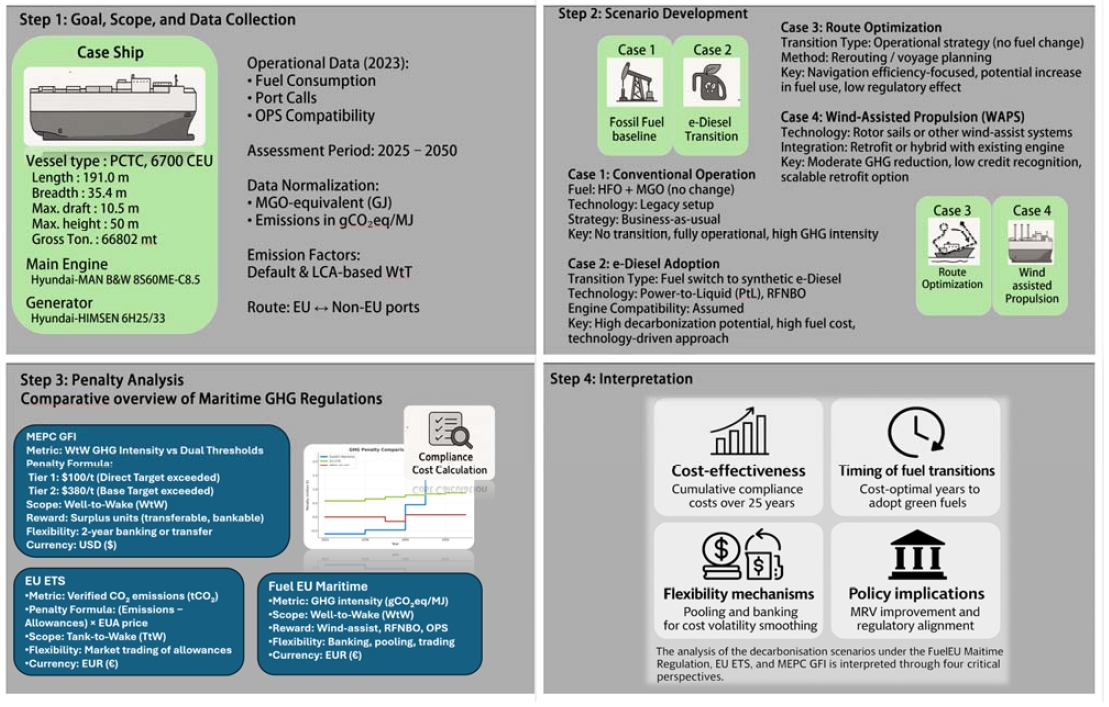
Overview of the approaches
Furthermore, the study explores how strategic measures such as pooling, rerouting, and phased fuel transitions influence cumulative compliance trajectories over time. Additionally, it evaluates the necessity of introducing contract clauses that align EUA liability with operational control, ensuring that financial and regulatory responsibilities are equitably distributed.
By addressing these multifaceted issues, the study aims to contribute a holistic and actionable framework for navigating the complexities of maritime climate regulations, thereby supporting more resilient and adaptive compliance planning across the shipping value chain.
2.1 Step 1: Goal, Scope and Data Collection
The target vessel is a 6,700 CEU PCTC operating between EU and non-EU ports. Daily operational data from 2023 is used, including fuel consumption (at sea and at berth), port call history, energy usage profiles, and technical parameters (e.g., engine type, power output, OPS compatibility). The assessment period spans from 2025 to 2050, aligned with FuelEU Maritime’s phased GHG intensity targets. All energy consumption data is converted into MGO-equivalent GJ, and all GHG emissions are calculated in gCO₂eq/MJ using both default and LCA-derived WtT values, where applicable.
The rationale behind selecting a Pure Car and Truck Carrier (PCTC) as the representative case study for assessing maritime decarbonization regulations - namely FuelEU Maritime, EU ETS, and IMO GFI - lies primarily in its distinctive operational profile, which provides a comprehensive and nuanced context for scenario-based regulatory impact analysis. PCTCs typically operate across diverse international routes, frequently engaging in voyages between EU and non-EU ports, thus inherently encapsulating regulatory complexities and applicability relevant to this research. Furthermore, their operational characteristics, including extended voyages and significant port stays, inherently align with emerging compliance strategies such as the utilization of Onshore Power Supply (OPS) and alternative propulsion technologies like Wind-Assisted Propulsion Systems (WAPS).
The vessel type also offers inherent analytical advantages, given the availability of detailed operational data that enables robust, empirically-grounded assessments of regulatory impacts. Consequently, while acknowledging the inherent specificity of focusing on a single vessel type, the insights derived from PCTC operations effectively illuminate broader strategic implications applicable across different shipping segments, especially regarding operational adjustments, fuel adaptability, and the practical feasibility of technological interventions under evolving environmental regulations.
While this study focuses on a single vessel type, the choice of a PCTC was intentional, as its operational profile captures a broad range of regulatory and technical conditions relevant to decarbonisation. Accordingly, the analytical approach applied in this study may also be adapted to other vessel types with similar trading patterns and operational characteristics. The simulation assumes that voyage frequency and operational patterns observed in 2023 remain constant throughout the assessment period, unless modified by specific compliance scenarios (e.g., rerouting or wind-assisted propulsion). Fuel consumption trends are projected based on historical averages, with scenario-specific adjustments applied to reflect changes in propulsion technology or routing. Power output profiles are derived from engine log data and maintained across scenarios to isolate the impact of regulatory measures.
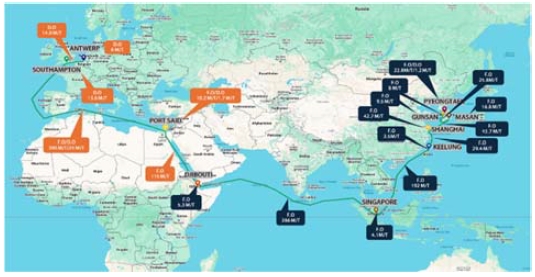
Overview of ship voyage with fuel consumptions over the route

General information for ship
Machinery information for ship
2.2 Step 2: Scenario Development
The scenario analysis evaluates the regulatory and economic impacts of four distinct compliance strategies—Conventional Operation, e-Diesel Adoption, Route Optimization, and Wind-Assisted Propulsion System (WAPS) on a Pure Car and Truck Carrier (PCTC) under the FuelEU Maritime regulation, and EU ETS framework.
- 1) Case 1: Conventional Operation (Baseline) – The vessel operates with Heavy Fuel Oil (HFO) and Marine Gas Oil (MGO), resulting in a GHG intensity of 90.32 gCO₂/MJ, which exceeds FuelEU Maritime targets, leading to substantial penalties and full EUA cost exposure. This serves as the baseline for comparison.
- Antwerp–Southampton Route – Fuel and GHG Summary
· Consumption: HFO: 276.6t, MGO: 21.6t
· WtT(gCO₂/MJ): HFO: 13.5 , MGO: 14.4
· LCV( MJ/g): HFO: 0.0405, MGO: 0.0427
· TtW(CO2): HFO: 3.114, MGO: 3.206
- Calculated Results (based on both fuels):
· WtT GHG intensity: 13.57 gCO₂/MJ
· TtW GHG intensity: 76.75 gCO₂/MJQ
· Total GHG intensity: 90.32 gCO₂/MJ
- 2) Case 2: e-Diesel Adoption – Conventional fuels are replaced with synthetic e-diesel produced via Power-to-Liquid (PtL) pathways, achieving a GHG intensity of 73.78 gCO₂/MJ, fully compliant with FuelEU Maritime thresholds, eliminating penalties and reducing EUA costs. Recognised as effective but costly.
- Antwerp–Southampton Route – Fuel and GHG Summary
· Consumption: HFO: 276.6t, MGO: 21.6t
· WtT(gCO₂/MJ): HFO: 0.7, MGO: 0.7
· LCV( MJ/g): HFO: 0.0427, MGO: 0.0427
· TtW(CO2): HFO: 3.114, MGO: 3.206
- Calculated Results (based on both fuels):
· WtT GHG intensity: 0.70 gCO₂/MJ
· TtW GHG intensity: 73.08 gCO₂/MJ
· Total GHG intensity: 73.78 gCO₂/MJ
- 3) Case 3: Route Optimization – An alternative sailing route is adopted, increasing fuel consumption slightly to 90.34 gCO₂/MJ, offering no regulatory improvement and higher EUA exposure. Operational adjustments alone are insufficient for compliance.
- Antwerp–Southampton Route – Fuel and GHG Summary
· Consumption: HFO: 432.237t, MGO: 23.3t
· WtT(gCO₂/MJ): HFO: 13.5, MGO: 14.4
· LCV( MJ/g): HFO: 0.0405, MGO: 0.0427
· TtW(CO2): HFO: 3.114, MGO: 3.206
- Calculated Results (based on both fuels):
· WtT GHG intensity: 13.55 gCO₂/MJ
· TtW GHG intensity: 76.79 gCO₂/MJ
· Total GHG intensity: 90.34 gCO₂/MJ
- 4) Case 4: Wind-Assisted Propulsion System (WAPS) – Wind propulsion technologies are introduced, moderately reducing GHG intensity to 85.80 gCO₂/MJ, though regulatory credits remain underutilized. Potential GHG reduction is estimated at 5–15% but requires proper reward factor application.
- Antwerp–Southampton Route – Fuel and GHG Summary
· Consumption: HFO: 276.7t, MGO: 21.6t
· WtT(gCO₂/MJ): HFO: 13.5, MGO: 14.4
· LCV( MJ/g): HFO: 0.0405, MGO: 0.0427
· TtW(CO2): HFO: 3.114, MGO: 3.206
· Rewarding factor, WAPS : 0.95
- Calculated Results (based on both fuels):
· WtT GHG intensity: 13.55 gCO₂/MJ
· TtW GHG intensity: 76.75 gCO₂/MJ
· Total GHG intensity: 85.80 gCO₂/MJ
The comparative performance of the four compliance strategies in terms of GHG intensity, regulatory alignment, and economic exposure is summarized in Table 3.
Comparative Summary and Synthesis
2.3 Step 3: Penalty Analysis FuelEU Maritime, EU ETS and MEPC GFI
The FuelEU Maritime penalty for each scenario is determined using the regulation's formula, which considers the annual GHG intensity gap as the basis for calculating the compliance deficit. The penalty multiplier increases progressively with each consecutive year of non-compliance, while FuelEU Maritime reward factors, such as wind-assist technologies or the use of Renewable Fuels of Non-Biological Origin (RFNBO), are incorporated where applicable. For each year from 2025 to 2050, the model evaluates the vessel's actual GHG intensity against the regulatory target, identifying compliance surpluses or deficits. Where deficits occur, applicable penalties are calculated, while surpluses can be banked, pooled, or traded, contributing to long-term compliance strategies. In pooling scenarios, net revenue is estimated based on benchmark "pool ticket prices," ranging from €90,000 to €180,000 annually for early compliance surpluses. Additionally, for Onshore Power Supply (OPS) scenarios, shore power usage is considered zero-emission during berthing, effectively lowering the vessel's overall GHG intensity and contributing to regulatory compliance.
In parallel, the EU ETS mandates that shipping companies surrender emission allowances corresponding to their verified CO₂ emissions. Should emissions exceed allocated allowances, companies are required to purchase additional allowances or face a penalty of €100 per tonne of CO₂ emitted beyond their allowance, adjusted annually for inflation. Non-compliance may also result in public disclosure of the company's name. Operating on a cap-and-trade principle, the EU ETS sets a decreasing cap on total emissions to meet climate targets. Notably, the EU ETS does not currently offer reward mechanisms for low-emission technologies or fuels.
Furthermore, the International Maritime Organization's MEPC GHG Fuel Intensity (GFI) framework assesses the WtW GHG intensity of fuels used by ships. Compliance is measured against two targets: the Base Target and the more stringent Direct Compliance Target. Ships emitting above the Direct Compliance Target but below the Base Target incur a Tier 1 penalty of $100 per tonne of CO₂ equivalent. Emissions exceeding the Base Target are subject to a Tier 2 penalty of $380 per tonne of CO₂ equivalent. Ships emitting below the Direct Compliance Target earn surplus units, which can be banked for up to two years or transferred to other vessels. The MEPC GFI framework incentivizes the adoption of zero or near-zero GHG technologies by providing financial rewards for over-compliance.
The following equations are described as (1) GHG intensity calculation; (2) WtT impact; (3) TtW impact applied to FuelEU Maritime. On the other hand, the questions (4)-(7) are applied to IMO GFI calculations: (4) attained GFI; (5) IMO target GFI; (6) Excess amount; (7) Penalty.
| (1) |
The above equation defines the total greenhouse gas (GHG) intensity of a voyage by combining the upstream WtT and combustion (Tank-to-Wake, TtW) emission components. The entire value is scaled by a wind correction factor 𝑓wind, which accounts for the effect of wind-assisted propulsion.
| (2) |
The above equation calculates upstream GHG emissions (WtT) from both fuel production and shore-based electricity. The numerator accumulates energy-adjusted emission factors for each fuel type and electricity source. The denominator reflects the total delivered energy to normalize the emissions.
| (3) |
The above equation quantifies direct emissions from fuel combustion TtW onboard. It includes methane slip by separating the burned and unburned fractions for each fuel-engine combination.
| (4) |
This equation defines the attained GHG Fuel Intensity (GFI), as proposed by IMO's MEPC.391(81). It represents the weighted average of emission intensities EIj over all fuel-engine combinations, normalized by total energy consumed.
| (5) |
The above is the regulatory compliance threshold for GHG intensity set by IMO for the year 2025. Ships with attained GFI above this threshold are subject to penalties.
| (6) |
The above equation calculates the surplus GHG intensity above the regulatory limit. This value determines the level of penalty under MEPC GFI.
| (7) |
This equation calculates the cost of exceeding the EU ETS allowance allocation. If the vessel’s verified emissions exceed its allocated allowances, the excess is multiplied by the current market price of EUA.
Description of Variables Used in GHG Intensity, WtT, and TtW Equations (1) – (7)
2.2 Step 4: Interpretation
The analysis of the decarbonisation scenarios under the FuelEU Maritime Regulation, EU ETS, and MEPC GFI is interpreted through four critical perspectives: cost-effectiveness over time, timing of fuel transitions, role of flexibility mechanisms, and policy implications. Cost-effectiveness is assessed by examining the cumulative compliance costs for each scenario over a 25-year period, benchmarked against a full-penalty baseline. The timing of fuel transitions is explored to identify cost-optimal years for adopting green fuels, with sensitivity analyses reflecting WtT assumptions.
The role of flexibility mechanisms, such as pooling and banking, is evaluated for their capacity to smooth cost volatility and enable commercial feasibility for sustainable fuels. For MEPC GFI, flexibility mechanisms include the use of surplus credits earned by achieving intensities below the Direct Compliance Target, which can be banked for future compliance or transferred to other vessels, thus providing additional strategic options for cost management.
Policy implications are considered with attention to risks of unintended consequences, such as carbon leakage through rerouting, alongside recommendations for refining Monitoring, Reporting, and Verification (MRV) rules and enhancing pooling strategies. Additionally, the analysis highlights the need for regulatory alignment among FuelEU Maritime, EU ETS, and MEPC GFI to avoid complexities arising from differing compliance targets and crediting mechanisms.
This multifaceted analysis, grounded in real-world voyage data from a Pure Car and Truck Carrier (PCTC), provides a comprehensive understanding of how technical, operational, and contractual decisions interact with the regulatory landscape, offering insights that inform both commercial strategies and future policy development.
3. Results
The bar chart illustrates the projected cost distribution for compliance with EU ETS, FuelEU Maritime, and MEPC83 GFI regulations from 2025 to 2050, measured in millions of Euros. Each cost component is represented by different colours:
- • Green bars indicate FuelEU Maritime costs, which gradually rise over time, reaching a maximum of €0.87 million in 2050.
- • Red bars reflect MEPC83 GFI expenses, remaining stable at €0.84 million annually from 2035 onward.
- • Blue bars represent EU ETS compliance costs, which see a marked increase beginning in 2035 and surge to €2.20 million by 2050.
The Figure 4 highlights that while costs for FuelEU Maritime and MEPC83 GFI are relatively consistent, EU ETS expenses escalate significantly over time, becoming the largest share of total compliance costs by mid-century. This indicates growing financial pressure linked to carbon pricing mechanisms as emission reduction targets intensify.
3.1 Case 1: Conventional Operation (Baseline Scenario)
Case 1: Conventional Operation (Baseline)
The conventional operation scenario relies solely on fossil fuels (Heavy Fuel Oil and Marine Gas Oil), resulting in the highest GHG intensity (90.32 gCO₂/MJ). This significantly exceeds the FuelEU Maritime targets, leading to substantial regulatory penalties and maximum EU ETS cost exposure. The cost projections illustrate escalating compliance expenses, highlighting this scenario as economically unsustainable over the long term.
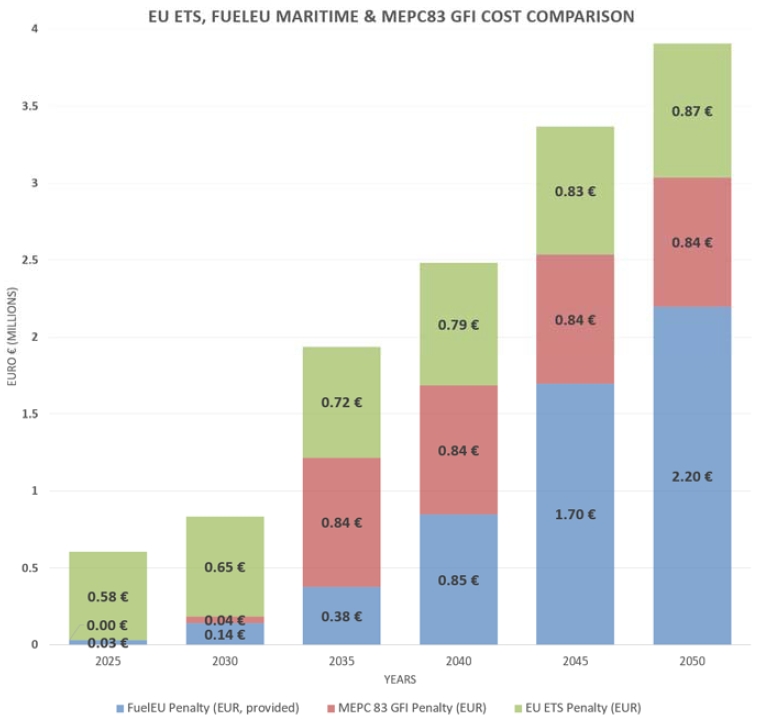
Results of Case 1 with staked penalties for EU ETS, FuelEU Maritime and IMO GFI (Note: Values shown are based on Equation (1) - (3) in Section 2.3, using 2023 operational data)
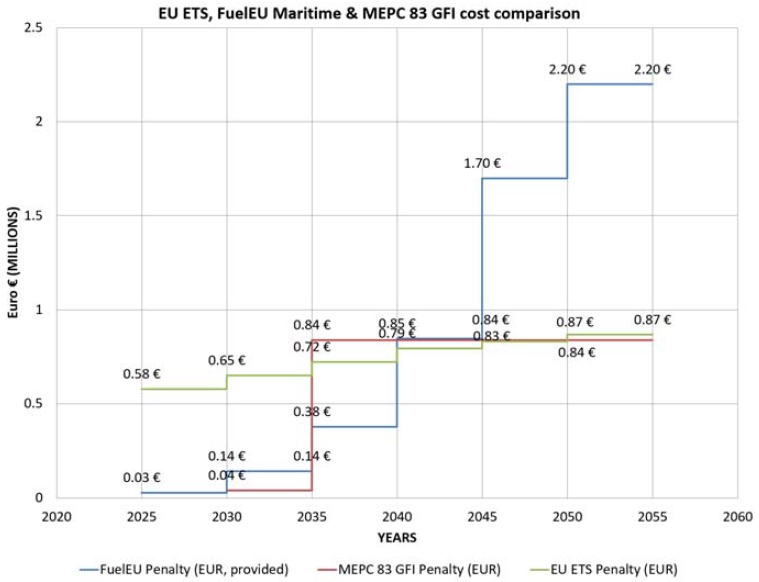
Comparative Results of Case 1 among the penalties for EU ETS, FuelEU Maritime and IMO GFI
3.2 Case 2: e-Diesel Transition
This scenario assumes a full switch from HFO/MGO to a synthetic e-diesel (a renewable fuel produced via Power-to-Liquid using green hydrogen and captured CO₂). The drop-in replacement fuel is used without engine modifications – consistent with industry expectations that synthetic diesel can be utilized in existing diesel engines as a true “drop-in” fuel. With e-diesel’s near-zero upstream WtT emissions, the vessel’s attained GHG intensity drops to ~73.8 gCO₂/MJ, comfortably meeting FuelEU Maritime requirements.
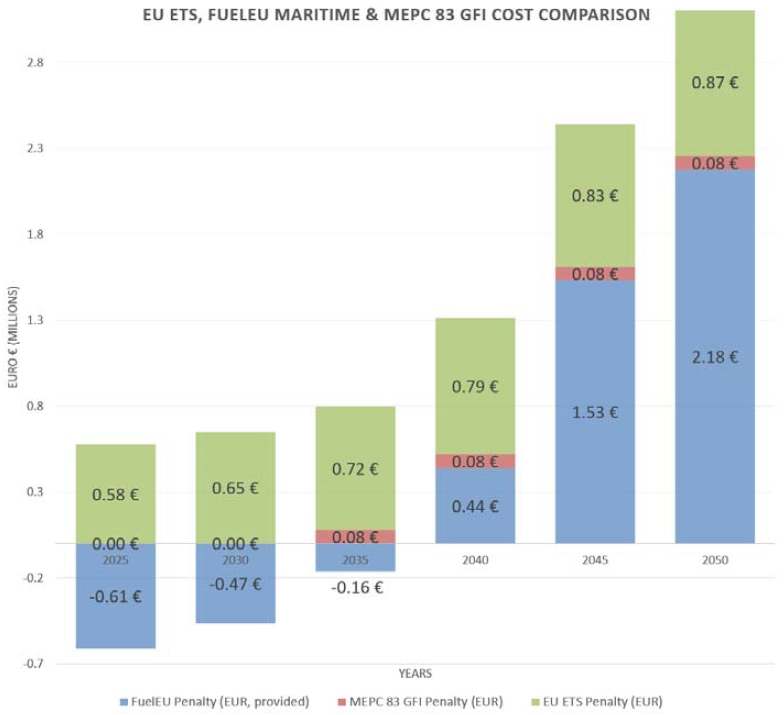
Results of Case 2 with staked penalties for EU ETS, FuelEU Maritime and IMO GFI (Note: Values shown are based on Equation (1) - (3) in Section 2.3, using 2023 operational data)
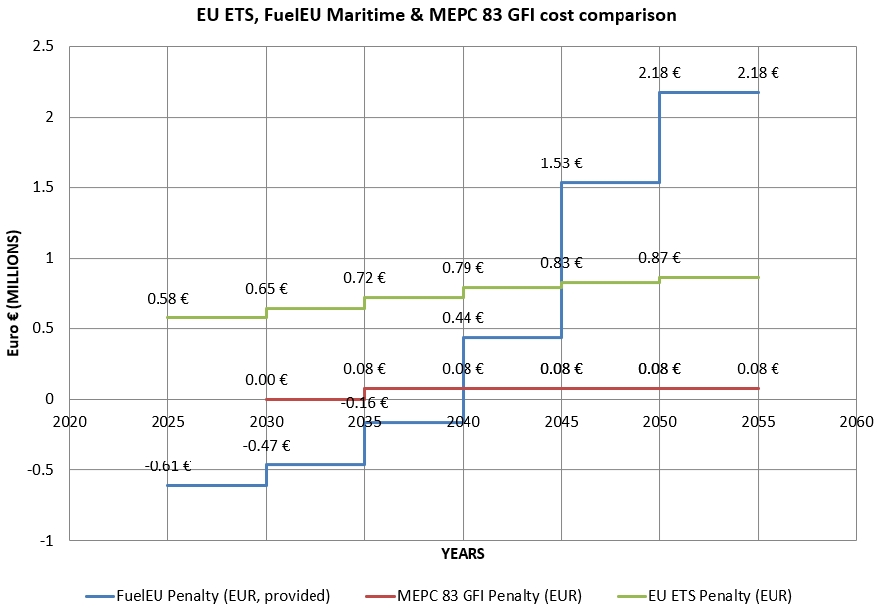
Comparative Results of Case 2 among the penalties for EU ETS, FuelEU Maritime and IMO GFI
In fact, Case 2 stays within the FuelEU Maritime intensity limits through 2030 and beyond, incurring no FuelEU Maritime penalties. EU ETS costs would also diminish significantly, since the net life-cycle CO₂ per ton of e-diesel is much lower than fossil fuels (though combustion CO₂ still occurs, which may require ETS allowances unless recognized as carbon-neutral). Lloyd’s Register and others identify synthetic drop-in fuels like e-diesel as a promising mid-term solution for compliance – they can be deployed fleet-wide with minimal technical hurdles.
Case 2 achieves the best regulatory alignment of all scenarios: it essentially eliminates FuelEU Maritime penalty risks and minimizes carbon costs. However, this comes at the expense of high fuel costs and limited availability. E-diesel (an RFNBO) is currently far more expensive than conventional fuel, and large-scale supply chains are not yet mature. Thus, while Case 2 offers an ideal emissions outcome, it relies on breakthrough improvements in e-fuel cost and supply. In an operational context, this strategy might only be viable if renewable fuel prices drop significantly post-2030 or if policy incentives (e.g. FuelEU Maritime’s 2× credit for RFNBO use before 2035) are leveraged.
Adopting synthetic e-diesel (renewable fuel produced through Power-to-Liquid processes) substantially reduces GHG intensity to 73.78 gCO₂/MJ, comfortably achieving full compliance with FuelEU Maritime standards. Consequently, this strategy incurs no FuelEU Maritime penalties and significantly lowers ETS-related costs. Despite higher fuel costs and current limited availability of e-diesel, this approach emerges as the most effective strategy for regulatory alignment and long-term cost optimization.
3.3 Case 3: Route Optimization
Case 3 – Route Optimization (Regulatory Evasion): In this scenario, the ship alters its voyage pattern without any technological upgrades – for example, rerouting to avoid congested areas or even to minimize time in EU jurisdiction waters. In our model, this resulted in a longer voyage and higher fuel consumption (HFO consumption increased by ~56% compared to Case 1). Consequently, the GHG intensity remained essentially unchanged (≈90.3 gCO₂/MJ) – in fact, slightly worse at 90.34 – because the extra fuel burned negated any efficiency gains.
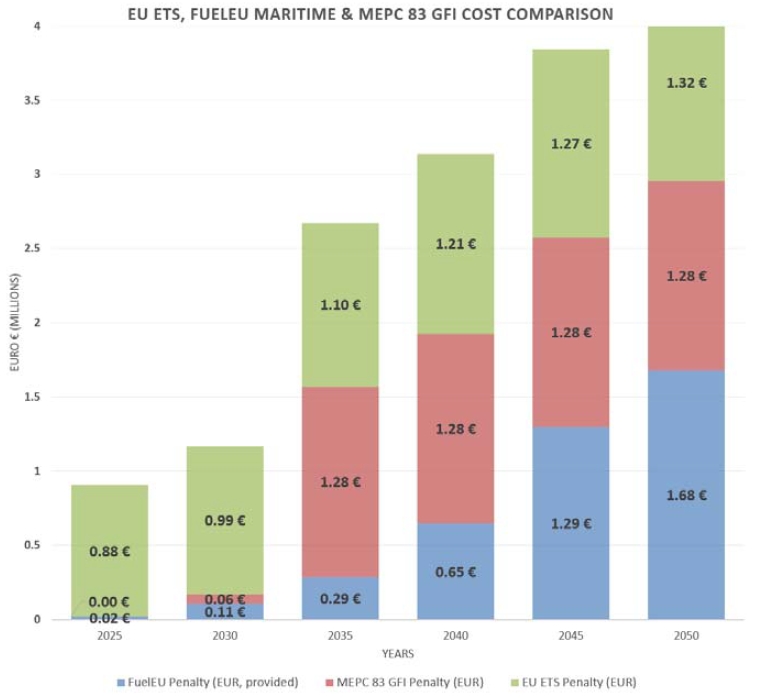
Results of Case 3 with staked penalties for EU ETS, FuelEU Maritime and IMO GFI (Note: Values shown are based on Equation (1) - (3) in Section 2.3, using 2023 operational data)
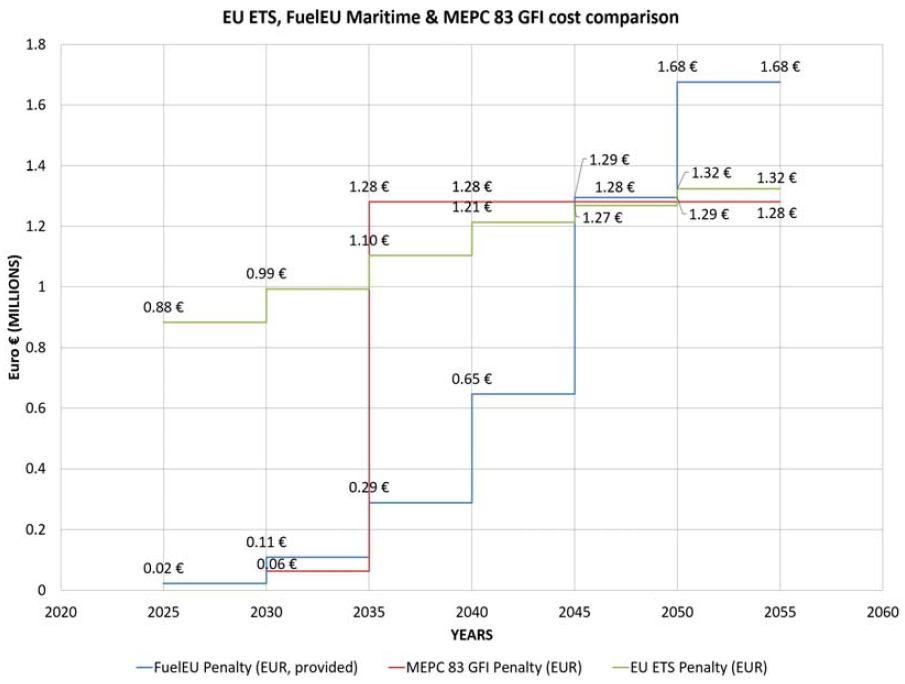
Comparative Results of Case 3 among the penalties for EU ETS, FuelEU Maritime and IMO GFI
Case 3 fails to improve compliance: the vessel still exceeds FuelEU Maritime targets, so no penalty reduction is achieved. On the contrary, the absolute emissions are higher, increasing EU ETS exposure (more CO₂ to report and offset) and potentially incurring even greater total costs than the baseline. This finding reinforces that operational changes alone, when not paired with emissions-reducing technology or fuels, are ineffective in meeting stringent GHG targets.
Some operators might consider evasive routing (for instance, avoiding EU ports to reduce regulated voyage legs). While tactically such rerouting can reduce the portion of emissions under FuelEU Maritime scope, it raises serious concerns. The EU already mitigates this by counting 50% of emissions from voyages between EU and non-EU ports. lr.org, so avoiding one port doesn’t fully eliminate obligations. Moreover, shuffling routes can lead to “carbon leakage”, simply moving emissions outside EU waters without global GHG reduction.
Case 3 demonstrates that attempts to reduce regulatory exposure through evasive routing may lead to adverse operational consequences, including increased fuel consumption, elevated emissions, and higher economic costs. While also being counter to the spirit of decarbonization efforts, this approach can increase OPEX without delivering compliance benefits.
This study focuses on a routing scenario based on a regulatory-evasion perspective, reflecting one possible strategic case that may occur in real operational settings. Various route optimization techniques such as weather routing, speed optimization, and port avoidance may lead to different emission and cost outcomes. However, the primary aim of this study is to examine whether compliance can be achieved through simple operational adjustments without applying technological interventions such as fuel switching or wind-assisted propulsion. Based on the results, we highlight the limitations of routing adjustments alone and emphasize the need for more comprehensive strategies. Future research may extend this analysis by incorporating a wider range of routing approaches.
Case 3: Route Optimization
Route optimization, intended to mitigate regulatory exposure through altered voyage patterns, inadvertently increases fuel consumption (to 90.34 gCO₂/MJ). This slight increase exacerbates emissions and regulatory penalties. Consequently, the scenario demonstrates operational adjustments without technological interventions to be ineffective in achieving compliance, highlighting increased ETS liabilities and overall higher costs compared to the baseline.
Case 4 – Wind-Assisted Propulsion (WAPS): This scenario adds a wind-assisted propulsion system, such as Flettner rotors or rigid sails, to supplement the main engine. By harnessing wind energy, the ship can reduce engine load and fuel consumption. In our case study, we assumed a modest fuel savings (~5%), yielding a GHG intensity of ~85.8 gCO₂/MJ – about a 5% improvement over the baseline. This moderately lowers FuelEU Maritime penalty exposure (narrowing the gap to the target) and cuts fuel use and emissions slightly, thereby partially reducing EU ETS costs.
However, Case 4 still falls short of full compliance with FuelEU Maritime’s current threshold (it remains above the target intensity, so some penalty would apply). The benefit is constrained by how the regulation credits wind energy. FuelEU Maritime includes the concept of an energy “reward factor” for innovative technologies, but in practice the compliance formula may not fully recognize wind-derived savings if not properly accounted.
Our analysis noted that the wind assist benefit seems under-credited in the calculated intensity. Indeed, industry experts emphasize that regulators and modeling tools must incorporate wind propulsion effects to reflect its true value.
According to Lloyd’s Register, wind-assist systems can yield 5–15% fuel and emissions reductions depending on ship and route, and DNV reports current WAPS installations achieving ~5–9% savings with potential up to 25% on optimized retrofits dnv.com. Case 4 demonstrates a technically feasible, operational measure that brings tangible (if not transformative) improvements.
The required technology – e.g. rotor sails – is available and has been piloted on commercial ships, with class societies issuing guidelines for such retrofits.
The key challenges are integration and crediting: ensuring that these systems are reliably effective (which can depend on weather and routing) and that regulatory frameworks reward their contribution. If fully realized, wind assist could play a supportive role in compliance, offsetting a portion of fuel consumption and emissions. In summary, Case 4 offers moderate GHG reduction with relatively low fuel cost and no change in fuel type, but it cannot alone satisfy the steep trajectory of FuelEU Maritime targets without additional measures. Its success also hinges on policy recognition (e.g. appropriate reward factors) to maximize the compliance benefit.
3.4 Case 4: Wind-Assisted Propulsion System (WAPS)
Case 4: Wind-Assisted Propulsion System (WAPS)
Incorporating wind-assisted propulsion technology achieves moderate GHG intensity reductions (85.80 gCO₂/MJ), partially alleviating FuelEU Maritime penalties and ETS costs. Despite tangible benefits, regulatory frameworks currently undervalue wind propulsion contributions, limiting their effectiveness in meeting stringent compliance targets. This scenario represents a technically feasible solution that offers incremental improvements but cannot independently fulfill regulatory demands without complementary strategies.
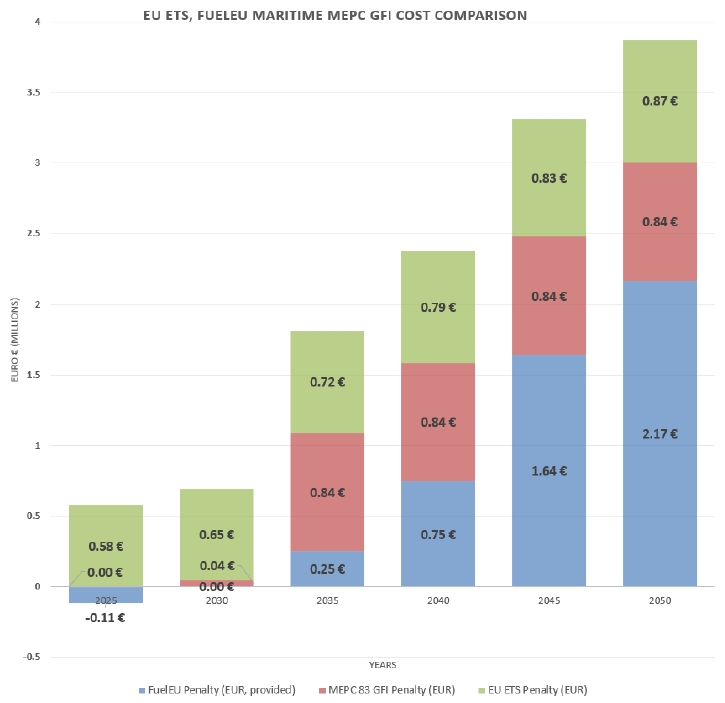
Results of Case 4 with staked penalties for EU ETS, FuelEU Maritime and IMO GFI
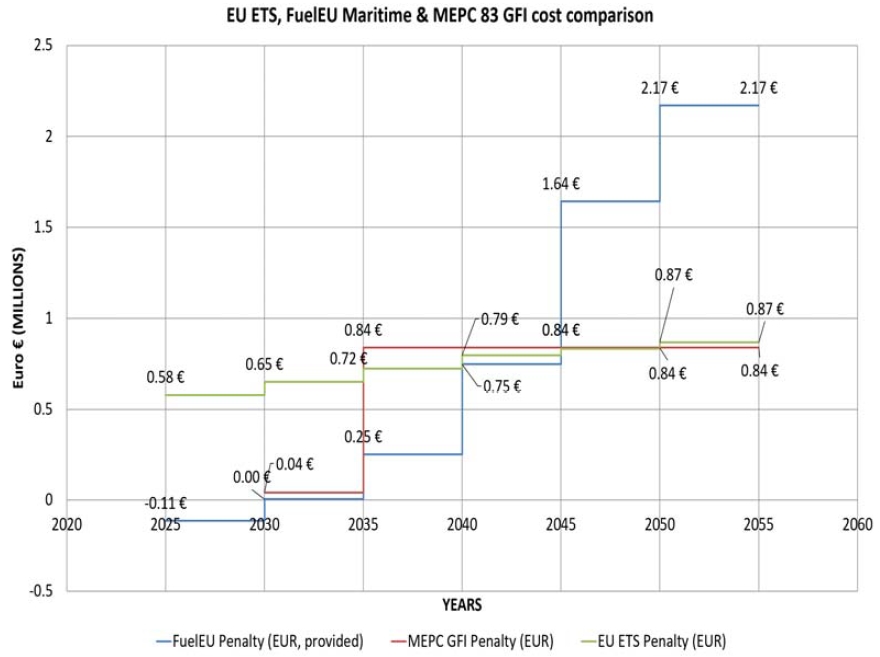
Comparative Results of Case 4 among the penalties for EU ETS, FuelEU Maritime and IMO GFI
Overall, the comparative analysis underscores e-diesel adoption as the most beneficial strategy for regulatory compliance and economic sustainability, while highlighting the limitations of operational adjustments alone and emphasizing the need for policy refinement regarding innovative technologies like wind assistance.
In Cases 1–4, we observe a broad spectrum of compliance outcomes under the dual-regulatory regime of FuelEU Maritime and the EU ETS. Figure 1 (the comparative chart) encapsulates each scenario’s performance in terms of GHG intensity relative to the FuelEU Maritime target, along with the associated penalty exposure and ETS costs. Case 2 (e-diesel) is the clear outlier in a positive sense – it achieves the lowest GHG intensity (≈73.8 gCO₂/MJ), well below the regulatory limit, and thus incurs no FuelEU Maritime penalties at all.
In contrast, Case 1 (baseline) and Case 3 (route change) yield nearly identical intensities (~90.3 gCO₂/MJ) which exceed the FuelEU Maritime requirement by roughly 15%. These two cases would face heavy annual penalties for non-compliance and full ETS carbon costs on all emissions. Case 4 (wind-assist) shows a modest improvement with ≈85.8 gCO₂/MJ, but still does not meet the target; it would incur reduced but non-negligible penalties.
Notably, as of 2025 the FuelEU Maritime target is only slightly below the baseline (a 2% cut from 2020 levels sailplan.com), so none except Case 2 achieve compliance even in the initial year. By 2030, the required GHG intensity will tighten further (–6%), widening the compliance gap for Cases 1, 3, and 4. Thus, from a regulatory standpoint, only a switch to near-zero-carbon fuel (Case 2) definitively secures compliance in the short and long term.
This is summarized succinctly in the comparative table: Case 2 is the only “Yes” for FuelEU Maritime compliance, whereas Cases 1, 3, and 4 are “No,” with varying degrees of penalty risk (high for 1 and 3, moderate for 4). The EU ETS exposure column in Figure 1 similarly reflects fuel choice and efficiency. Case 1 and Case 3 continue to burn large amounts of fossil fuel, so their ETS exposure is “Full/High” – they must purchase allowances for essentially all their (considerable) emissions.
Case 2, by virtue of using a renewable fuel, has “Very Low” ETS exposure. In practice, if e-diesel is certified as a zero-net-carbon fuel, the operator might be exempted from needing ETS allowances for those emissions; even if not fully exempt, the overall tonnage of CO₂ emitted per voyage is slightly lower than with HFO/MGO (due to marginally different carbon content and efficiency), so ETS costs are minimized.
Case 4 shows “Partial” ETS exposure, reflecting that it still uses fossil fuel but in reduced quantity (approximately 5% less fuel consumed). These distinctions highlight how fuel carbon intensity directly drives ETS costs: switching to a low/zero-carbon fuel is the only way to dramatically cut ETS obligations, whereas operational tweaks or efficiency measures yield more modest savings.
Total compliance cost is a critical result inferred from these scenarios. While our study provides qualitative labels (e.g. “High” vs “Low” cost), quantitative modeling by DNV offers insight: a baseline fossil case can accumulate nearly $230 million in combined costs (fuel + ETS + penalties) over 2025–2045. In our Case 1, we likewise see escalating annual FuelEU Maritime penalties (e.g. on the order of €0.85–2.2 million by 2040–2050 for a single ship, based on FuelEU Maritime penalty formulas) and rising carbon allowance expenditures as EU ETS prices increase over time (assumed to grow from €80 to above €115 per ton CO₂).
Case 3, with even greater fuel burn, would incur slightly higher cumulative costs than Case 1, because it pays similar penalties and ETS fees on a larger emissions base (due to the longer route). Case 4 avoids some fuel expense and emissions, translating to a moderately lower total cost than Case 1. However, the improvement is limited – the 5% fuel savings might reduce lifetime costs by a few million dollars, which is helpful but not game-changing.
DNV’s findings corroborate this: adding wind-assist (WAPS) to a biofuel scenario saved about $7 million over the ship’s lifetime, a meaningful reduction but not enough to offset the much larger costs of fuel or penalties.
Case 2 presents an interesting cost dynamic: on one hand, it completely avoids FuelEU Maritime penalties (which, for non-compliance cases, grow substantially after 2030) and significantly cuts the need for carbon credits; on the other hand, the fuel itself is far more expensive than conventional fuel. Depending on e-diesel price trajectories, the Case 2 total cost could be higher than baseline in early years, yet potentially lower in the long run if e-fuel costs drop or if extremely high carbon prices materialize.
For example, if e-diesel costs remain, say, 3–5 times higher than HFO per ton, then Case 2’s fuel bill would far exceed the penalties that Case 1 would pay in the 2020s. But by the 2040s, FuelEU Maritime penalties and carbon prices become so punitive for fossil fuel that Case 1’s annual cost might overtake Case 2’s. Thus, there is a temporal crossover point where investing in green fuel starts to pay off.
Our mid-century projection suggests that by 2045–2050, a fossil-fuel ship would be paying on the order of millions of Euros per year in penalties – effectively a carbon cost that narrows the gap with expensive e-fuel.
In summary, Case 1 and 3 are costliest and riskiest, as they expose the operator to compounding fees and market volatility in carbon pricing. Case 4 slightly alleviates these costs, and Case 2 trades operational expenditures for capital expenditure on fuel, potentially achieving cost parity or savings in the long term if technology trends continue. From a technical feasibility and operational impact perspective.
4. Discussion
It highlights that adopting e-fuels (Case 2) achieves the highest regulatory alignment by reducing WtW emissions and EU ETS liabilities, while conventional operations (Case 1) represent misalignment due to high carbon costs. Route optimisation (Case 3) risks exploiting regulatory loopholes without genuine emissions reduction, potentially triggering stricter policies, while wind-assisted propulsion (Case 4) shows promise but is currently undervalued by regulatory frameworks.
Cost optimisation is shown to favour proactive investments in green technologies over penalty-based compliance, with pooling and banking mechanisms under FuelEU Maritime offering strategic flexibility and risk mitigation. Specifically, pooling allows over-compliant vessels to transfer surplus GHG performance to under-compliant ones, enabling fleet-level compliance and incentivising early adopters of low-carbon fuels. This mechanism supports transitional pathways for vessels unable to meet targets in the short term, while providing economic value to frontrunners through internal credit trading.
Technical feasibility varies across strategies; e-fuel adoption hinges on supply chain development, while wind-assist depends on route-specific conditions. Lifecycle emissions underscore the importance of accurate WtT assessments, as regulatory credits and penalties are sensitive to fuel origin and production methods. Finally, the analysis suggests that a balanced approach combining fuel transitions, operational efficiencies, and flexibility mechanisms is the most resilient path for regulatory compliance and long-term cost savings.
This analysis is based on a single vessel and selected scenarios; future studies could expand the scope to enhance generalizability.
5. Conclusion
This study investigated the strategic and economic implications of the FuelEU Maritime regulation using a real-world case study of a Pure Car and Truck Carrier (PCTC), simulating multiple compliance scenarios over the 2025–2050 regulatory timeline. The following key findings were derived from the analysis.
- 1) e-Diesel Adoption is the Most Effective Strategy: Among the four scenarios, e-Diesel adoption achieves the highest alignment with FuelEU Maritime and EU ETS regulations, effectively reducing WtW GHG intensity and minimising compliance costs. The scenario analysis showed that e-diesel adoption (Case 2) achieved the lowest GHG intensity at 73.8 gCO₂/MJ, while conventional operation and route optimization (Cases 1 and 3) recorded the highest intensities at 90.3–90.34 gCO₂/MJ. Wind-assisted propulsion (Case 4) resulted in a moderate reduction to 85.8 gCO₂/MJ.
- 2) Conventional Operation is Unsustainable: Continuing with fossil fuels results in substantial penalties and full EU ETS cost exposure, highlighting the long-term financial risk of a "pay-to-comply" approach.
- 3) Route Optimisation Alone is Insufficient: Although route optimisation aims to reduce fuel consumption, it ultimately increases emissions and ETS liabilities, proving ineffective without technological upgrades.
- 4) Wind-Assisted Propulsion Shows Potential: Wind-assisted technologies can moderately reduce GHG intensity, but current regulatory frameworks undervalue their contribution, suggesting a need for improved credit mechanisms.
- 5) Cost Optimisation Requires Strategic Investment: Proactive investment in green technologies, coupled with pooling and banking mechanisms, optimises compliance costs and reduces long-term financial exposure.
- 6) Policy Harmonisation is Essential: Greater alignment between FuelEU Maritime, EU ETS, and IMO measures, alongside enhanced credit recognition for sustainable technologies, is necessary to prevent fragmented compliance and regulatory gaps.
Overall, a holistic approach that combines sustainable fuels, energy efficiency measures, and strategic regulatory adaptation is the most resilient pathway for decarbonising maritime operations.
Acknowledgments
This research was supported by the Ministry of SMEs and Startups (MSS), Korea Institute for Advancement of Technology (KIAT) through the Innovation Development(R&D) for Global Regulation-Free Special Zone.
Author Contributions
Conceptualization, B. J. Kwon; Methodology, B. J. Kwon; Formal Analysis, B. J. Kwon; Investigation, B. J. Kwon and Y. M. Park; Data Curation, B. J. Kwon and S. B. Lee; Software, B. J. Kwon; Visualization, B. J. Kwon and S. B. Lee; Writing – Original Draft, B. J. Kwon; Writing – Review & Editing, B. J. Kwon, B. U. Jeong, S. B. Lee, Y. M. Park, S. J. Oh and S. C. Shin; Supervision, B. J. Kwon, B. U. Jeong and S. C. Shin; Project Administration, B. J. Kwon and S. C. Shin; Funding Acquisition, B. J. Kwon; Validation, B. U. Jeong; Policy Interpretation, B. U. Jeong; Formal Analysis Support, Y. M. Park.
References
- European Parliament, The Inclusion of Maritime Transport in the EU Emissions Trading System (EU ETS). European Parliament Reports, 2023.
- IMO, 2024 Guidelines on Life Cycle GHG Intensity of Marine Fuels (Resolution MEPC.391(81)). International Maritime Organization, London, 2024.
- A. Smith, L. Jones, and P. Roberts, “FuelEU maritime and the European green deal: pathways to sustainable shipping,” Journal of Maritime Affairs, vol. 15, no. 3, pp. 215–229, 2023.
- X. Zhou and Z. Fan, “The Role of FuelEU maritime in decarbonising European shipping: a policy analysis,” Transport Policy, vol. 129, pp. 304-318, 2023.
- M. Gibson and S. Wang, “Economic impacts of the EU maritime ETS on global shipping,” Journal of Environmental Economics, vol. 28, no. 4, pp. 290–305, 2024.
- X. Huang, C. Li, and Y. Tan, “Adapting to maritime ETS: strategic options for cost mitigation,” Transportation Research Part D: Transport and Environment, vol. 92, 102896, 2024.
- M. Fitzgerald and Y. Zhang, “IMO carbon pricing and its global implications for maritime trade,” International Journal of Maritime Law, vol. 18, no. 1, pp. 88-103, 2024.
-
S. H. Jung, “Study on characteristics of GHG life cycle assessment for alternative marine fuels,” Journal of Advanced Marine Engineering and Technology, vol. 45, no. 6, pp. 334-338, 2021.
[https://doi.org/10.5916/jamet.2021.45.6.334]
